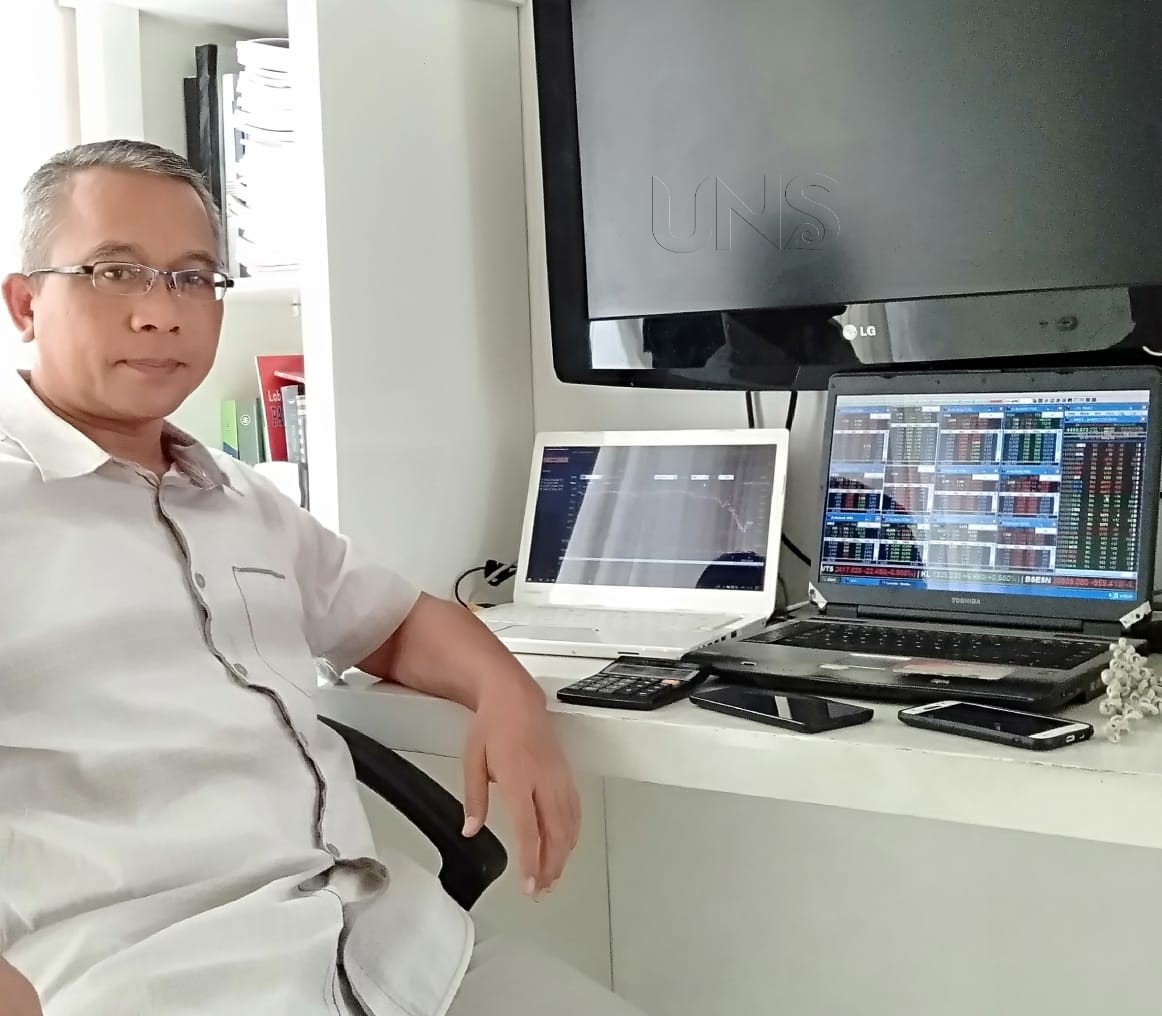
UNS – COVID-19 Pandemic in Indonesia is not only affecting the real sector but also the capital market. The weakening of the market has become a highlight for many parties amid the global pandemic. The economist and capital market practitioner from Universitas Sebelas Maret (UNS) Surakarta Riwi Sumantyo, SE., MM, provided his comment.
The impact of COVID-19 on the capital market is extreme. For several weeks now the Indonesian capital market has experienced very sharp fluctuations. However, this situation is not only existing in the Indonesian capital market but also in the global capital market. In Indonesia, IDX Composite has experienced many trading halts; when the decline in stock index reached 5% compared to the previous closing day, a trading halt will be activated for 30 minutes.
“This is a part of protocols implemented by OJK (Financial Service Authority) and IDX to avoid a deep decline in IDX Composite. Because the current focus of markets is Corona handling, therefore in the short-medium term, Indonesia capital market will tend to fluctuate,” stated Riwi
The IDX Composite position now has been corrected by about 27.5 percent year to date (YTD). This is not the first phenomenon that takes place in Indonesia, in 2008 and 1998 the condition of the capital market was much worse. In 2008, as an impact of the Sub Prime Mortgage (SPM) crisis in the US. But at the time, the financial sector was the one impacted, the real sector (business) was relatively stable. In 1998, as we all know, the current situation has similarities with 1998, but with different causative factors.
“We have never experienced something like this before, thus why all countries are having a headache. No one has found the appropriate formula, both for handling pandemic and for the mitigation of the economic sector. Everything is trial and error. So, if there are flaws in policymaking and implementation everyone needs to understand that the situation is very complex,” Riwi continued.
The efforts to handle the situation are done by OJK by releasing stimulus to the market, but OJK is not alone, the monetary authority and the government through fiscal authority have participated. Lastly, as stated by the president of the Republic of Indonesia yesterday, there will be around Rp 405.1 trillion stimuli to handle the pandemic.
“But so far, the stimulus provided (by the government) has not brought a sense of calmness to the market players. The market players are a very rational party (rational economic). I am sure that they have done some calculations on the impact of COVID-19 on the economy, politics, and social situation and everything has been priced in the market. Market players always move to precede the data because their market intelligence is extraordinary. Big funds always have A1 information on this matter,” Riwi said.
Almost all economic sectors are negatively affected by the pandemic; trade, tourism, investment, export-import, etc. There is almost no sector is safe from the pandemic impact. The pharmacy sector might be ‘relatively safe’ in the short term due to the increase in demand for pharmacy products, medical devices, and other products. But it is likely a temporary situation because soon they will experience difficulty caused by the weakening of rupiah to dollar exchange. About 85% of medicinal raw materials (BBO) are imported.
“Currently there is a disruption in the supply chain of BBO because the largest BBO imports in Indonesia are from China and India. Some companies that already used hedging scheme to fulfill their supplies have less ‘headache’, but in the long-term, this condition is unfavorable. Let’s wish that China will recover soon so that there will be no supply shock”, explained Riwi.
In the current situation, investors with idle funds should not enter the market hastily, they better wait for the situation to be clearer and under control. It is fine to take a late step with small risks instead of being aggressive and taking high risks.
“If (investors) want to take a position, they should take it gradually, because my guess is that there a room for great decline for IDX Composite. The moderate number could go to level 3.800, the extreme number to 2.600”, explained Riwi.
So far, the government has taken some steps but indeed there is no risk-free decision-making space today. The example is whether the government wants a territory quarantine or PSBB (enhanced social distancing) or other policy, each policy has its positive and negative side. The experience of other countries has proved it, there is a successful lockdown policy, but there are also those that are failed, a similar result is shown in social distancing policy. The point is that, we should not place this burden solely on the government, all parts of the society can act according to their respective capacity.
“The war of argument is worthless now, there must be compliance, active participation by all citizens. Indonesia will get through this. “Badai pasti berlalu” (The Storm will Pass). It is time for us to participate because Indonesia calls us,” Riwi said firmly.
Riwi also expects that investors will be calm in responding to the highly fluctuating market condition, which according to him can be considered as in turbulence. Investors should not panic because Indonesia has experienced another economic shock caused by different triggers before.
“Fundamentally, the current stock value has been greatly discounted, PER IDX Composite is also low, for those who want to buy, you can start with accumulates to anticipate if the price will decline further,” Riwi closed. Humas UNS