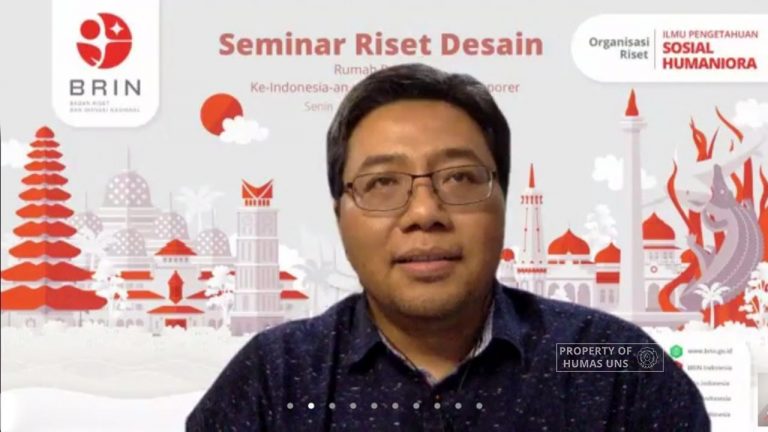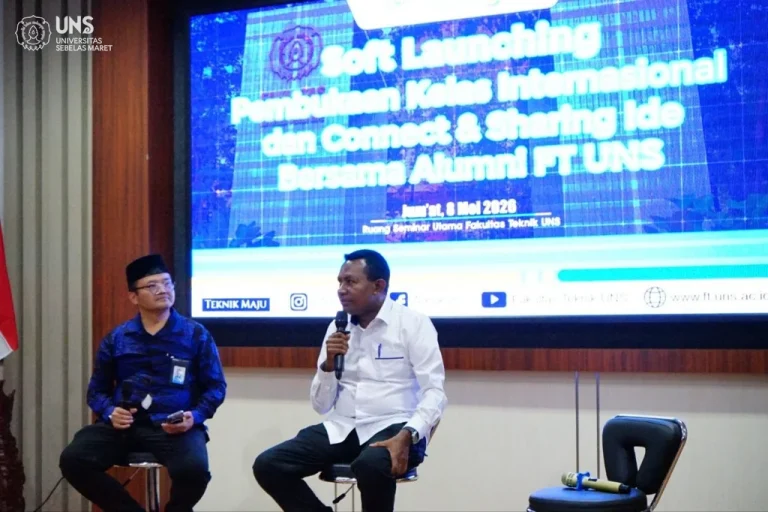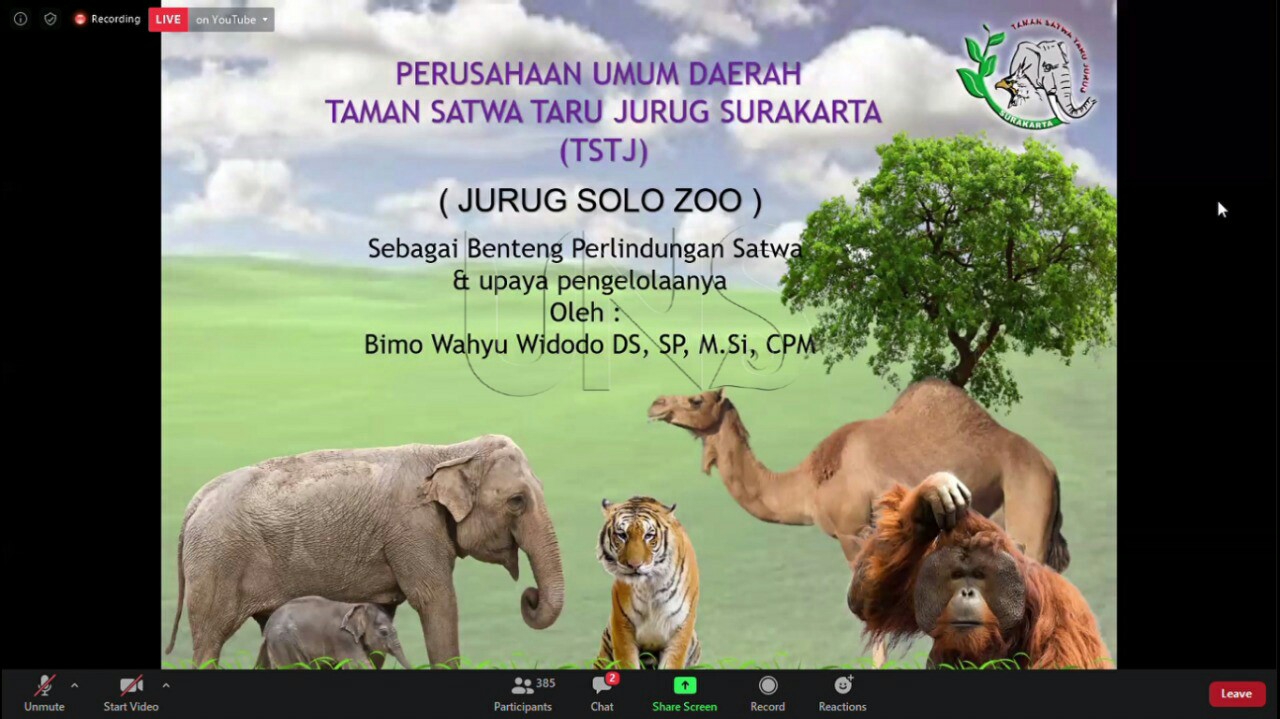
UNS – The Covid-19 pandemic has been struck for three months and has affected not only human life but also animal’s life at the zoos. Concerned with the phenomenon, the Biology Education Program Faculty of Teacher Training and Education (FKIP) Universitas Sebelas Maret (UNS) Surakarta held a webinar on Saturday (30/5/2020) to discuss the animal’s condition at zoos and National Parks. Jarot Wahyudi, M.URP. of the Gunung Merbabu National Parks and Bimo Wahyu, M.Si., the president Director of Taman satwa Taru Jurug (TSTJ) Surakarta were invited as speakers in the event.
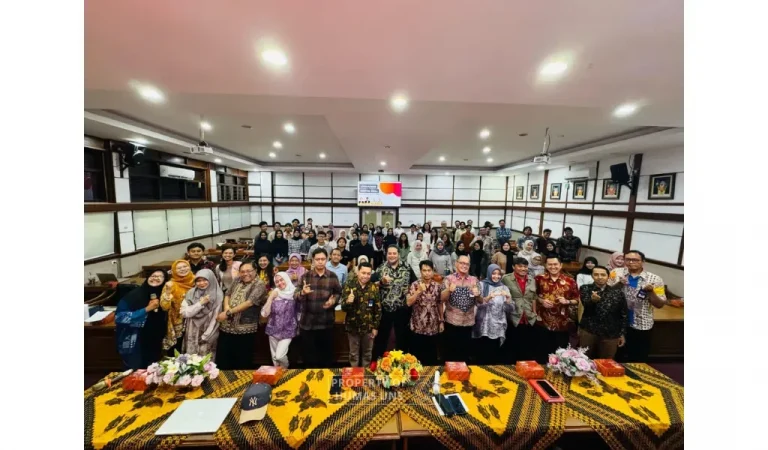
The webinar that discussed the theme of Indonesia Animal Red Zone Amid the Covid-19 Pandemic started at 09.30 and attended by 450 active participants from 29 provinces through Zoom Meeting App.
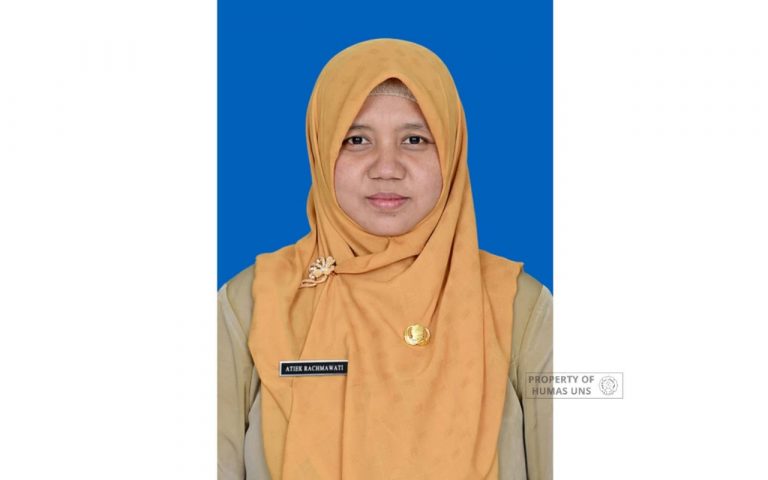
The Head of Biology Education Program, Dr. Muzzazinah highly appreciates all participants who have attended the webinar.
“We deliver our highest gratitude to all participants who have enthusiastically registered. There was a total of 684 participants who registered from various institutions in 29 provinces. This event was also attended by 7 National Parks in Indonesia,” she said in her welcoming speech.
The changes that take place during the pandemic in TSTJ Surakarta was conveyed by Bimo Wahyu, M.Si. as the President Director of TSTJ Surakarta. Since Solo entered the Extraordinary Event (KLB) Covid-19, TSTJ stopped their activities for visitors. This affects the operational costs which include the feed costs for animals living in the zoo. Bimo Wahyu stated that one of the efforts that have been taken by TSTJ to meet the operating cost is by collaborating with the Municipal Government of Surakarta.
“In March to April, we can still survive, but in May, we began to stumble. Finally, we coordinate with the municipal government, and the municipal government will help with the animal feeds for 100 million rupiahs from May to July. We need 120 million rupiahs, (to fill) the shortage we made a campaign through the mass media so that the community assists (us) in providing feeds, besides that, we also conducted presale tickets,” he explained.
The campaign is the form of goods and money transfer donation to TSTJ. Per- 31 May, TSTJ will close the donation temporarily and focuses on ticket presale. To date, there are 50,000 tickets sold that can be used until December 2021.
“We temporarily close (the donation) because the need for feeds for May to September have been fulfilled, this is all because of the enthusiasm of the people in assisting. If we don’t close (the donation) we are afraid that there will be people who send eggs while we have our needs of egg fulfilled until September, like that,” he added.
The material delivered by Jarot Wahyudi, M.URP. is the Wildlife Management in the In-Situ area Amid the Covid-19 Pandemic. Jarot conveyed that the Gunung Merbabu National Park closed all of its areas since 15 march 2020.
“Since the pandemic, wildlife management also experienced changes. In the pandemic, we limit the number and area coverage in the survey or inventory, monitor the tourism object, zero visitors, and facilities and infrastructure, we also conducted various online activities such as questionnaire distribution and webinar,” he explained.
Gunung Merbabu National Park also utilizes technology in wildlife management. Jarot added that the wildlife database is very helpful in the management process.
“We performed a recap of simeru data of each field staff, forest ecosystem controllers, forest rangers, and forestry instructors. There is also a report of events/animal encounters at the end of the month. We also use technology, for example, by maximizing simeru application for field staffs, monitoring CCTV, and conducting Resort Based Management according to the typology of each resort management,” he explained.
Based on the discussion, it is visible that the Covid-19 pandemic also affects the lives of animals, especially those who live at the zoo due to the cut in the fund after their operation stopped three months ago. Aside from webinar, the Biology Education Program UNS also donates feeds for animals in TSTJ. On 13 May, UNS also provided cash donation delivered directly by the Rector of UNS, Prof. Jamal Wiwoho. Humas UNS/Bayu