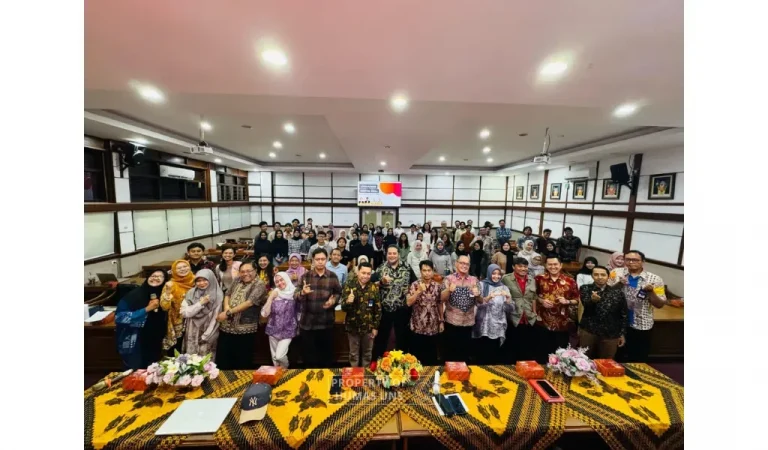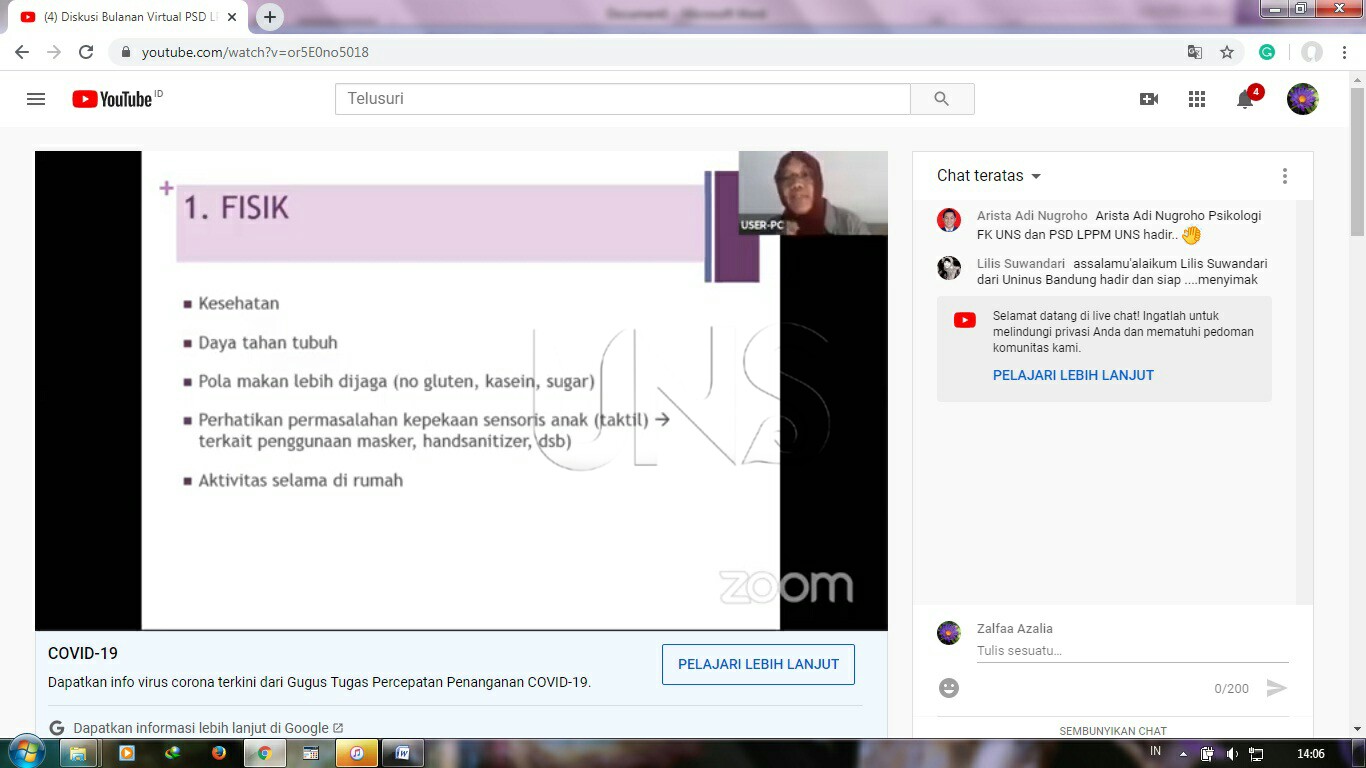
UNS – The Center for Disability Study (Pusat Studi Difabilitas – PSD), the Institute of Research and Community Engagement (LPPM) Universitas Sebelas Maret (UNS) Surakarta held a virtual monthly discussion entitle ‘Education for Autistic Children During the Ongoing COVID-19 Pandemic’ on Friday (5/6/2020) through Zoom Cloud Meeting and Youtube Live Streaming on PSD LPPM UNS Account.
The discussion invites 4 speakers namely Dr. Joko Yuwono, M.Pd., Erma Kumala Sari, M.Psi., Erny Kadarwati, S.Pd., and Dr. Minsih, M.Pd. In total 110 participants were attending the discussion, which consists of lecturers, PSD LPPM UNS Peer Group, teachers, parents, students, and the general public. The discussion was opened by the Head of PSD LPPM UNS, Prof. Dr. Munawir Yusuf, M.Psi.
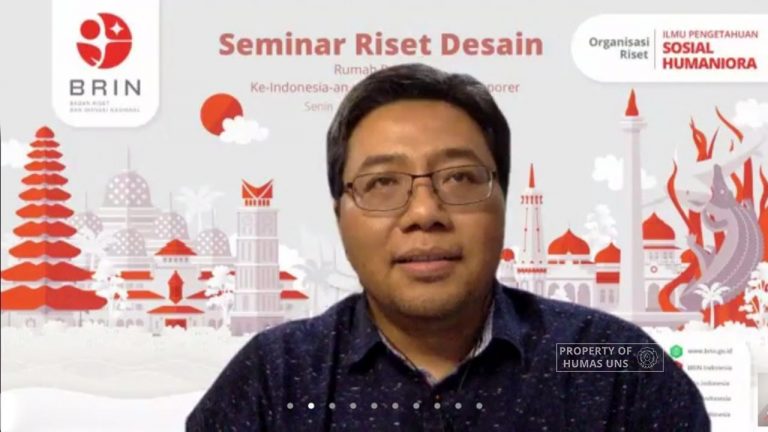
The opening material delivered by Dr. Joko Yuwono, M.Pd., regarding the challenges in autistic children’s education during the ongoing COVID-19 pandemic. This lecturer of Special Education Study Program UNS, explains that the COVID-19 pandemic greatly affects autistic children with developmental problems.
“The COVID-19 has a profound impact on the education of autistic children who have developmental problems, this is related to how to give health priorities to children with autism and quality education services. They need assistance,” Dr. Joko explains.
Autistic children have a high risk of transmission if there is no assistance provided related to a health matter. As for development, the teachers and schools must know how to transform their lectures through online media. While staying home there are several challenges faced by autistic children, which divided into three components teachers, parents or family, and the autistic child itself. There is also a challenge on how the teachers provide assistance for the children’s study during the ongoing pandemic because they are more prone to stress.
Considering the problem, Dr. Joko suggests that schools can collaborate with parents.
“My suggestion is for the school to collaborate with the parents. The parents and children need time to adapt to the current COVID-19 situation. During this pandemic, let the family adapt and recognize the need of the children with disability, including autistic children,” suggest Dr. Joko.
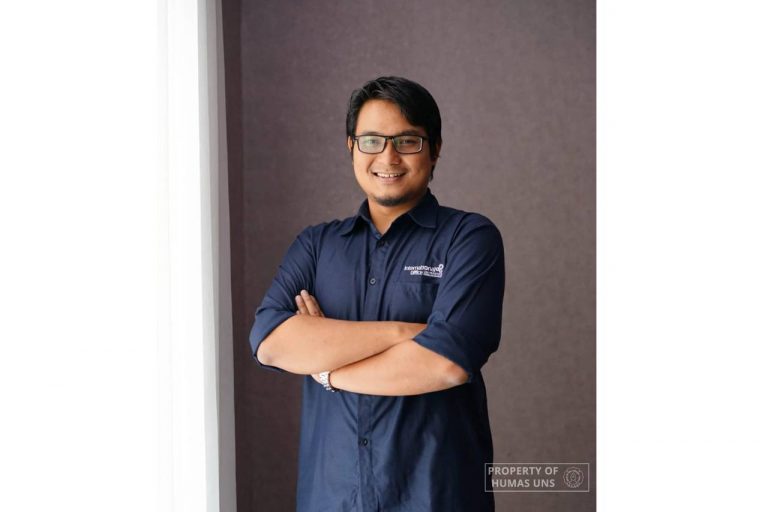
The second speaker, Erma Kumala Sari, M.Psi., discusses the material on the review of the psychology of autistic children and their families during the Covid-19 pandemic. During the ongoing condition, the environment becomes an important supports for autistic children. The COVID-19 usually makes someone overthink themselves and increases the possibility to experience psychosomatic symptoms. Hence, mind management is needed to remain calm and accepting the condition.
“We can manage our own mind to remain calm and to accept the condition. We need to find information but can limit the information we obtain. We must be able to think positively and have confidence. We need to find a new strategy to survive through the current conditions,” explains Erma.
Alternative strategies are needed to avoid boredom and stress. During the current ongoing pandemic, parents should be able to provide positive energy. If the parents are in poor condition, an autistic child can feel it and it will have an impact on the child’s development. An autistic child will need to comprehend the pandemic condition, while the parents or family can monitor the child’s diet and hygiene. A change in routine will also affect autistic child, thus parents need to establish a new schedule by considering free time for the child.
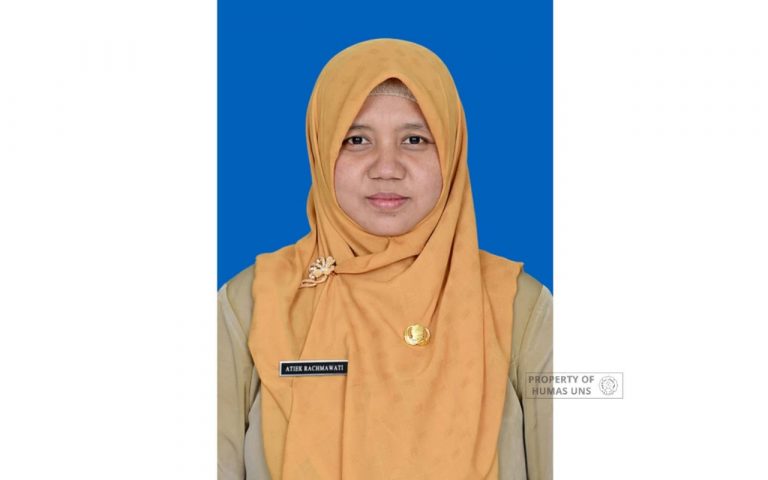
The third speaker, who serves as a teacher in Extraordinary State School (SLBN) Surakarta, Erny Kadarwati, S.Pd, delivers material on learning practice in SLBN Surakarta during the pandemic. In general, there are 40 autistic children in SLBN Surakarta, start from SDLB to SMALB. The online lectures implemented during the pandemic need to consider several aspects where teachers need to prepare a new structure or routine to assist the parents, establish governance on assignments, monitoring program implementation, evaluating each task’s results, and opening consultations regarding the children. There are some advantages of online lectures among others are the parents become more pro-active, more eager to handle their children, and creating a closer relationship between parents and children.
Dr. Minsih, M.Pd., who is a parent of an autistic child shares her experience in nurturing and educating an autistic child in the midst of the COVID-19 pandemic. She suggests using a continuous verbal and visual language to communicate with the autistic child. New habits need to be established through a new schedule, while maintaining their mental and physical health. Another suggestion is regarding the collaboration and communication between parents and the school. Parents need to use any resources available at home. Lastly, the children need to be involved in a daily activity such as cooking, do the dishes, and make the bed.
Education is a right for everyone including an autistic child, during this pandemic, there are inevitable challenges. However, those the closest with an autistic child need to pay attention to all aspects of the wellbeing of the autistic child. Education must always be symmetrical. Humas UNS/Zalfaa