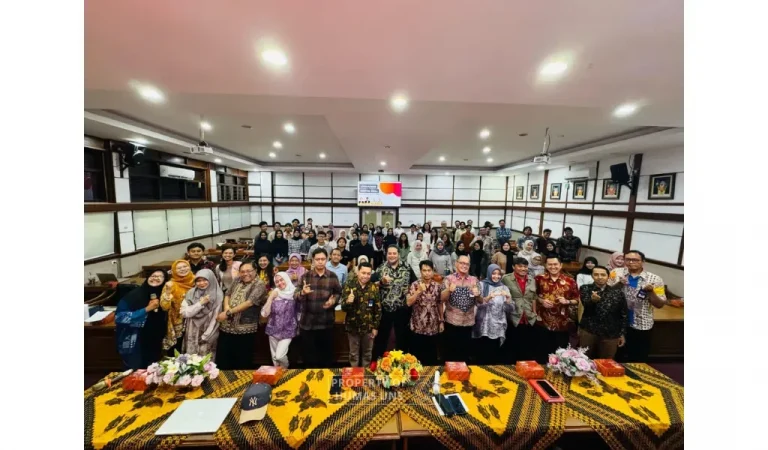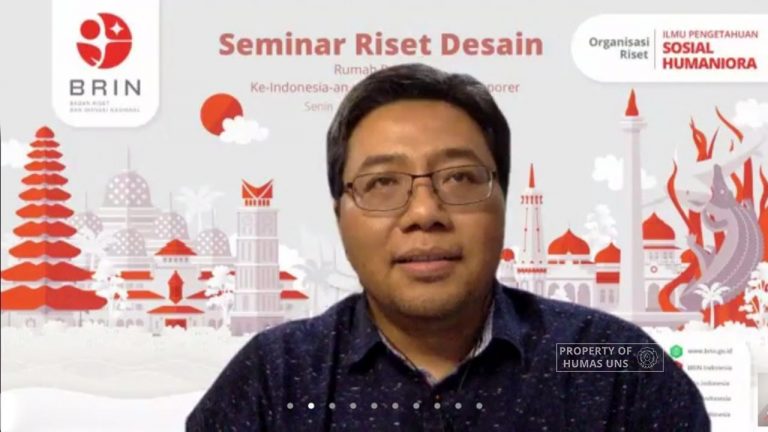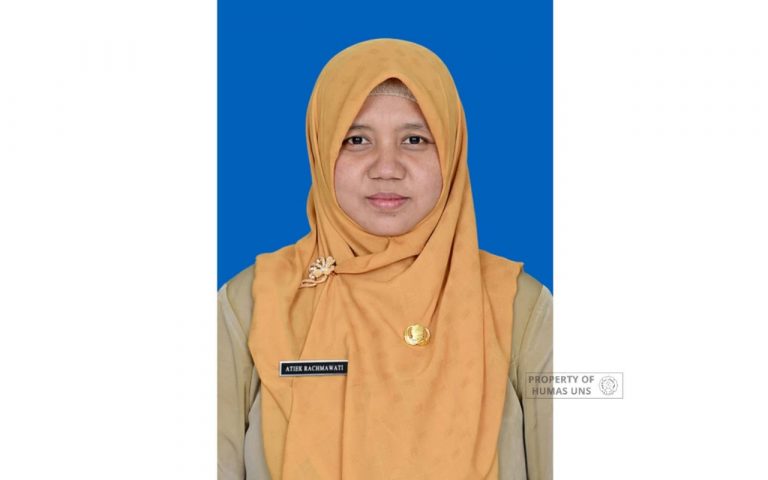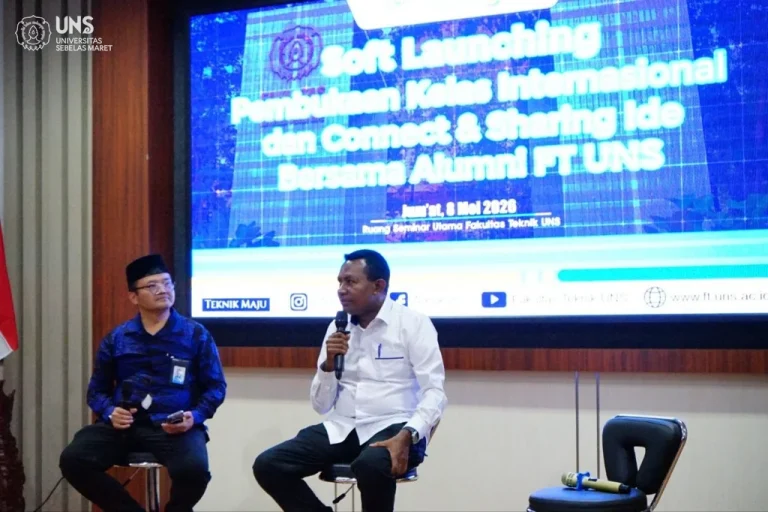
UNS – The new normal era become the next challenge that will change the various settings in society and require a mature strategy, with no exception in Environmental Impact Assessment (EIA), which involve participation from many parties and need field observation. Therefore, coincides with World Environment Day on Friday (5/6/2020), the Environmental Research Center (PPLH) Universitas Sebelas Maret (UNS) Surakarta held a national webinar on ‘Preparation and Assessment for EIA Documents in the New Normal Era’.
In total 1,168 participants, either from governmental agencies, companies, and the general public, from various regions in Indonesia joined the webinar through Zoom Cloud Meeting and live streaming from the PPLH UNS Youtube Chanel.
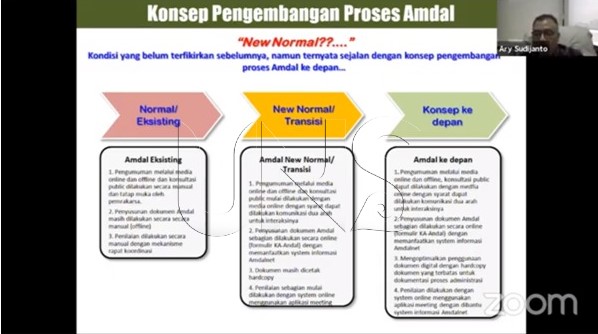
Acting as the first speaker Ir. Ary Sudijanto, MSE, the Director of the Prevention on Business and Activities Environmental Impacts at the Ministry of Environment and Forestry, explains that the mechanism of EIA preparation in the new normal era will combine the online and offline system to remain in compliance with the Covid-19 health protocol. The method will include online public consultation using a two-way communication system, assessment of EIA documents, which partly can be done through an online meeting application, and the preparation of EIA documents that can be done partly through the amdal.net platform that is being developed by the central gov.
“Eventually, amdal.net will be applied to regional gov. as testing, because this system is designed as a national system,” he explains.
Ary adds that the regulation related to the mechanism of EIA drafting at the regional level during the new normal era is delegated to the respective regional heads in accordance with the local situation. This mainly because of the variation in the implementation of the new normal in each regional gov. by considering the number of transmissions in a region.
Ary also reveals that with the combination of online and offline systems, there will be challenges that must be considered and anticipated with a mature strategy. The first matter, which he emphasized, is the need for legal review or new legal directives regarding the validity of the modification process carried out if it will be applied under these new normal conditions. According to him, the EIA editor can no longer use the policy prior to the new normal, which is the Letter from the Director-General of PTKL No. SE.7/PKTL/PDLUK/PLA.4/4/2020, that regulate the Procedures for Assessment by KPA in the Context of Covid-19 Prevention.
Secondly, a policy review on the effectiveness and accountability on the implementation of public consultation through an online system, in soliciting public opinions and responses. This point is in line with the third point, namely the need to evaluate the readiness of infrastructure to support the online assessment process. This is conducted to enable the entire community to gain access as an EIA assessor and to ensure its legality.
“This community involvement becomes a big challenge for us. Not only public consultation but also its representation as KPA member. The one that deals with expert involvement or institution is well established. However, communication with the public through the online system still needs the development of internet infrastructure. Thus, when we back to normal condition, we need to assess the effectivity of its implementation and devising mechanisms from the experience during social restrictions,” add Ary.
Similar matters also mentioned by Widi Hartanto, ST., MT., the Head of Planning, Impact Assessment, and Environmental Capacity Development, Department of Environment and Forestry (DLHK) of Central Java. He conveys that unstable internet access becomes the main challenge. This part of the community that is not yet familiar with the online system must be an important note because suggestions, opinions, and responses from the community are a basic frame of reference that must be met.
“The existing activity plans and environmental impact must be conveyed. This related to the methodology and reference framework. During this pandemic, assessment of reference framework and sampling in the field is indeed a major problem. Mobility is limited even though physical distance is maintained,” Widy states.
Because of the drafting of EIA must involve many people, Ary and Widy both emphasized that the EIA proponent could facilitate and ensure that the community had access. For example, by providing generators in areas with no electricity, providing internet access, providing teleconferences in 1-4 locations with 4-7 people in each location to comply with the health protocols, or providing operators from representative initiators who understand the online system.
On the occasion, the Head of Institute for Research and Community Engagement (LPPM) UNS, Prof. Okid Parama Astirin, also present during the webinar. Prof. Okid, in her remark, mentions that this discussion can provide a clearer picture of the EIA drafter and related parties. Although, all of those plans will, certainly, be evaluated and undergoes some developments.
“We can find out what strategies to do and there is a transfer of knowledge that may be useful for us all,” Prof. Okid says. Humas UNS/Yefta