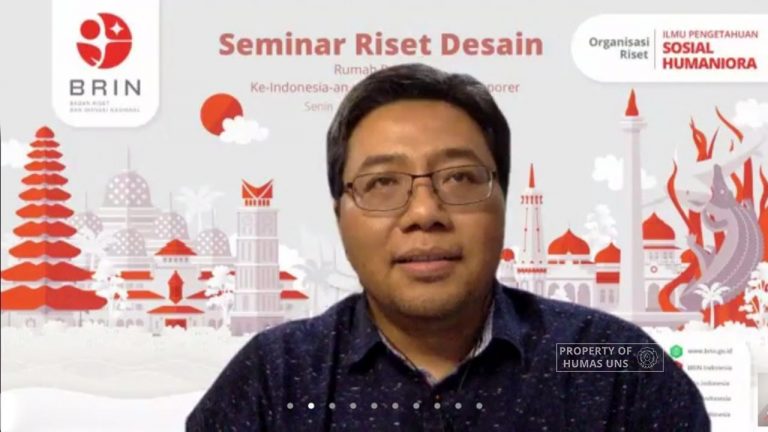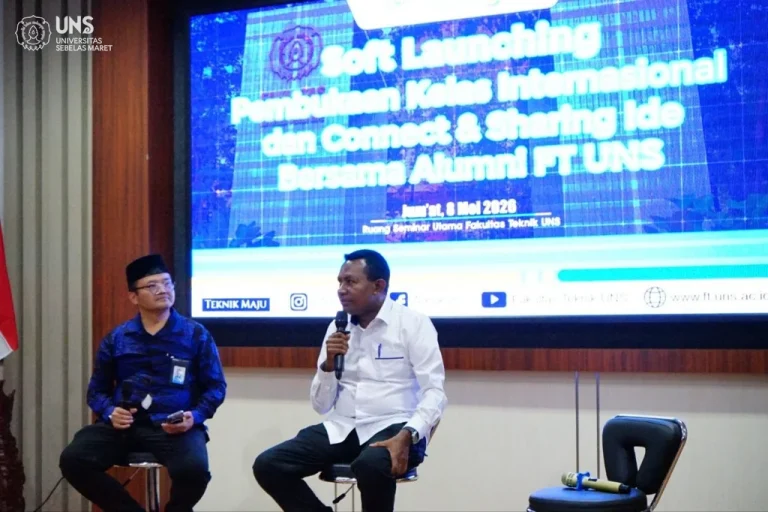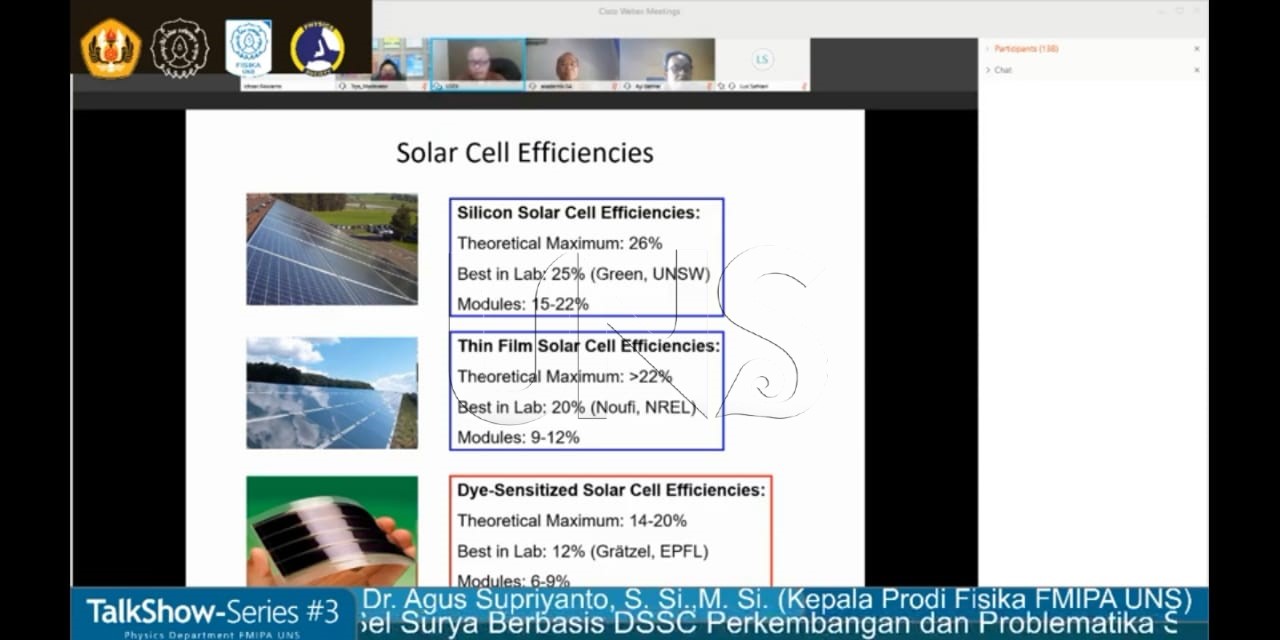
UNS – The Undergraduate in Physic Study Program, Faculty of Mathematics and Natural Science (FMIPA) Universitas Sebelas Maret (UNS) Surakarta, held a talk show on collar cell. This event was held online through the Webex application and live streaming in Himafis UNS Youtube channel on Friday (5/6/2020). In this third series of talkshow, acting as the moderator is Trya Andini, and two speakers are present they are Dr. rer.nat. Ayi Bahtiar from Universitas Padjajaran (Unpad) Bandung and Dr. Agus Supriyanto (the Head of Physic Study Program, FMIPA UNS).
The talkshow entitles ‘Technology Development and Material Problems in Solar Cell’ is followed by 240 participants from various universities. Also, present on the talk show is the Dean of FMIPA UNS Drs. Harjana, Ph.D., and the Head of Physic Program Unpad, Dr. Lusi Safriani, who delivers the opening remarks.
In his opening remark, Drs. Harjana, Ph.D., expresses his appreciation to all participants and hope that the collaboration between Physic Study Program FMIPA UNS and Physic Study Program Unpad can continue and finally achieve ‘Kampus Merdeka’ program. Currently, the government is launching the program as a form of freedom for the students to gain knowledge. Through this program, students can enroll in a course from other universities both private and state universities. This becomes one of the points mentioned by the Dean of FMIPA UNS in his opening remark.
“Hopefully, this event can be useful for all participants, thanks to all participants from the Physic Department Unpad as well as all participant, I hope this collaboration can be continued. If possible, this activity can be recognized in order to realize the ‘Kampus Merdeka’ program, this webinar is designed to reach 6-7 series with duration around 2 hours. If there are 10 activities, each for 2 hours, then it is equivalent with 2 credits, it can be included in a certain course or Special Topics,” explains Harjana.
Dr. rer.nat. Ayi Bahtiar conveys that the application of solar cells currently is used in solar cell power plants, electricity for house, office, and street lighting. Further development will be continued. This development can take many forms such as an e-bike solar charger, umbrella laptop solar charger, CIGS Roll-able solar panel, EFTE flexible solar panel, and many other. the solar cell that currently developed is perovskite solar cell due to its various superiority.
“The excellence of this solar cell is that it has a wide absorption range of light, optical properties can be regulated by adjusting the halide content, and the length of its carrier charge diffusion is quite long. Moreover, exciton binding energy is also low, can be made using a solution-based method, and can be made in a flexible form,” explains Ayi.
Perovskite solar cell module development will continue even with limited funds and facilities. This was mentioned by Dr. Ayi who has implemented it. “Although funding and research facilities are limited, the development of solar cells is still possible. This can be achieved by using Pb waste as the source of Pbl, finding cheap perovskite material such as Zinc, design of solar cell structures, as well as conducting institutional research both at home and abroad,” he adds.
Dr. Agus Supriyanto delivers materials on the development and problems of Dye-Sensitized Solar Cell (DSSC). DSSC is a solar cell formed through the process of photoelectrochemical mechanisms, where the light absorption process is carried out by dye molecules and the charge separation process by nanostructured inorganic semiconductor materials.
“SSO or Organic Solar Cell has many advantages such as low operational manufacturing costs, environmentally friendly, easily formed, and has aesthetic value compared to other technologies because the color is not monotonous. This DSSC module can be applied to carrying bags and outdoor accessories. One of the interesting things is that it can be used for windows because it can be made to be transparent,” explains Agus.
The materials used in the DSSC module are subtracts, Nanopores TiO2, electrolyte, and counter electrode catalyst. “Subtract is the place for the electrical charge to flow, the material used is fluorine-doped tin oxide and indium tin oxide. The use of semiconductor oxides in photoelectrochemistry because of their stability against photo-corrosion. Then, the electrolyte used consists of iodine and triiodide as a pair of redox and solvent. Catalysts are also needed to accelerate the reaction kinetics of the triiodide reduction process on TCO,” he reveals.
Through this activity, it is expected to increase knowledge about the utilization of solar energy through solar cells. In addition, the collaboration between the Physics Study Program UNS and the Unpad Physics Department, hopefully, can also continue, thus, it can be applied to the ‘Kampus Merdeka’ program. Humas UNS/Bayu