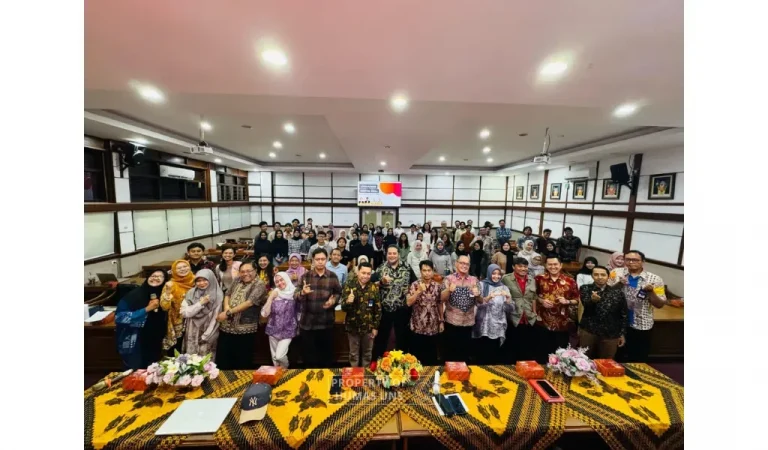
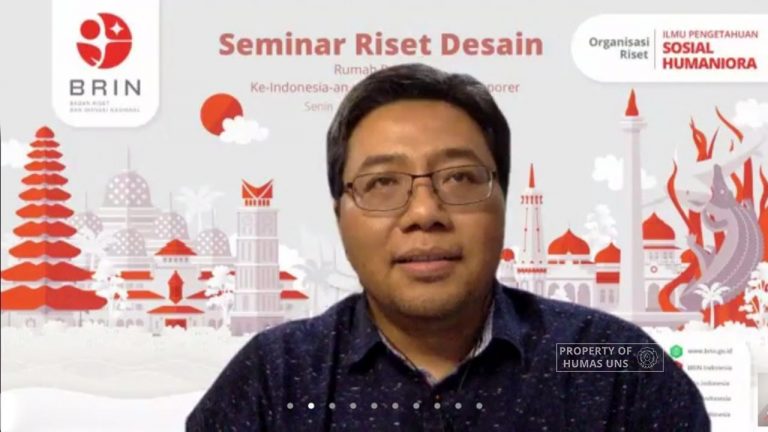
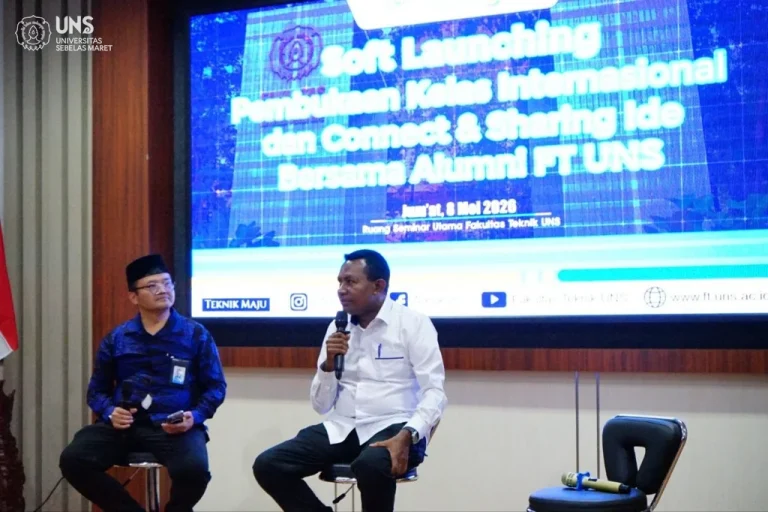
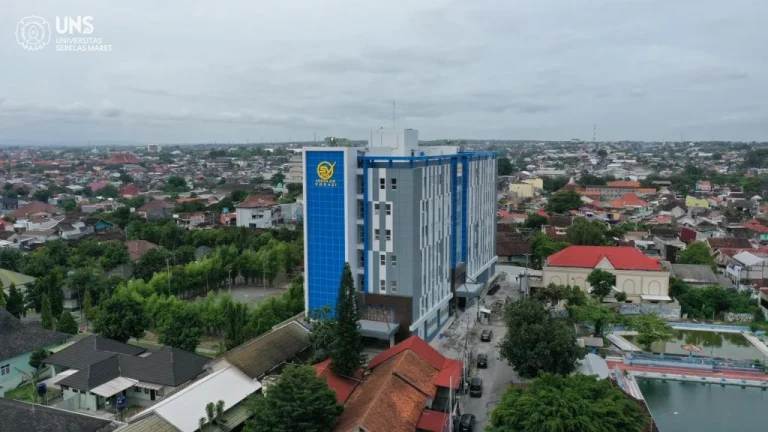
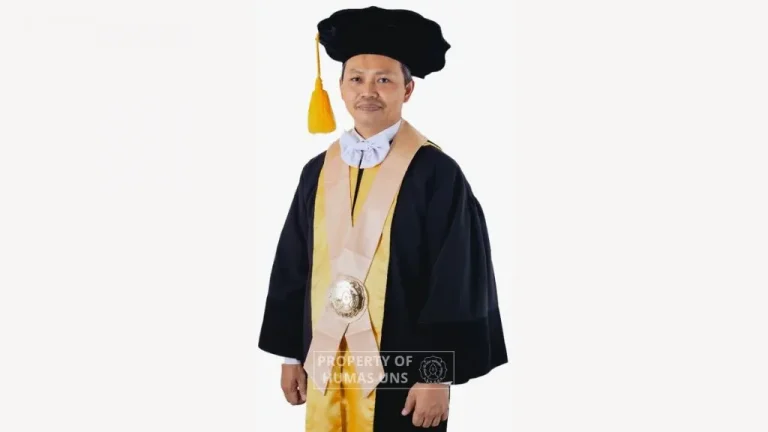
UNS – The Vocational School (SV), Universitas Sebelas Maret (UNS) Surakarta keep on strengthen and develop its learning design since it was established at the end of 2018. This is proved from the various plans presented by the Director of SV UNS, Santoso Tri Hananto, M.Acc., during the first series of Ngobrol Bernas Vokasi (Ngobrassi). With Agus D. Priyanto, MCALL, Director of SV UNS in Academic and Student Affairs, serving as Moderator, the discussion is attended by the academic members, either students or lecturers from various regions in Indonesia such as Padang, Jakarta, Yogyakarta, Surabaya, Bandung, Bogor, and others.
The first point that becomes the emphasis in SV UNS Learning is the importance of high technology and low technology combination implementation (appropriate technology) to strengthen competency laboratory. Technology advancement is used in order to make the competency laboratory in SV UNS has an industrial-class quality, as a provision for students to prepare the industrial internship, which is indeed the main focus of SV UNS.
Moreover, the Study Programs that are highly heterogenous requires the availability of diverse laboratories. Therefore, SV UNS plans for an Augmented Reality & Virtual Reality (AR/VR)-based laboratory to streamline room usage and make it easy to update practicum content.
“However, we are not forgetting the land where we stand. The low technology is needed to remind our children regarding a simpler appropriate technology. Because most of the Micro, Small, and Medium Enterprise (MSME) use this type of technology,” explains Santoso on Sunday (7/6/2020).
Santoso also gave an example of MSMEs that will be burdened with computer-based accounting, with concerns that their performance may be disrupted. Therefore, MSME needs a system that allows them to work independently and does not need to add personnel with a special accounting background.
“When they are developed, we will follow-up,” he adds.
As mentioned previously, SV UNS is focused to prepare its students in an industrial internship. Because through an industrial internship, SV UNS can share its Human Resource and infrastructure with the industrial partners.
“Our competency laboratory strives to approach the industry to provide students with sufficient provisions. Indeed, it is better in the industry. For instance, in mid of March, his party has an MoU with Tiga Serangkai Inti Corpora. The company itself will prepare 2 classes namely lecture classes that are directly next to the industry. Thus, the students can take an internship program as well as industrial lectures,” he explains.
Regarding the number of companies needed, Santoso mentions that approximately 600 to 700 partner companies are needed to reach the learning outcomes. Therefore, the vocational program administrators can share.
“We establish a partnership with industry, profession association, other universities, and polytechnics, which provides vocational education to strengthen each other. We also open a room for discussion, to share information, and many others,” Santoso said.
As the principle of vocational education, SV UNS seeks to deliver more practical lectures with a composition of 70% of practical lectures and 30% of theoretical lectures. Out of the 70% quota, half of them are in the form of industrial internships to form skilled human resources.
Further, Santoso states that to meet these targets, the learning model at SV UNS uses a 3:2:1 pattern for Diploma 3 Study Programs and 4:3:1 pattern for Diploma 4 programs. The 3:2:1 pattern refers to the length of the semester taken by students for a certain type of lecture, which means students spend 3 semesters for campus/class lecture, 2 semesters for an industrial internship, and 1 semester for Final Assignment/Diploma Thesis. Meanwhile, the 4:3:1 pattern means students spend 4 semesters for campus/class lecture, 3 semesters for an industrial internship, and 1 semester for Final Assignment/Diploma Thesis.
Aside from that, as mentioned by Santoso, lecturers will also be combined with a composition of 50% of academic lecturers and 50% of industry lecturers (practitioners). The industry lecturers will accompany students during an industrial internship and some are invited to campus, while academic lecturers focused on theory and practice lectures.
However, for a certain course, there will be a teaching team with one academic lecturer and one industry lecturer. The academic lecturers will design character-based learning, while business matters and the strengthening of expertise are taught by industry masters who are more proficient.
Even though there is a collaboration with the industry lecturer, SV UNS keeps improving the competency of its lecturers, which incidentally is dominated by bachelor or academic level graduates.
“For students, we are determined when they are graduated, they already have at least 2 competency certificates. Because during the last 5 years, the education certificate and transcripts are slowly only used for administrative requirements, which explains that someone already finishes studying hard skills and not a soft skill. Therefore, we strive to improve the SV students’ soft skill competency to be excel in the working world,” explains Santoso. Humas UNS/Kaffa