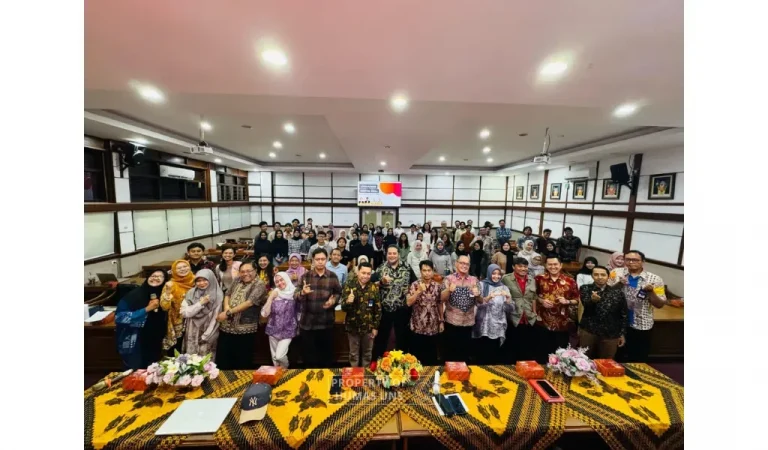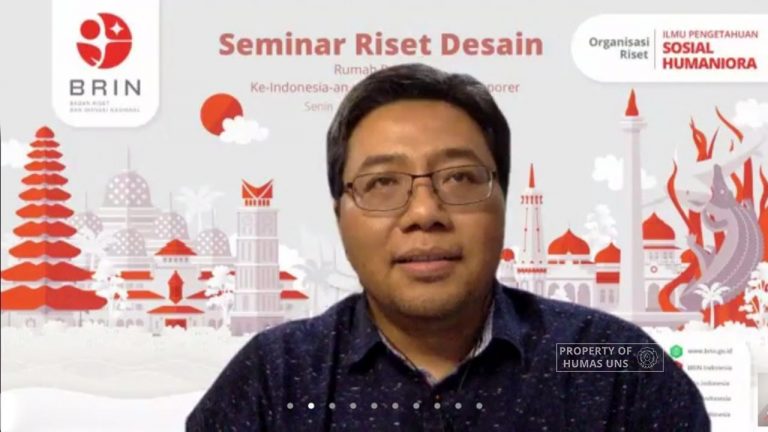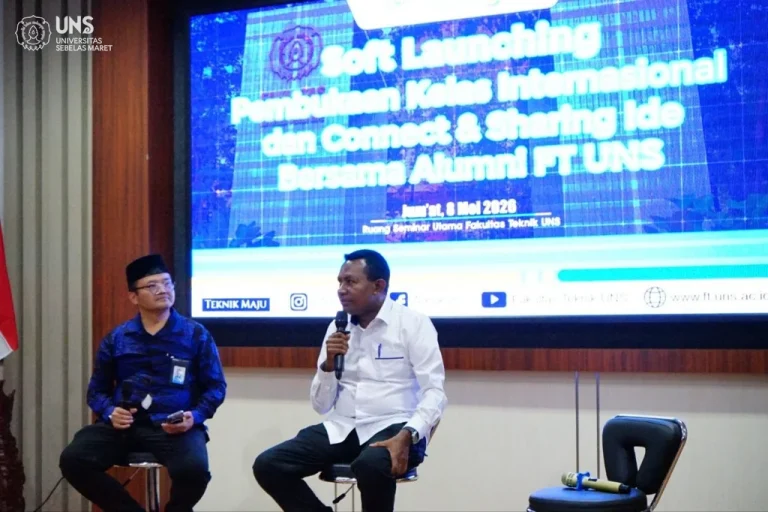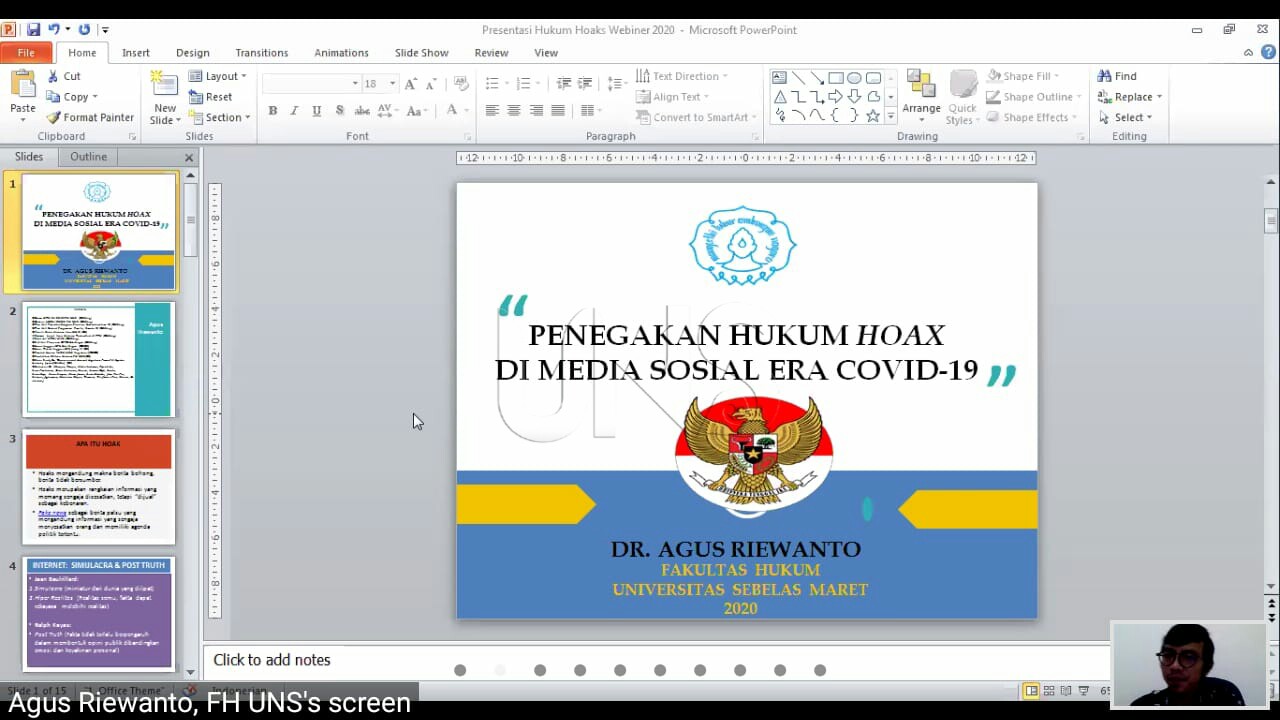
UNS – The Consultation and Legal Aid Institute (LKBH) Universitas Sebelas Maret (UNS) Surakarta in collaboration with the Faculty of Social Studies (FIB) Universitas Diponegoro (UNDIP) Semarang, the Faculty of Social and Political Sciences (FISIP) UNS, and the Indonesian Anti-Defamation Community (Mafindo) organize a webinar entitled “Hoax and COVID-19, Using Social Media Wisely During COVID-19 Era”. The event was held on Wednesday (17/6/2020) through Zoom Meeting Application.
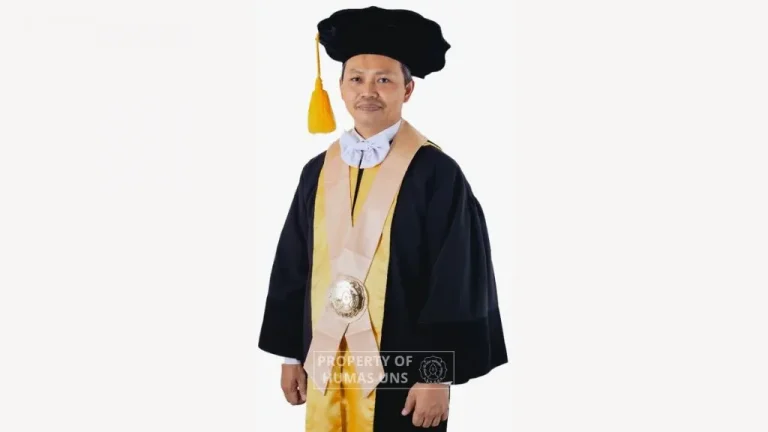
Discussing the matter from the culture, law, politics, and ethics perspective, the event presented four speakers and was led by Achmad, S.H., M.H. as a moderator. The invited speakers are Dr. Agus Riewanto, the Director of LKBH in the Faculty of Law (FH) UNS, Rino Ardhian Nugroho, Ph.D., the Head of State Administration Science Study Program (AN) FISIP UNS, Dr. Amirudin, Head of Study Program in FIB UNDIP, and Niken Satyawati, M.I.Kom, Mafindo Activist.
The spread of Hoax in Indonesia itself has been around since 2016, based on the data delivered by Dr. Rino, since 2016 there was already hoax spread in the society but the amount is not as much as today. The pandemic condition that requires people to stay home becomes one of the triggers why hoax spread easily. The main activity of the society is increasingly intersecting with the internet. Based on the data presented by Dr. Agus, the highest spread of hoax occurs on social media.
“Referring to the data, the most hoax spread through social media reaching 92.40%,” explains Dr. Agus.
From a political standpoint, Dr. Rino explains that hoax becomes an effective method to influence someone in the political field. The way a hoax works is by striking someone’s fear and try to protect its own interests. Incorrect news is delivered to benefit one party by lowering the level of public trust.
From a cultural standpoint, hoax becomes a part of society because of the advancement of technology. The technology itself becomes a tool owned by the society to facilitate all their activities. One of them is as a means to express opinions. The freedom of opinion becomes a matter of right if it is conveyed into the news. However, if delivered without seeing the facts, then this becomes a boomerang for the community.
From a law perspective, Dr. Agus explains that there are several studies regarding internet law in Indonesia. The current law is considered not yet effective in providing a deterrent effect to the perpetrators.
“Currently, the law in Indonesia consists more of criminal law than amercement law,” explains Dr. Agus.
The other speakers also find that an amercement can be more effective in providing a deterrent effect. However, this needs to be balanced with good education to tackle the spread of the hoaxes. On this occasion, Niken Satyawati explains the need for an effort to continue to improve people’s digital literacy, evaluation for the government, thus, it can be faster and more open in providing information, massive and contextual education, the media are also expected to contribute to having more responsibility in conveying information, and strict law enforcement. Humas UNS/Ratri/Dwi