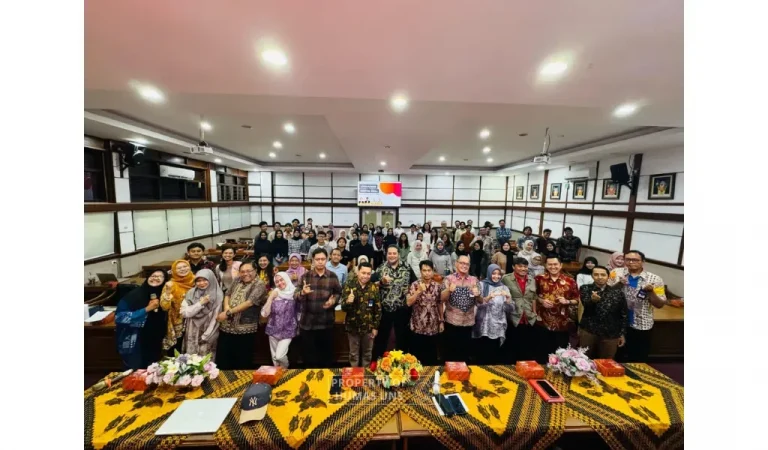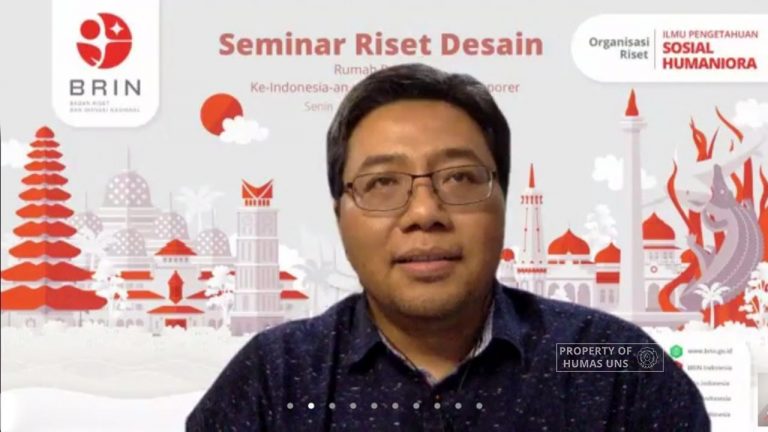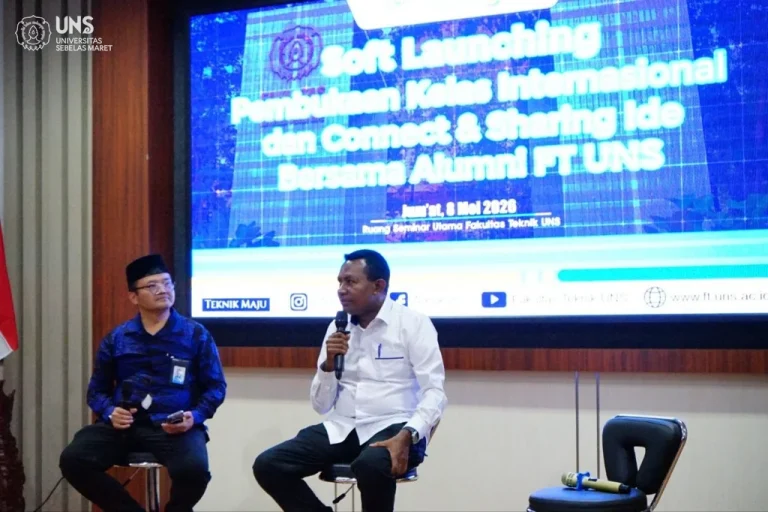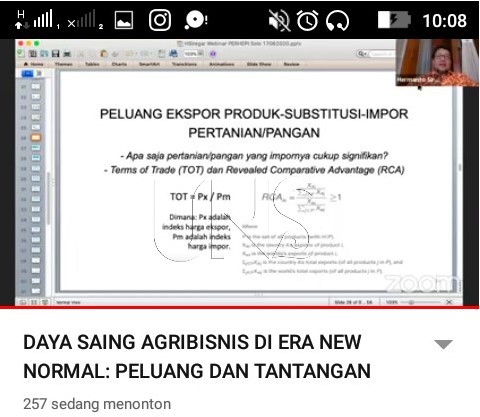
UNS – Collaborating with Indonesian Agricultural Economics Association (Perhepi) Surakarta, the Agribusiness Study Program, Faculty of Agriculture (FP) Universitas Sebelas Maret (UNS) Surakarta, discuss the Agribusiness Competitiveness in the New Normal Era: Opportunities and Challenges, on Wednesday (17/6/2020). The event was held through the Zoom meeting and UNS Youtube channel live streaming. Four speakers are invited to the discussion namely Prof. Hermanto Siregar (Chairman of PP Perhepi), Prof. Masyhuri (Professor in Faculty of Agriculture UGM), Dr. Mohd. Harisudin (Lecturer of Agribusiness in FP UNS and Rector of Usahid Surakarta), and Dr. Tedy Dirhamsyah (Balitbang Ministry of Agriculture RI).
Prof. Hermanto Siregar, as the keynote speaker, states that the effort to encourage exports of agricultural commodities or food products in 2020 is estimated to be ineffective and difficult. This is mainly due to COVID-19 pandemic, which causes global trade, both exports and imports tend to decrease.
“Based on the data released two days ago, Indonesia’s export in the agriculture sector reaches 253 million USD. It is decreased compared to April and compared to May last year also decreased. Therefore, this pandemic has a negative effect on the trade and overall economic performance,” explains the Professor from IPB University.
By sector, according to Prof. Hermanto, the trade balance in the agricultural sector experienced a surplus. Commodities with a high surplus are rubber, tobacco, tea, coffee, and palm oil. However, by subsector, all of them are facing a deficit except for the plantation subsector with USD 22.7 billion.
Prof. Hermanto also mentioned that to support trade in the agricultural sector in the midst of a pandemic and new normal, a substitution of various imported products is needed. This can be done by consuming or replacing imported products with other food products. This can be a new export commodity opportunities.
“We can substitute import by improving domestic trades, between regions, or between islands. Besides cereal, other commodities that can be substituted in 2020 are fruits and nuts, vegetables and certain roots, beverages, spirits, vinegar,” he added.
Meanwhile, other commodities such as cocoa, tobacco, meat, and fish can be increased by increasing its productivity and quality. This aims to prepare the agricultural sector to take advantage of economic growth in 2021, which is estimated by the World Trade Organization will recover around 5-7%.
A similar matter is delivered by Prof. Masyhuri, who mentioned that Indonesia needs to fix the productivity of those high imported commodities. This can be started with cultivating wheat or replacing wheat with another commodity. The former Chairman of Perhepi also proposes another strategy, namely integrated agriculture or integrated farming with the use of house yards. This farming system is highly recommended for farmers and communities in the village in particular. Because there are many people who lost their jobs and returned to the village.
Meanwhile, Dr. Mohamad Harisudin, is more focussed on the momentum taken by the agricultural sector during the pandemic. He called this condition as the reorientation of agribusiness system development. The agricultural sector, he added, acts as a buffer sector and is able to accommodate workers who must face unemployment.
“Use this momentum for the agricultural sector to be a priority for future development and to realize food independence. The agricultural sector should be the main focus of the economy in the future, not only during this pandemic,” he said. Humas UNS/Kaffa/Dwi