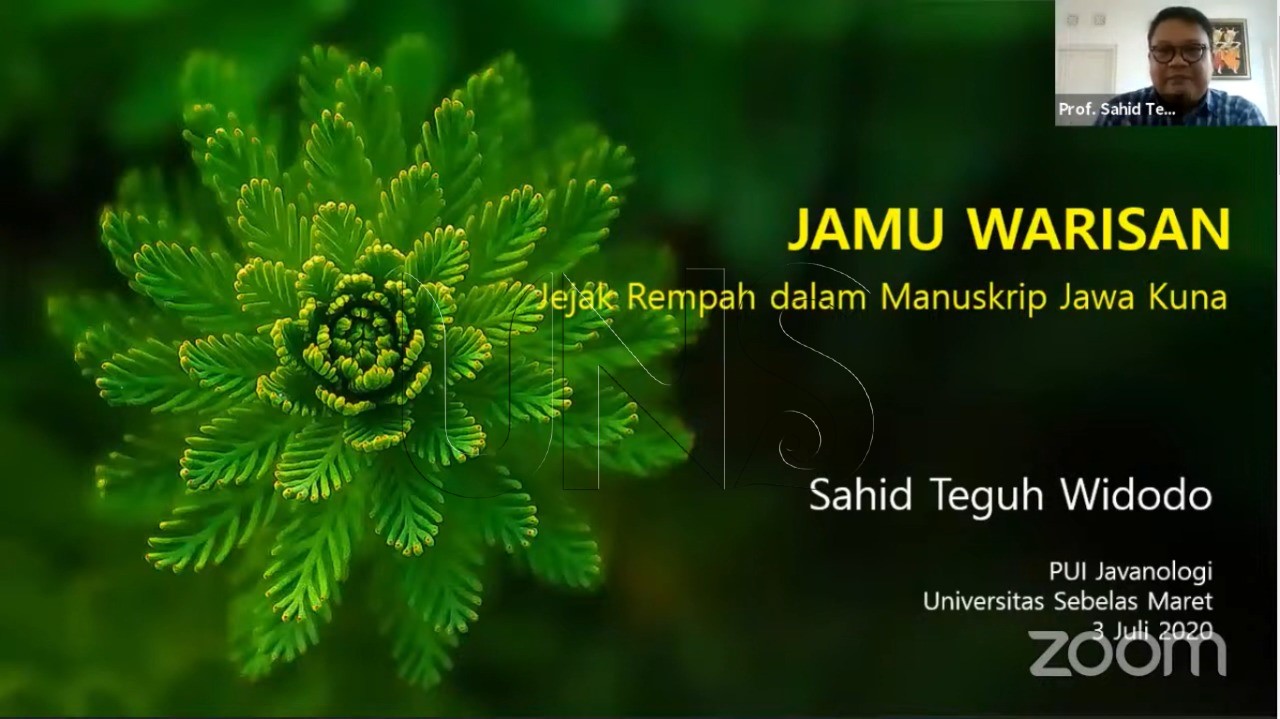
UNS – The professor of Universitas Sebelas Maret (UNS) Surakarta, Prof. Sahid Teguh Widodo shared information on the traces of herbs and jamu (Javanese herbal beverage) in the ancient Javanese Manuscript in the webinar on Herbs Line conducted by the Directorate of Culture Development and Utilization, Ministry of Education and Culture, Friday (3/7/2020). The webinar was held through Zoom Meeting application and YouTube live streaming.
Prof. Sahid, as the Chief of Javanologi Institute UNS, stated that Indonesia has large and diverse heritage, especially regarding herbs. Therefore, Javanologi UNS researched the tracking heritage knowledge and publications through all kinds of academic meetings and also the tri dharma of higher education.
“Many manuscripts that we have mentioned about medication, we also received help in the form of lontar usada. Our main struggle is in the translation because many stages need to be performed considering the damaged and old condition of the manuscripts. The languages are all classic language such as old Balinese, ancient Javanese, and languages that have idioms that are difficult to explain in semiotics. There are many lacunae, additions, all of them need time to unload the content of the manuscripts,” he explained.
Indonesia is a country that is ‘gemah ripah loh jinawi’, a Javanese idiom that means a peaceful, prosperous, and fertile country which becomes a paradise for medicinal plants. The trace of herbs refers to the data or information in the ancient Javanese manuscripts. “The practice of concocting and consuming jamu is observed on Borobudur Temple reliefs were built in 825 M at the Kamadatu and Rupadatu levels because both levels narrated the worldly life. The reliefs show that people in the past mix and consume jamu as a habit. Similar reliefs are also observed on Prambanan Temple were built in 850 M, Penataran temple was built in 1200 M, Sukuh temple was built in 1437 M, Tegalwangi Inscription (Hindu and Buddhist Kingdom period after the 15th century),” he explained.
Currently, the Javanologi Institute UNS is working on several Javanese manuscripts, among others, Kagungan Dalem Buku Racikan Jampi-Jampi Jawi 2nd edition, Serat Buk Jampi-Jampi Jawi, Kawruh Bab Jampi Jawi, Usada Keling, Tenung Saptawara, and Serat Centhini, which contains rich literature but also contains information on types of jamu and stories about the use of jamu. Prof. Sahid stated that optimism appeared after reading the manuscript because the jamus are inserted in various stories such as a wedding that has offerings and strength virility jamu. He also conveyed the difficulties to collect information of jamu from the past. The greatest obstacles in the process are the terminology of language, terms of ingredients, dosage, and processing.
Javanologi Institute UNS has taken several steps concerning the information of herbs in the Ancient Javanese Manuscripts, for example, modernize products, diversify the types of jamu, strengthening the use of herbs as jamu or traditional medicine in the formal healthcare, the development of philology research in the manuscripts, digitization, and introducing herbs to children. Humas UNS
Reporter: Bayu Aji Prasetya
Editor: Dwi Hastuti