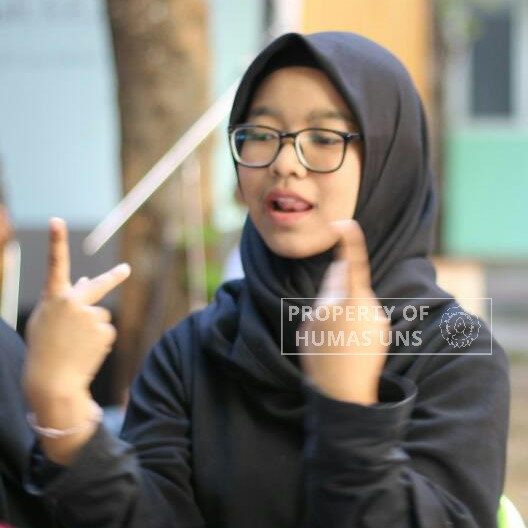
UNS — Universitas Sebelas Maret (UNS) Surakarta continue to create an inclusive and disability-friendly environment. One of the aspects that need to be established is the presence of sign language interpreter on every agenda in UNS. The mastery of sign language is necessary for hearing people to deliver messages and information to deaf people. A student of Special Education Program FKIP UNS, Widyawati Dyah Setyaningrum who often appear as sign language interpreted in UNS shared her story with uns.ac.id.
Starting from becoming a new student in the Special Education Program in 2017 is when she started learning sign language. “When I knew that the program offers a class to learn sign language, I joined it with my other friends. From that I can get acquainted with a deaf friend who works as a tutor of sign language until now we still hang out together because we often hang out together, sign language becomes a habit and over time (I) get used to it,” the girl who often referred to as Widya explained, Monday (9/11/2020). Widya added that her skill mostly came from her friendship with her deaf friends because to maintain communication among friends she needs to understand and master sign language. Moreover, she felt that the sign language course offered in class was limited, thus, she wants to learn sign language further by communicating directly with her deaf friends.
In Indonesia, there two sign languages that are widely used, SIBI and Bisindo. SIBI, Widya, explained, is Sistem Isyarat Bahasa Indonesia (Indonesian Sign System), this sign will help deaf people to learn language structure in Indonesia Language. This sign system is created by hearing people and not deaf people. While Bisindo is Bahasa Isyarat Indonesia (Indonesian Sign Language). “Bisindo is what I learned from the start and my deaf friends also converse in this language,” Widya said. She added that the basis of Bisindo is the interpretation and not translation, which will make it easier for deaf people to understand the language.
Entering the second semester, Widya started to actively participate as a sign language interpreter in campus events. Every year, she acts as a sign language interpreter in New Student Introduction to Campus Life (Pengenalan Kehidupan Kampus bagi Mahasiswa Baru – PKKMB UNS). But even though she has many experiences as a sign language interpreter, she stated that she will continue to learn because each event has a different theme. From there, she learned new words and the ethics of sign language interpreter, the code of ethics, and the standard operating procedure of dress, which add into her knowledge as a sign language interpreter.
Widya stated that sign language interpreter has a high demand considering that Indonesia has started to provide access to people with disabilities. This means that people who could provide access is highly needed, one of which is sign language interpreter. Widya also added that people should not feel worried when they want to learn sign language because there is much training in Gerkatin and PUSBISINDO. The interpreter thinks that it is normal for people who just learned sign language to be confused at first. “Like, how can I improve my skill? But now people do not need to worry because they can join Gerkatin event,” she said. In Gerkatin, people can directly befriend deaf people, while PUSBISINDO, she added, is a sign language class that offers certificate and has a levelling system. “So, don’t worry that your skill will be stuck with dictions because in PUSBISINDO you can upgrade your skill in each level,” Widya concluded. Humas UNS
Reporter: Zalfaa Azalia Pursita
Editor: Dwi Hastuti