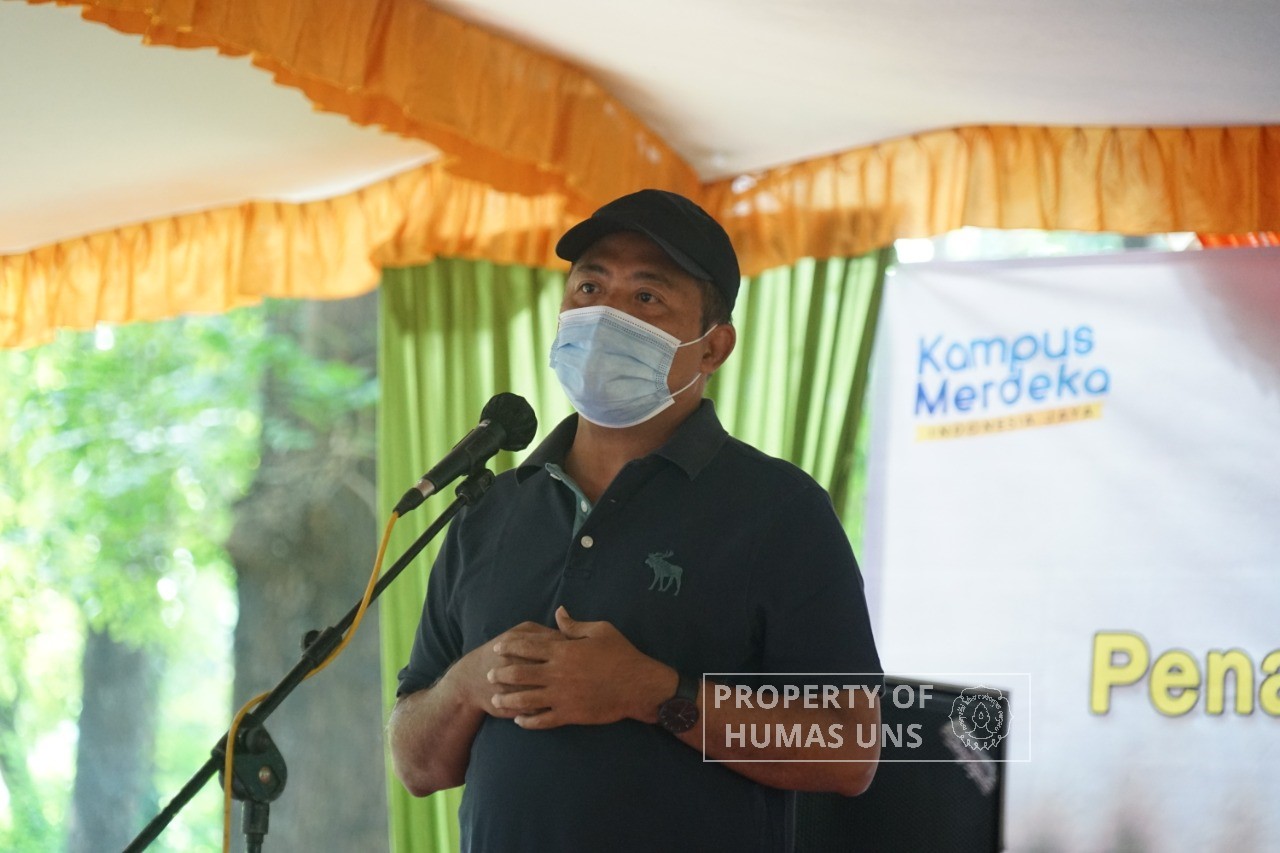
UNS — Karanganyar Regent, Juliyatmono shared his commitment to support Universitas Sebelas Maret (UNS) Surakarta in developing Special Utilization Forest Area (Kawasan Hutan Dengan Tujuan Khusus – KHDTK) Gunung Bromo UNS, Saturday morning (6/3/2021).
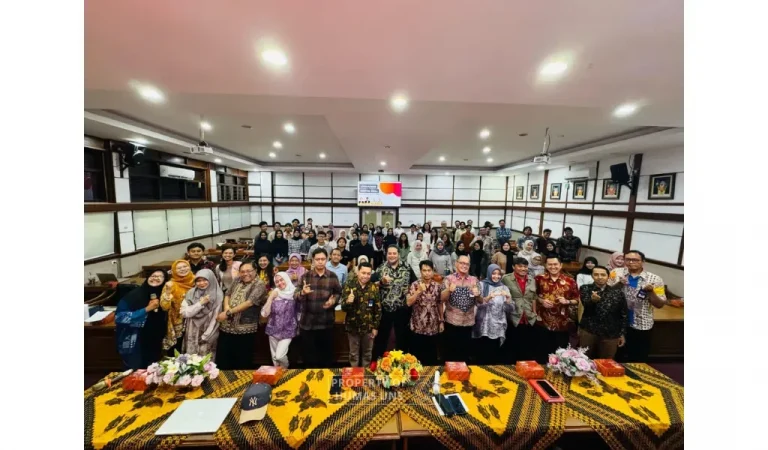
The regent shared his commitment in front of UNS Rector, Prof. Jamal Wiwoho, Deputy Chairman of the Board of Trustees (MWA) UNS, Prof. Hasan Fauzi, Chairman of UNS Academic Senate (SA), Prof. Adi Sulistyono, and Ustaz Yusuf Mansur before tree planting ceremony in KHDTK Gunung Bromo UNS.
“Firstly, the Faculty of Forestry will be established here. Thus, it can be utilized for many purposes. We will support (UNS) if needed. And we will participate and provide encouragement,” Juliyatmono said.
The number one person in Karanganyar also stated that his team would ask the President of the Republic of Indonesia, Joko Widodo (Jokowi), to develop the UNS campus Karanganyar. This support is provided because KHDTK Hutan Bromo UNS has beautiful scenery over its 126.291 hectares of pines and rubber tree-covered lands.
“We take care of the area because the 80 years old trees are magnificent. We cannot create something similar. Therefore, we utilized it well,” the regent added.
The KHDTK also has 44 bird species, including three kinds of raptors, birds of prey, 19 reptilian species, 36 butterfly species, and three mammal species. This finding was announced after UNS researchers identified the rare species in KHDTK Gunung Bromo UNS in October 2019. This richness is the reason for careful and serious management of the area.
“After it (the forest) is cleaned, it is wonderful, and it is second to none. Hopefully, this shakes our minds. And nature should merge with us. Who will utilize it better except us,” he said.
KHDTK management was handed to UNS based on the Minister of Environmental and Forestry of the Republic of Indonesia Decree No. SK. 177/MENLHK/SETJEN/PLA.0/4/2018 as an oxygen-producing area and groundwater protection area. Since 2018, KHDTK UNS has been planned as an area with strategic value to improve the holistic quality of Human Resources and as forest management, agriculture, animal husbandry, and tourism laboratory. Humas UNS
Reporter: Yefta Christopherus AS
Editor: Dwi Hastuti