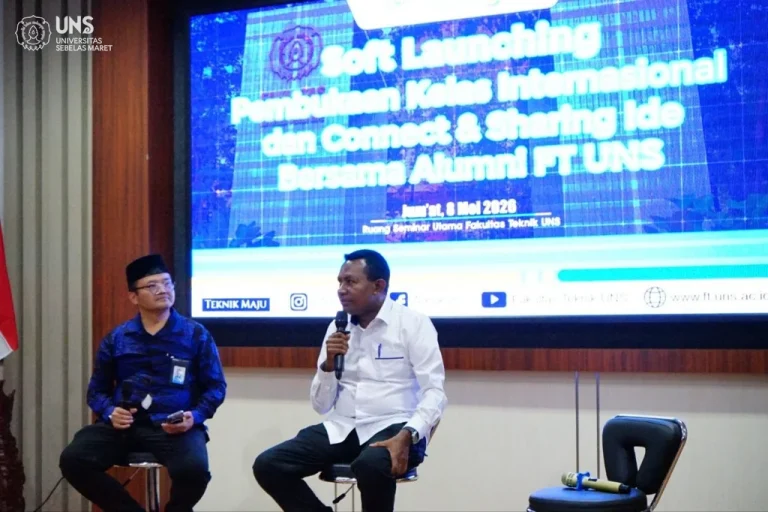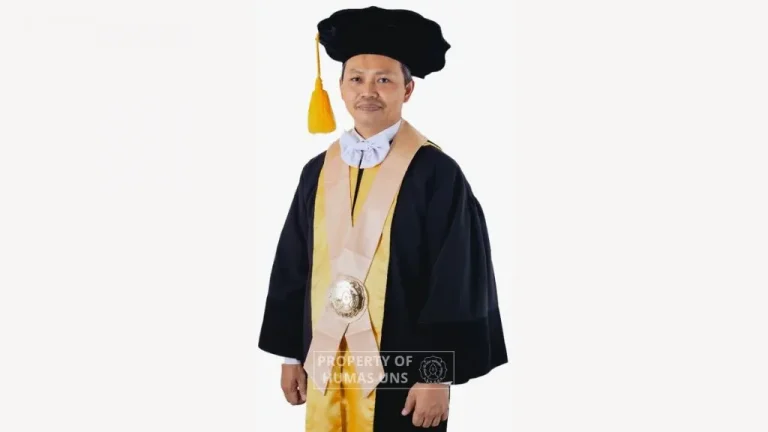
UNS — One of the criteria in the Excellent Student Competition (Mahasiswa Berprestasi – Mawapres) is the delivery of creative ideas through Scientific Writing (KTI). Two Mawapres Universitas Sebelas Maret (UNS) Surakarta, Aiman Hilmi Asaduddin, and Rizka Lailatul Rohmah shared strategies that can be implemented by students in preparing their scientific writing. They shared their tips and tricks in scientific writing in Scientific Talkshow held by SIM UNS, Saturday (13/3/2020).
Opening the discussion, Aiman explained that KTI as a scientific material means it contains an idea to solve an issue using a clear scientific basis. All information in KTI must be based on facts, written directly and effectively, organized systematically, logically, and objectively. Aiman added that KTI for Pilmapres is prepared in the form of description based on logical and accurate reasoning. The writing is relatively more fluid and flexible but is complex enough to solve the existing issues. It should be prepared akin to business planning and mentioned the implementation of the idea and its funding.
“The theme is SGDs and Industrial Revolution 4.0. Different from 2019 with its general structure that requires paper as an outcome,” Aiman, the Mawapres for UNS Undergraduate Program 2019, explained.
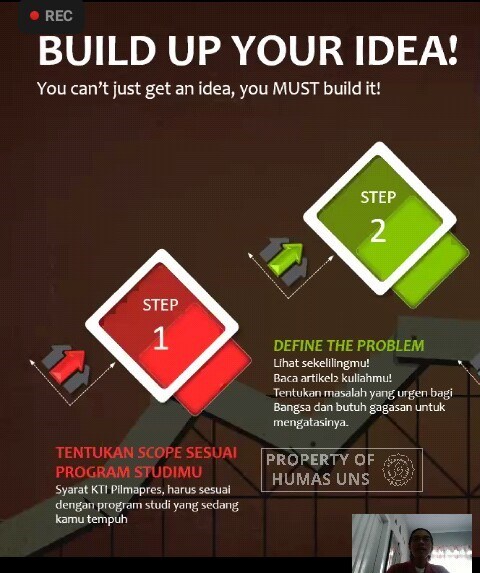
How do students should build ideas for this KTI? Aiman explained that the idea for KTI should start from the basics. Firstly, students need to choose ideas according to their discipline or Study Program as a requirement in KTI Pilmapres. “Because in this event, participants will bring the name of their program. There was a case of a student who wrote articles outside their discipline and got far lower scores,” Aiman said.
Second, students need to determine the issue they want to solve. This issue can come from students’ daily problems requiring a prompt solution and demanding innovative ideas to solve the issue. Third, find the root of the problem, for example, by criticizing the existing solution and its weaknesses. Lastly, make your own strategy. Because KTI is a creative idea, participants are free to offer their plan. Whether the concept is entirely new or a combination of the existing strategy or even development of the current solution does not matter as long as it is applicable.
Aiman emphasized that the creative idea should be connected with Sustainable Development Goals (SDGs) and based on Industrial Revolution 4.0. “We should combine our idea with the latest technological development. Maybe it is tricky to connect it with the basic natural science, but this is where we need our creativity,” Aiman added.
SMART Concept
On the same occasion, Rizka shared the limitation in creative ideas for Pilmapres. She stated that KTI for Pilmapres contains discussion, identification of potential and needs, determine the potential of the target environment and the benefit recipients according to the data and facts, the development target formulation, analysis used to select methods to achieve the targets, description of the work plan and additional information, idea visualization, and supplements.
The Mawapres for Diploma Program UNS 2020 discussed the development target and the targeted outcome regarding the environmental potential and needs. To formulate the development target, Rizka said that there is a SMART concept that students can adopt. The SMART concept means that the development target should be specific and right on target. It should be Measurable, with indicators to measure the success of the development. Then, Acceptable, the idea should be accepted by the target and implemented. The idea should also be Realistic.
“It means we should be able to implement our idea. If we reached National Pilmapres, we have an opportunity to realize our idea. The difference is, for the undergraduate degree, the idea is in the form of concept or strategy, while for the Diploma degree in the form of a product. Lastly, the idea should be Time-bound. Problem formulation should have a detailed time period,” Rizka said.
In selecting the methods to achieve targets, Rizka added that students have to consider several aspects. For example, the difficulty level, financial need (the possibility of minimizing funding or the need for large funds), and comparing time effectiveness and efficiency. Humas UNS
Reporter: Kaffa Hidayati
Editor: Dwi Hastuti