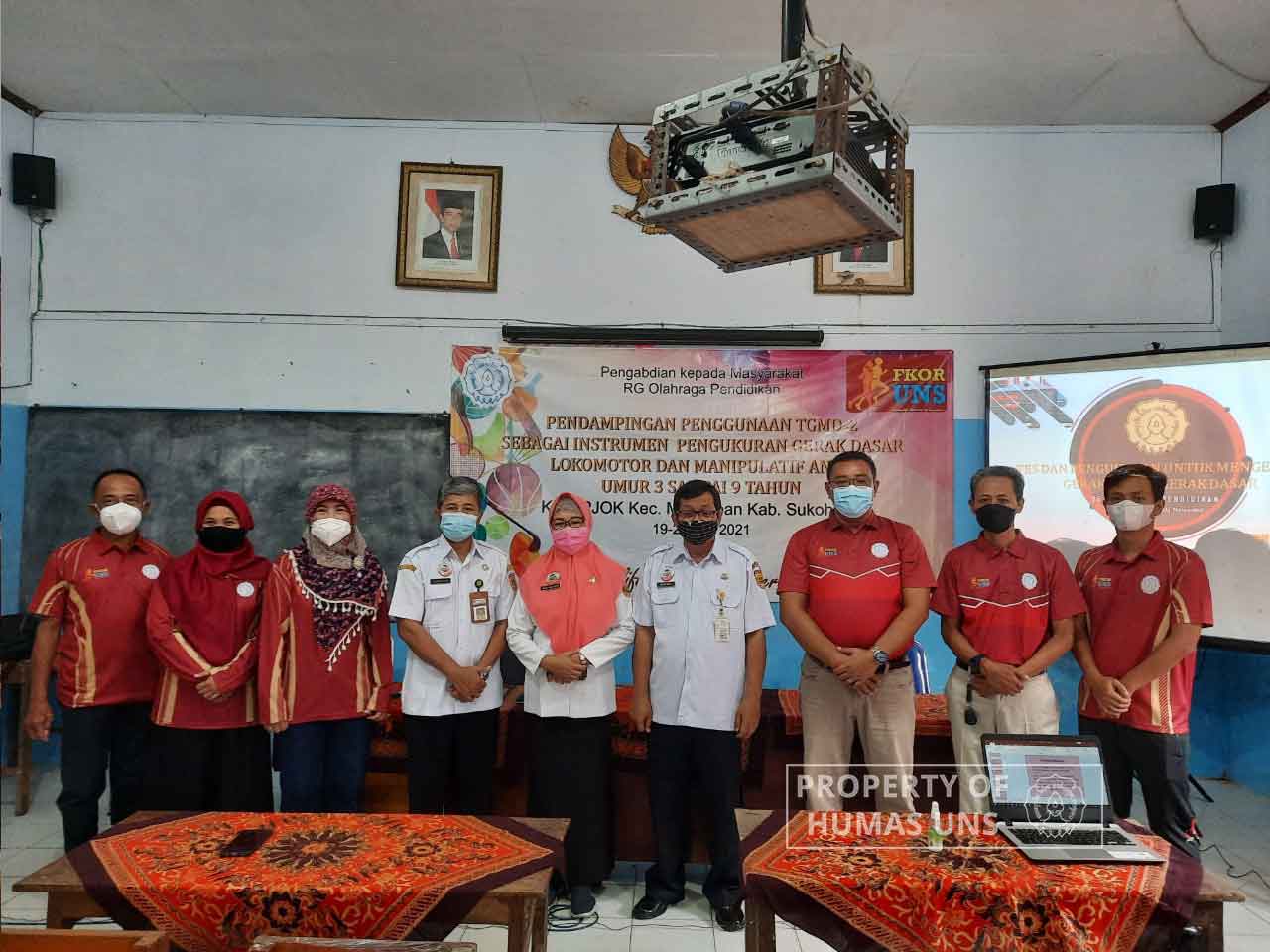
UNS — As a part of the Higher Education Tri Darma, the Physical Education Research Group of the Faculty of Sport (FKOR) Universitas Sebelas Maret (UNS) Surakarta organizes a community service program in SD Negeri Wirun 1 Mojolaban, Sukoharjo. This community service entitled “Technical Assistance on TGMD-2 Implementation as Basic Locomotor and Manipulative Movement Measurement Instrument for Childrens of Three to Nine Years Old in KKG PJOK Mojolaban Sub-District, Sukoharjo District, Jawa Tengah,” was conducted with a strict health protocol implementation on Wednesday (19/5/2021). The event was opened by Drs. Purwanto, M.Si., as the Head of K3S Mojolaban, and attended by 15 physical education teachers in KKG PJOK Mojolaban Sub-District.
Led by Dr. Hanik L, M.Pd., the community service program aims to understand the basic movement skills of the first-grade to third-grade elementary school students. This understanding can be used as the foundation for learning development planning. Moreover, this data can be used for the early detection of weaknesses and strengths of the child’s basic motor skills using existing norms.
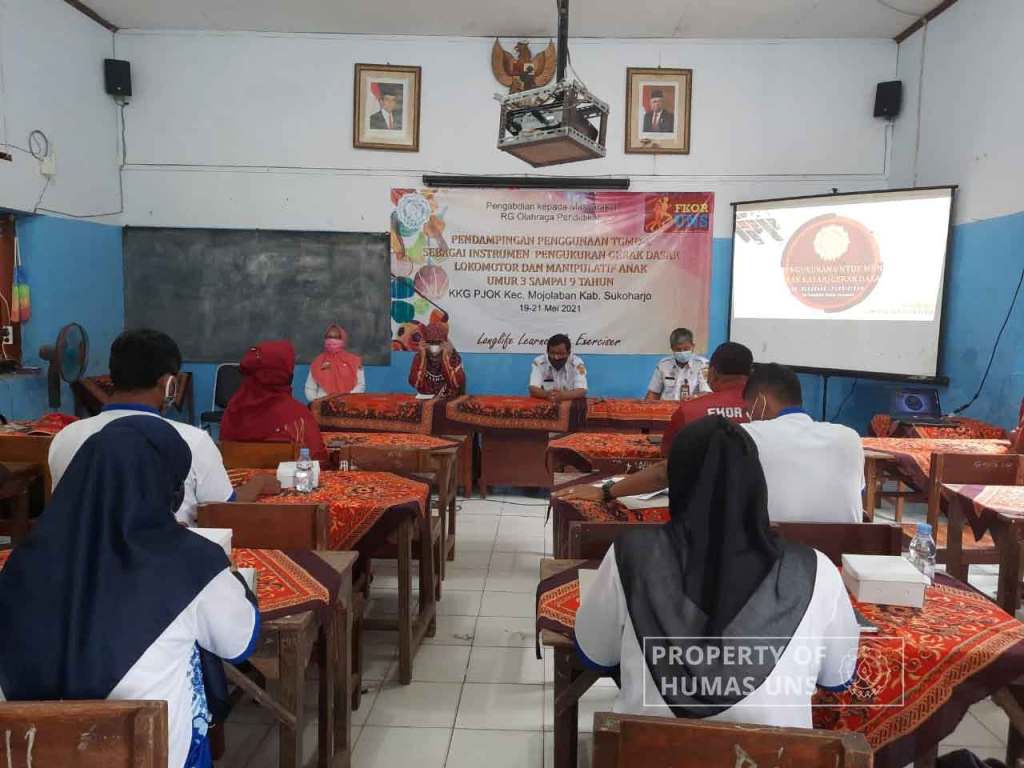
The uns.ac.id team got the opportunity to contact one of the community service program committee, namely, M. Joko. In his commentary, the community service program is funded by the Institute of Research and Community Service (LPPM) UNS and providing various facilities for participants such as material, 5 sets of TGMD-2 tools, and a workshop certificate.
The event was divided into three stages. The first stage provides technical direction regarding the Test of Gross Motor Development-2 (TGMD-2), starting with measurement preparations, assembling tools and measurement implementation procedure, and measurement execution using TGMD-2. The second stage covers TGMD-2 practice at a nearby field, which involves four 9 years old children. Each participant was given a chance to calculate the measurement test result and to try the TGMD-2 measurement while receiving assistance from the UNS lecturer. This assistance will help the participants to understand the steps in measuring children’s basic movement skills.
“Hopefully, the Elementary school teachers can understand how to measure the basic movement skills, thus improving the basic movement learning process. Upon knowing children with excellent basic movement skills, they can be introduced to school or public sports club as a prospective athlete,” M. Joko states. Humas UNS
Reporter: Rangga Pangestu Adji
Editor: Dwi Hastuti