UNS — Research and scientific journal publication is two familiar works for academicians at the university. However, with many manuscripts waiting to be published by leading publishers, manuscript rejection is very common. Associate Prof. Norlin Khalid, Ph.D. from Universiti Kebangsaan Malaysia, shared the points that lead to manuscript rejection in the “Economic Analysis and Academic Writing” Webinar held by the Master Program in Economics and Development Study (MESP) Faculty of Economics and Business (FEB) Universitas Sebelas Maret (UNS) Surakarta.
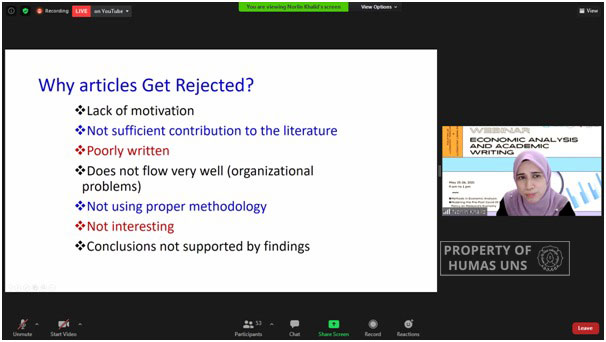
The first reason for rejection is the lack of motivation and literature in a manuscript. Unavailable article references in universities and a lack of motivation to continue writing and preparing journal articles will reduce the manuscript’s contribution to the existing literature. Poor writing is the next reason for rejection. Researchers need to train their writing and deliver their research idea in a structured manuscript. Assoc. Prof. Norlin also mentioned that he started at the same level and improved his writing by looking into the existing literature and seeing the writing style and methodology.
“Of course, you cannot plagiarize. But see the writing style. So, we can write a good article,” he stated, Wednesday (25/5/2021).
The third reason is the use of the inappropriate method. The method is a vital point in a scientific paper. However, writers often explain the different methods in the introduction and the methodology section. Additionally, the research method should be able to answer the research problems. Thus, research is well connected. The fourth reason is manuscript is not interesting. A mature topic that is heavily studied will be harder to be published. To attract readers, writers should demonstrate the novelty of their research and the benefits of their study.
“Lastly, conclusion not supported by findings. The conclusion is taken should be supported by (your) research findings,” Assoc. Prof. Norlin added.
He also shared writing tips for writers to publish high-impact factor articles. Research needs to be strong and solve relevant issues, clear and concise writing, publish in a journal that discusses the topic, follow journal’s guidelines, and work with expert writers. Assoc. Prof. Norlin suggested writers collaborate with their colleagues as each person usually has their field of expertise, such as analytical ability, language editing, and design. Writers could send their manuscript to proofreader to improve their manuscript quality.
“You need to revise your article at least 20 times. When the supervisor or reviewers explained and gave suggestions for revisions, you should be grateful because they make time to read your manuscript. You could develop and improve your writing,” Assoc. Prof. Norlin added. Humas UNS
Reporter: Kaffa hidayati
Editor: Dwi Hastuti