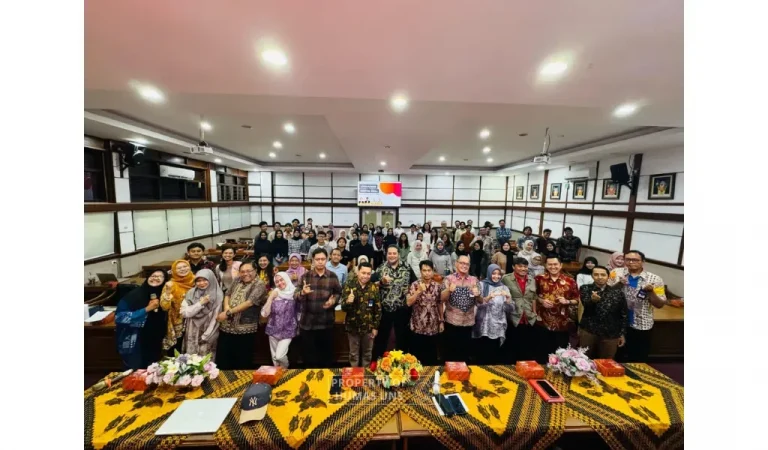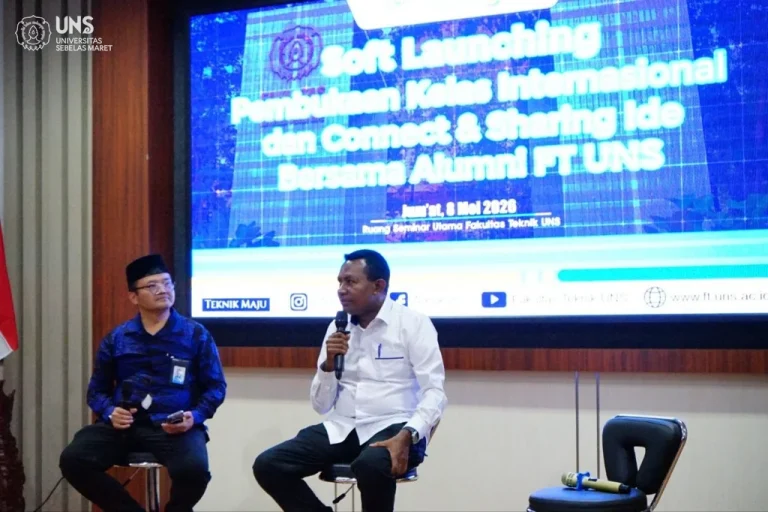
UNS — An exciting webinar on “Anthropological Studies Insights in Design and Green Lab” organized by the Faculty of Art and Design (FSRD) Universitas Sebelas Maret (UNS) Surakarta, Tuesday (27/7/2021). Available virtually through Zoom Cloud Meetings and Official FSRD UNS YouTube Channel, this webinar is part of the 2021 Creative Program in collaboration with the Indonesian Furniture and Craft Industry Association (HIMKI) Yogyakarta.
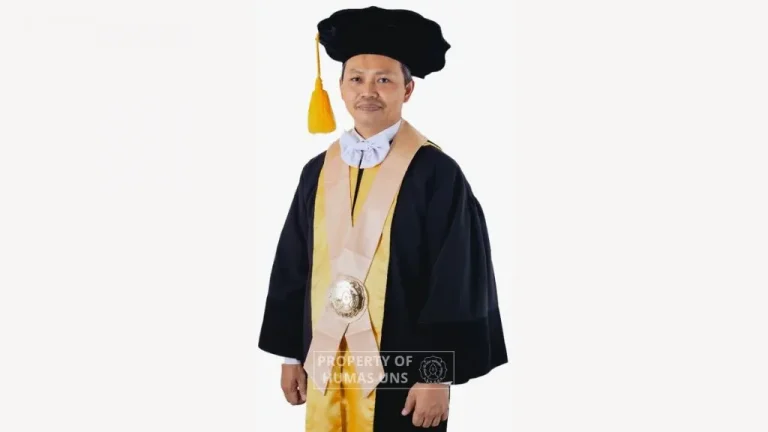
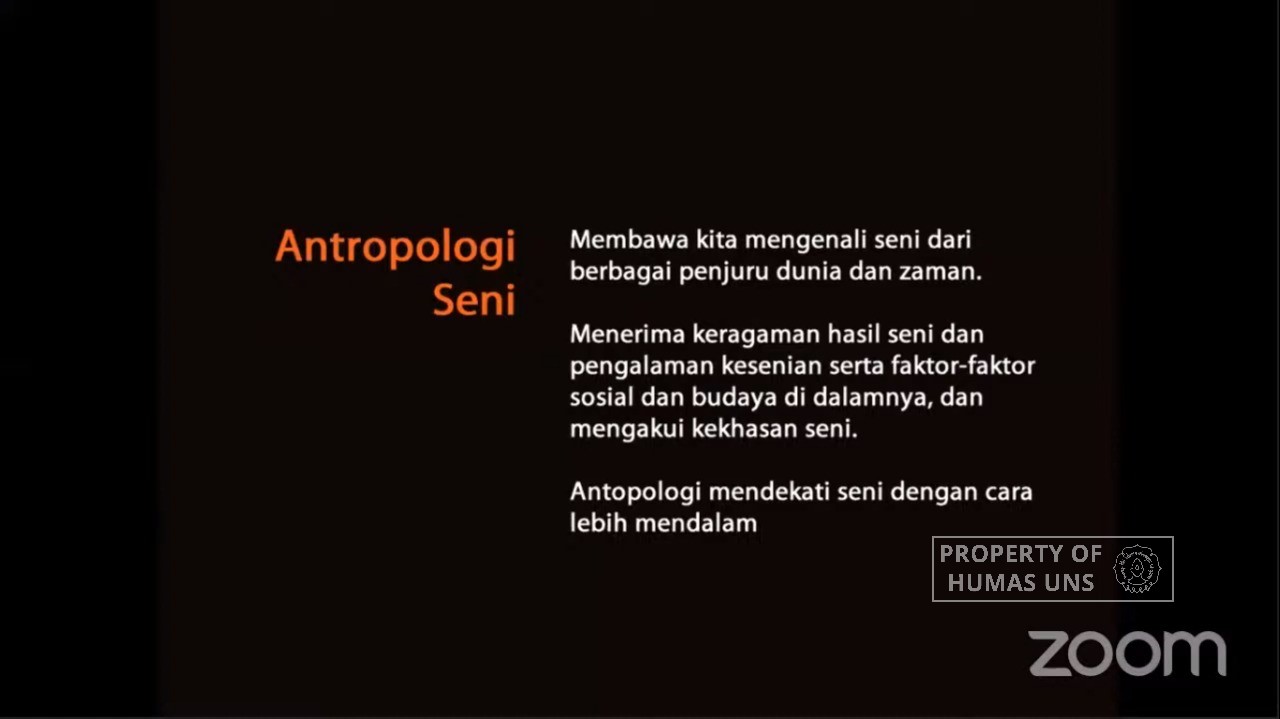
The collaboration is incorporated within the invited speakers’ list for the webinar. The first speaker is Setyawan, S.Sn., M.A., a Textile Craft Lecturer in FSRD UNS, followed by Nor Jayadi S.Sn., MA., the owner of CV. Nafarrel Furniture, as the second speaker to share his experience in the business. Starting his material, Setyawan, S.Sn., M.A., states that art and design is a multidisciplinary science. He ‘borrows’ and involves other scientific fields such as sociology, psychology, anthropology, engineering, and many others. He added that anthropology has numerous contributions, such as helping us to understand art from various corners and ages as well as to understand how diverse art is. Secondly, it encourages us to understand and recognize art from different nations and time frames.
This aspect cannot be separated from the paradigm in anthropology that focused on studying art in different ethnic groups in the world. Therefore, using anthropology study, we can learn to accept the diversity of art and experience, including the social and cultural values within it. “Art has its uniqueness. Thus, different times and places will build a diverse concept of art. This is a crucial point of view needed to evaluate a work of art contextually (according to place and time),” Setyawan explained.
Third, the anthropology approach toward art is more in-depth, viewing art and craft not only as aesthetic product but also as part of the system, values, ideology, and behavior in certain period and location. Art does not necessarily appear out of nowhere. This is different from modern art, which values art from its origin. Thus, a piece of art is considered valuable if its made from something non-existent. This encourages modern fine art to create something new. “This contradicts the anthropology value, where it is impossible for someone to create something inherently new. There must be an influence from the previous value we received. There is always a root to track back,” he revealed.
Further, Setyawan, S.Sn., M.A., explains the design anthropology that tries to understand the social and cultural aspects in a design. The adaptation of anthropology method and theory in the theory of design is known as ethnography. Ethnography provides rich materials provided in design studios, participant observation, and comparative cultural studies. “Design deals with product and human at the same time, thus it needs a more holistic and complex approach. We can use anthropology research findings to strengthen the design,” Setyawan added.
Design for Added Value
Meanwhile, Nor Jayadi, S.Sn., MA., shares his experience in managing the CV. Nafarrel Furniture. A furniture industry in Yogyakarta that transform used drums into various products, such as table and chairs with various beautiful designs. This business is an example of a design application to enhance the economic value and usage of a used item to reduce environmental damage. “On the other hand, I want to produce designs that are not widely implemented. A specific business with a special identity will reduce competition. I started this business in 2015 by processing the raw material under different methods. Later on, the material (oil barrel) become a trend that can be easily found in numerous social media platforms such as Pinterest and Instagram,” Nor Jayadi, S.Sn., MA., reveals.
There are several criteria implemented by Nor Jayadi in producing his product. The design must be unique, ergonomic, functional, innovative, environmentally friendly, and market orientation. Specifically, for chair production, Nor Jayadi mentioned that the design must be comfortable, safe, and strong.
Safety has become an aspect that needs the utmost concern because a used oil barrel can harm the user. Even if the design and shapes offered are attractive, but if in certain parts they are still sharp edges, of course users do not want to use them. Humas UNS
Reporter: Kaffa Hidayati
Editor: Dwi Hastuti