UNS – The Research Group (RG) of Vocational and Mechanical Engineering Education (VMEE) at Universitas Sebelas Maret (UNS) Surakarta conducted a community service activity focusing on “Green Skills in Technical and Vocational Education and Training” through the UNS 2024 International Community Partnership Program (PKMI). This activity was held in partnership with PKBM Banyutowo and Universiti Tun Hussein Onn Malaysia (UTHM).
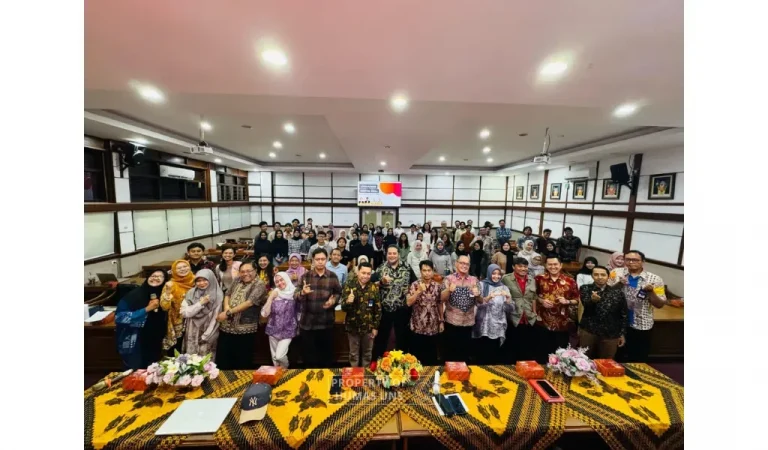
The RG VMEE team organized the Green Skills Holiday Camp in the Pusur River area, Tulung, Klaten, managed by Kipas River Tubing from Saturday (22/6/2024) to Sunday (23/6/2024). The camp was attended by 25 students from SMK Negeri 2 Jiwan, SMK Negeri 2 Surakarta, SMK Negeri 5 Surakarta, and SMK Negeri 1 Kaliwungu, Semarang.
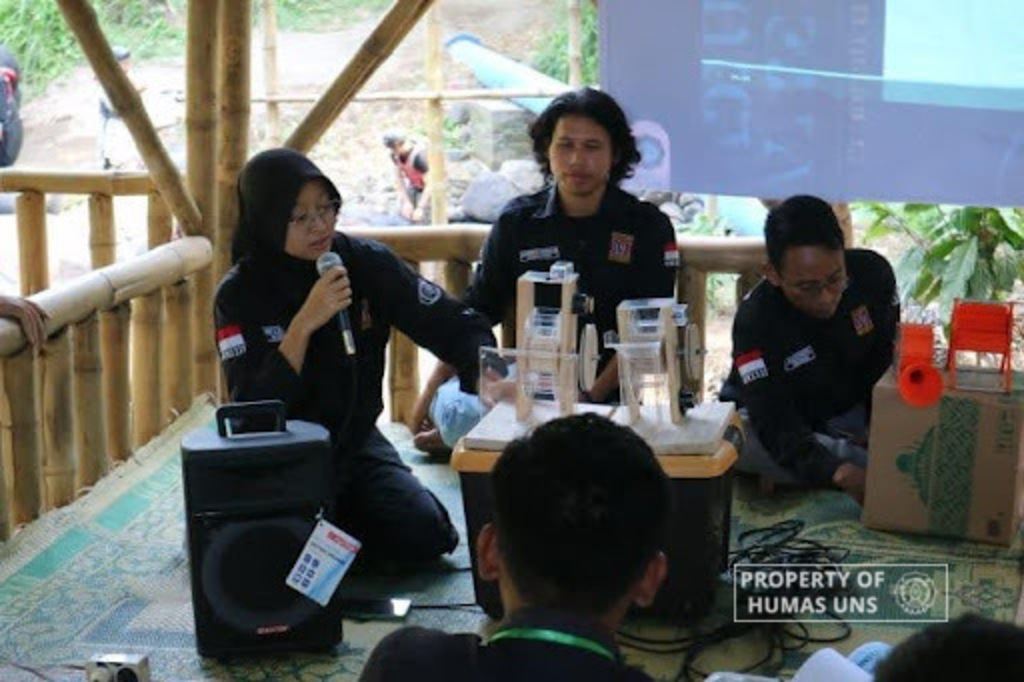
The Green Skills Holiday Camp included riverside camping and green skills socialization through learning modules on water turbine installation, 3D printing introduction, and Internet of Things (IoT) technology for water quality evaluation.
The green skills learning modules were developed by a team led by Prof. Dr. Indah Widiastuti, S.T., M.Eng., with team members Taufik Wisnu Saputra, S.Pd., M.Pd., Cucuk Wawan Budiyanto, S.T., Ph.D., and Dr. Danar Susilo Wijayanto, S.T., M.Eng., supported by several students from UNS’s Mechanical Engineering Education and Informatics and Computer Engineering Education programs. The Mechanical Engineering Education students involved included Aling Sangwidi, Agvendo Heksa Mahendra, Diefa Nasywa Aedelia, Dony Setiawan Nur Salim, Irba’ Rizka Putri, Rifai Aditya Pratama Putra, Satriya Nugraha, Sheva Novianto, Siti Fadilah, Rizki Ikhsan Ramadhan, and Linda Widyawati. Additionally, Informatics and Computer Engineering Education students Bangun Panduko Johan, Candra Zulkarnain, and Raihanah Nurul Izzah also participated.
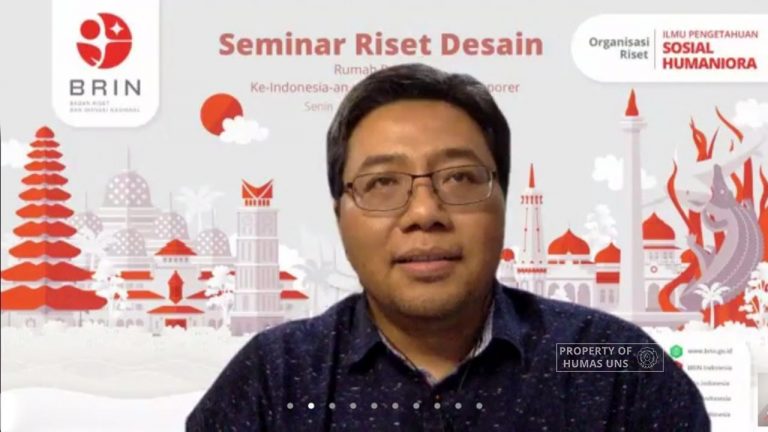
Prof. Indah, as the team leader, stated that this community service focuses on developing green skills in vocational education in response to global demands and the workforce’s needs for better environmental management. Prof. Madya TS. Dr. Aini Nazura Binti Paimin from UTHM, one of the speakers, presented data from CNN Indonesia indicating that Indonesians produce 65 million tons of waste every day.
“Green skills aim to support and encourage sustainable and environmentally friendly practices across various sectors. These skills include the ability to reduce environmental impact, manage resources efficiently, and develop and implement green technologies. Green skills also encompass knowledge of environmental regulations, recycling practices, renewable energy, and sustainable design and production,” Prof. Aini explained.


The primary goal of green skills is to create a greener and more sustainable economy while raising environmental awareness and responsibility among the public. Prof. Aini advised practicing the 5Rs in daily life: reduce, reuse, recycle, renew, and redesign. By applying these principles, individuals can significantly contribute to reducing negative environmental impacts.
“Reduce encourages us to minimize the use of unnecessary items, while reuse promotes the reuse of still-usable items. Recycle involves turning used goods into new products; renew involves restoring natural resources; and redesign means rethinking products to be more environmentally friendly,” she added.
Prof. Aini also urged the younger generation to take active steps, starting with simple actions to preserve the earth. “Every small action counts,” she said.
Awareness and small actions such as reducing single-use plastics, bringing reusable water bottles, or separating organic and inorganic waste at home can bring significant changes if done consistently and collectively. Prof. Aini emphasized that environmental sustainability is a shared responsibility, and the younger generation plays a crucial role in achieving it.
Following the material presentation, participants practiced installing water turbines and using IoT technology to evaluate water quality. Several types of water turbines were introduced, and participants learned how turbines could be developed using 3D printing technology. In this session, participants tested water turbines in the river while measuring the voltage, current, and power generated.
The participants were enthusiastic, as they enjoyed playing in the water while testing the turbines. This activity also provided an opportunity for participants to learn through hands-on experiments with IoT technology and water turbine installation in the river flow.
“This activity can enhance participants’ understanding of the importance of preserving rivers so that their potential can be optimally utilized,” Fefe, a facilitator from Kipas River Tubing, said.
It is hoped that this activity will foster environmental awareness and develop green skills among vocational high school (SMK) students. Vocational education plays a crucial role in equipping graduates with the new skills needed for emerging green job opportunities now and in the future.
Humas UNS
Reporter: Annisa Fakhira
Editor: Dwi Hastuti