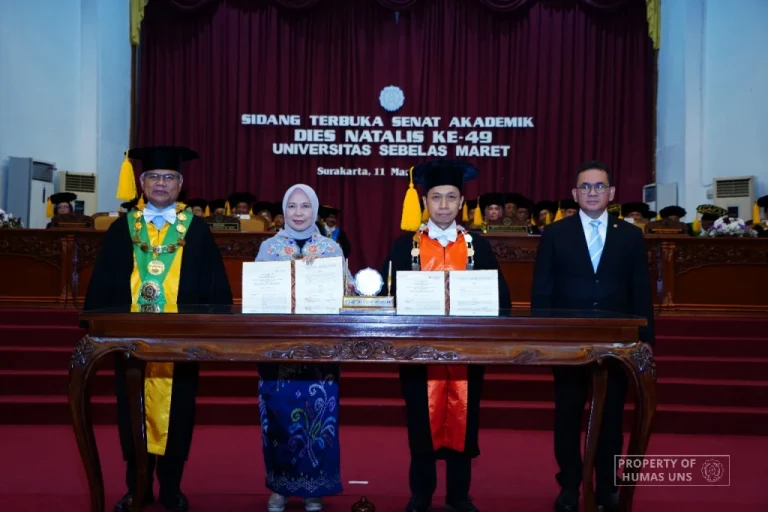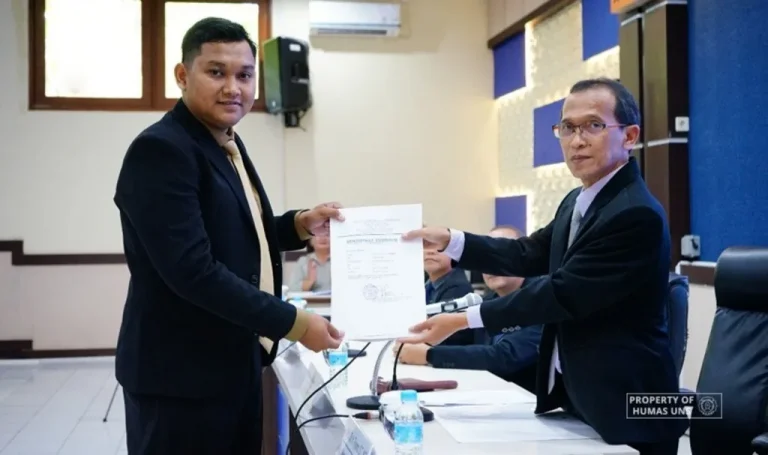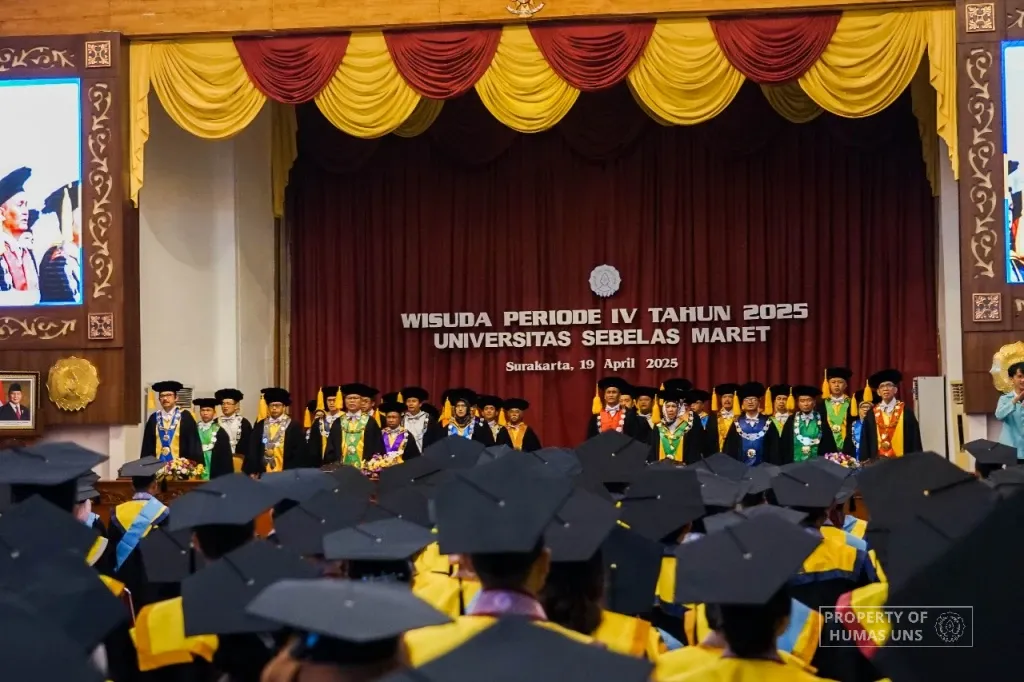
UNS – Universitas Sebelas Maret (UNS) held its 2025 Graduation Ceremony Period IV, awarding degrees to 497 graduates. The event took place in person at the G.P.H. Haryo Mataram Auditorium on Saturday (19/4/2025). UNS also streamed the event live through its official YouTube channel. Among the graduates, 220 earned the cum laude distinction.
Key university officials, including UNS Rector Prof. Dr. Hartono, dr., M.Si., Vice Rectors, and Deans, attended the UNS graduation ceremony. Members of the academic community also took part in the event. Distinguished guests such as representatives from the Board of Trustees (MWA), Academic Senate, and the Professors Council were also present. Dr. Ir. Heru Tjahjono, M.M., a UNS alumnus and member of the Indonesian House of Representatives Commission IX, also attended. He represented the UNS Alumni Advisory Council.
Rector’s Remarks: Embracing Lifelong Learning
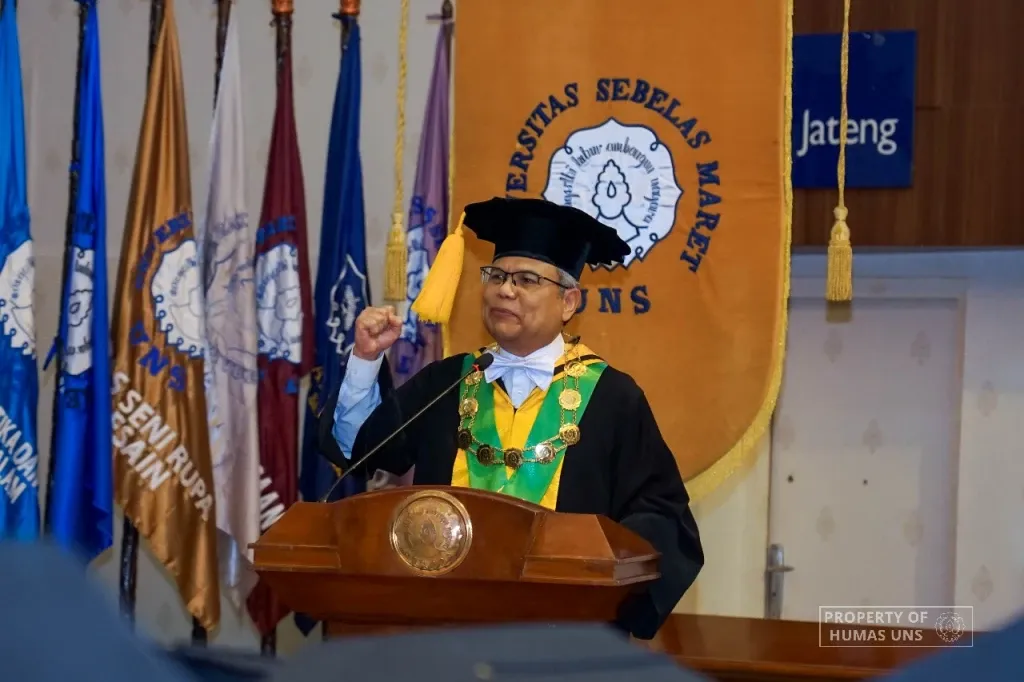
In his address, Prof. Hartono congratulated all graduates and expressed appreciation to their families for their support. He emphasized the importance of lifelong learning and adaptability in an ever-changing global environment.
“Graduation is not the end—it is the beginning of a new journey in the real world,” he said. “Today’s job market is dynamic and highly competitive. It demands graduates who are adaptable, creative, and committed to lifelong learning.”
He encouraged graduates to continuously improve themselves through further studies, professional training, or practical work experience. Prof. Hartono reminded them not to become complacent, but instead to actively refine their skills and expand their professional networks.
Academic Report: Breakdown of Graduates
Vice Rector for Academic and Research Affairs, Prof. Dr. Fitria Rahmawati, S.Si., M.Si., delivered the official graduation report. She revealed that out of 497 graduates, 220 earned the cum laude title.
The graduates came from diverse academic levels, including:
- 21 from the Diploma III program,
- 346 from Bachelor’s programs,
- 10 from the Professional Engineer program,
- 13 from the Specialist Doctor program,
- 2 from the Sub-specialist Doctor program,
- 76 from Master’s programs, and
- 11 from Doctoral programs.
Notably, three graduates were international students from Timor-Leste.
Furthermore, she detailed the number of graduates by faculty:
- Graduate School: 10
- Faculty of Cultural Sciences: 2
- Faculty of Social and Political Sciences: 12
- Faculty of Law: 51
- Faculty of Economics and Business: 28
- Faculty of Medicine: 4
- Faculty of Agriculture: 14
- Faculty of Engineering: 15
- Faculty of Teacher Training and Education: 17
- Faculty of Sports: 8
- Faculty of Mathematics and Natural Sciences: 4
- Faculty of Art and Design: 34
- Faculty of Animal Science: 2
- Vocational School: 19
Graduates with Outstanding Achievements
This graduation period also celebrated outstanding students. In the Doctoral program, Dr. Singgih Dwi Prasetyo from Mechanical Engineering was the fastest and youngest graduate. He completed his degree in 2 years and 5 months at the age of 25 years and 6 months.
From the Master’s program, Isnayni Sabila, M.Ak. (Accounting) completed her studies in just 1 year and 3 months. Meanwhile, Arining Indrasari Ahdi, M.Pd. (English Education) became the youngest graduate at 23 years old.
In the Bachelor’s program, Widya Indriani, S.P. (Agribusiness) was the fastest graduate with a study period of 3 years and 4 months. Nisa Nurlaila Pangesti, S.Ds. (Visual Communication Design) was the youngest at 20 years and 9 months.
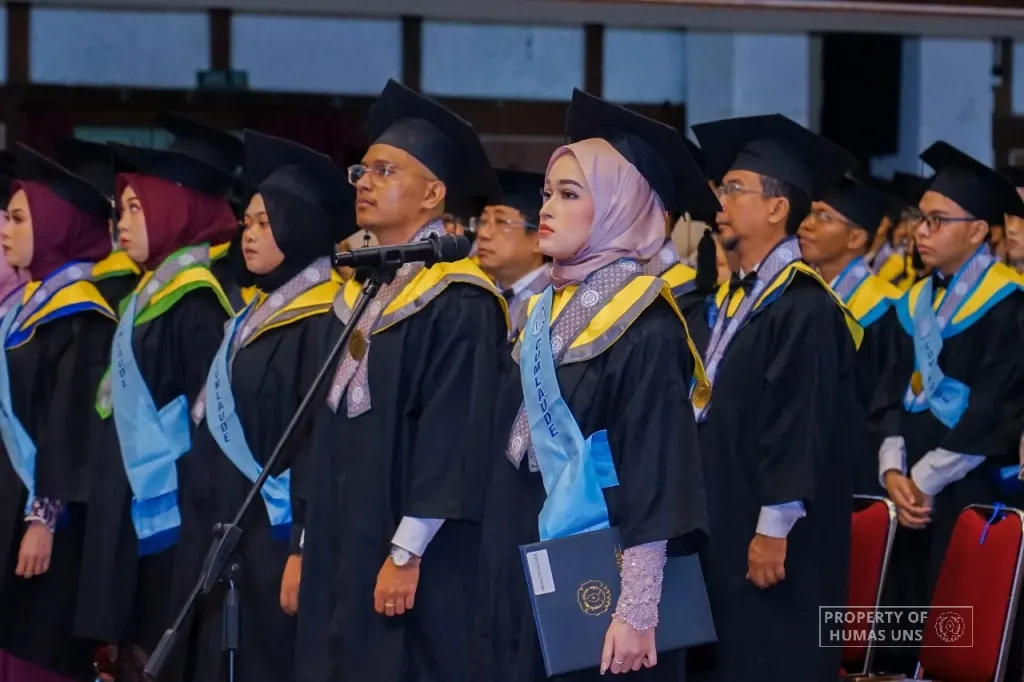
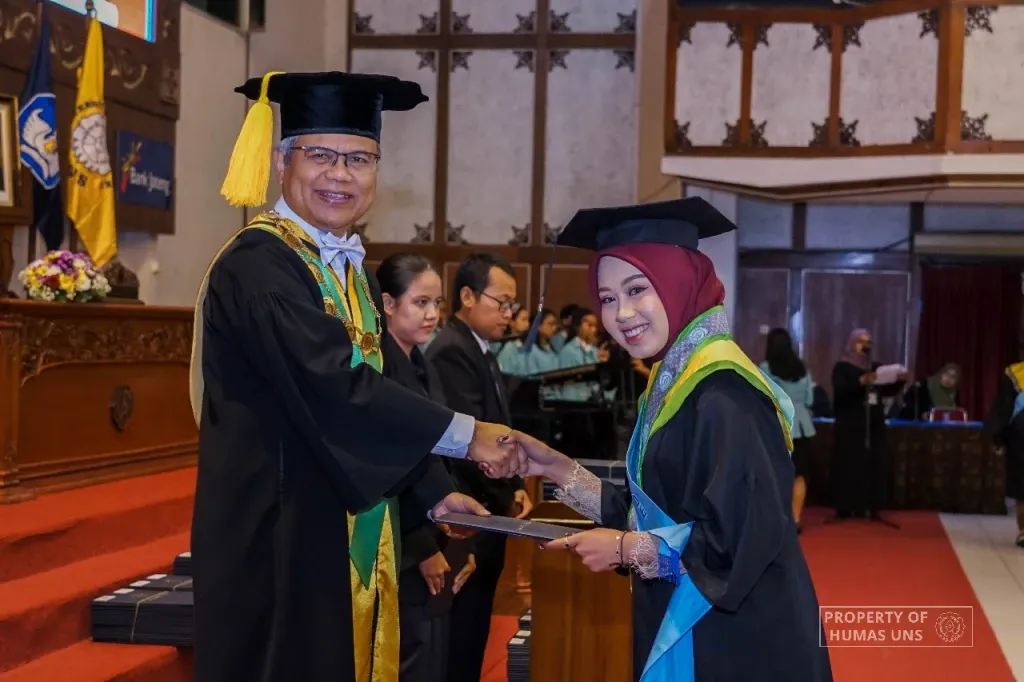
For the Diploma III program, Mutiara Anugerah Safitri, A.Md. (Agricultural Product Technology) graduated in 2 years and 10 months. Safira Chairunissa, A.Md. (Agribusiness) was the youngest graduate at 21 years and 1 month.
Alumni Insights from Dr. Heru Tjahjono
UNS alumnus Dr. Ir. Heru Tjahjono, M.M., praised the university’s contributions to national development. He noted that UNS alumni have served the country in key roles. These roles range from ministers and parliament members to governors and mayors.
He also reminded graduates to be wise in utilizing today’s abundant information access. “While AI is becoming more common, LMK—Leadership, Marketing, and Communication—can still surpass it,” he said. “Start by being leaders in your immediate environment. Continue to develop your hard and soft skills, and always enhance your competencies.”
Humas UNS