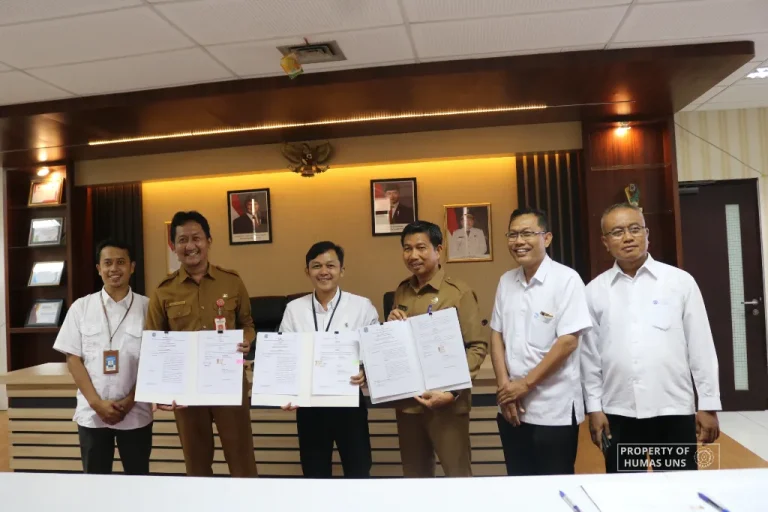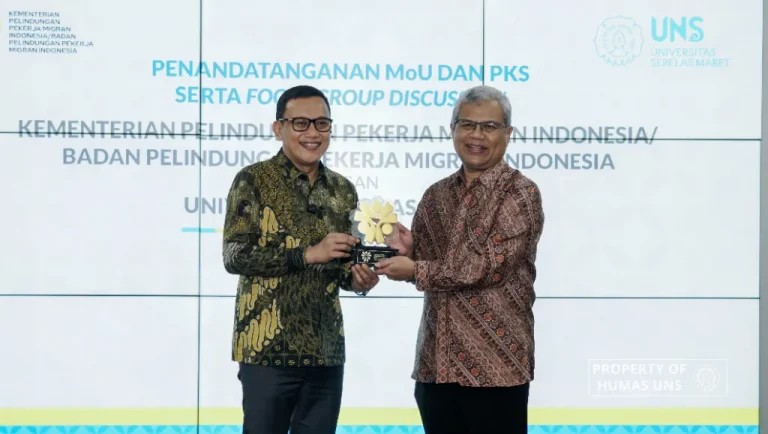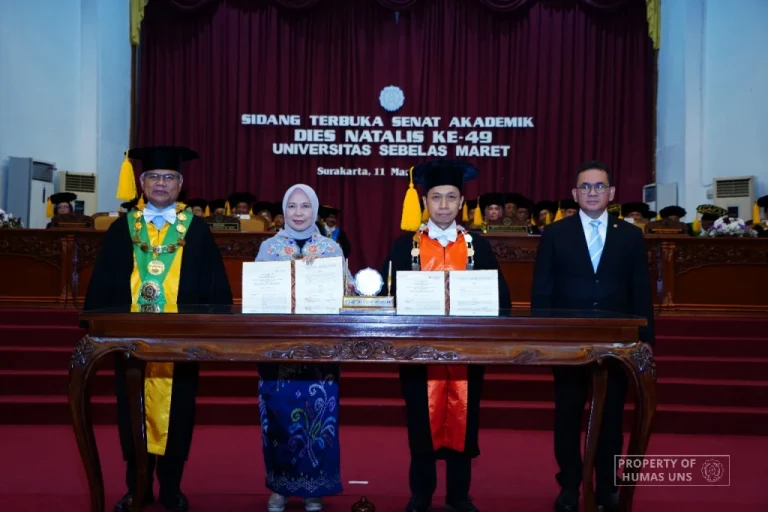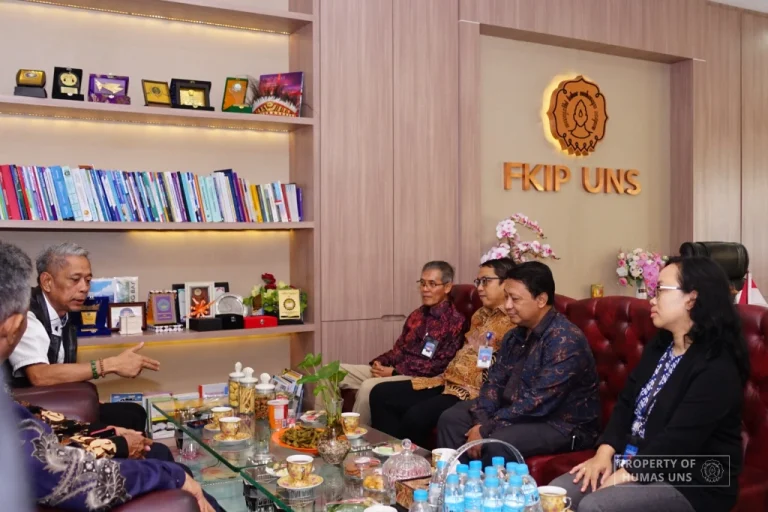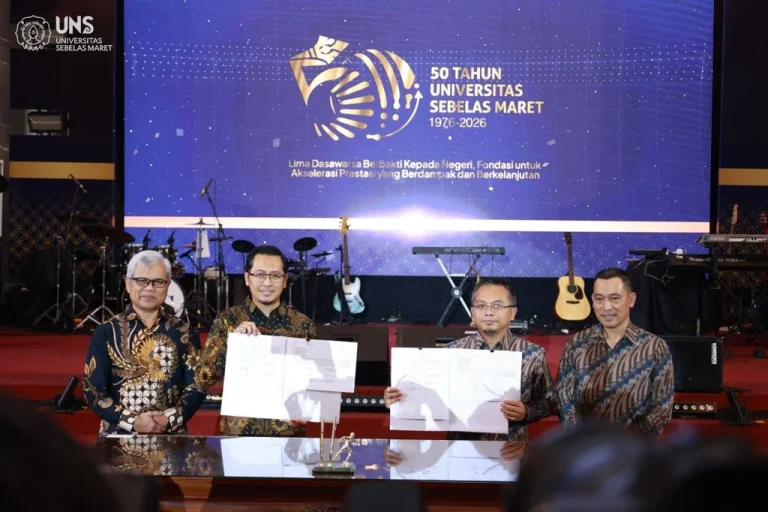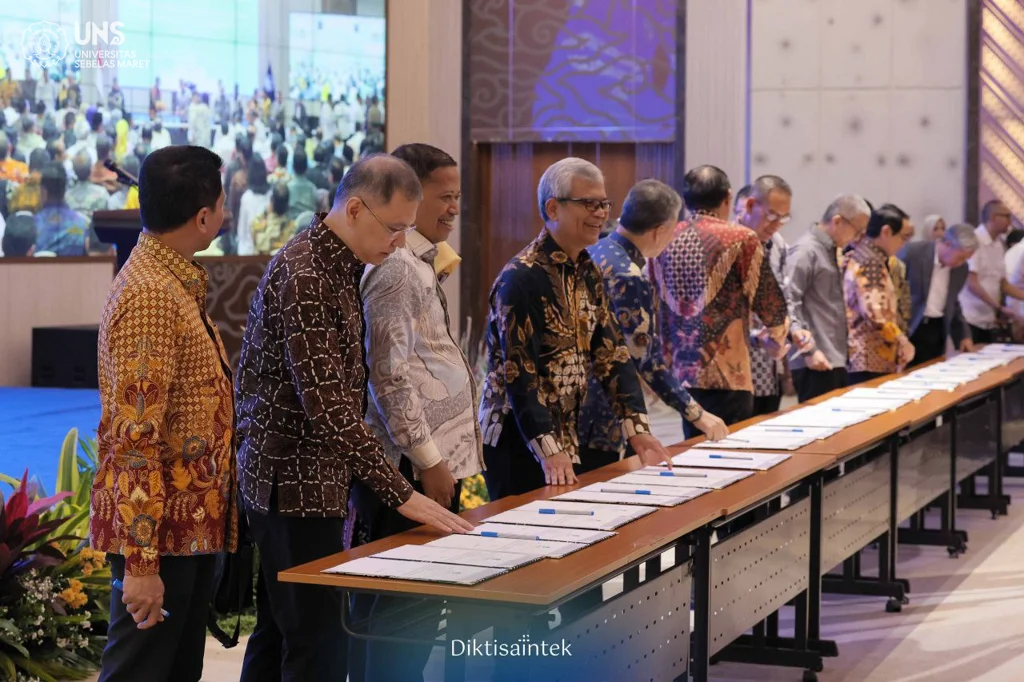
UNS — Universitas Sebelas Maret (UNS) Surakarta, together with leaders of public and private universities across Indonesia, signed the 2026 Performance Contract for Impactful Higher Education Institutions. This signing marks a strategic step in aligning university governance with the national development vision toward Golden Indonesia 2045.
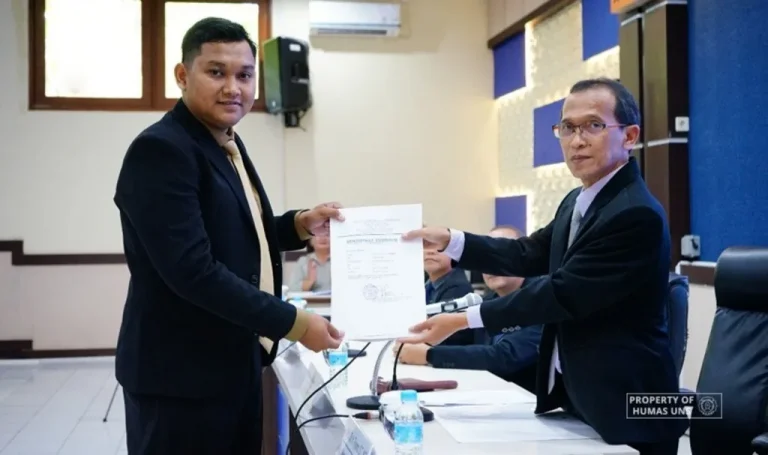
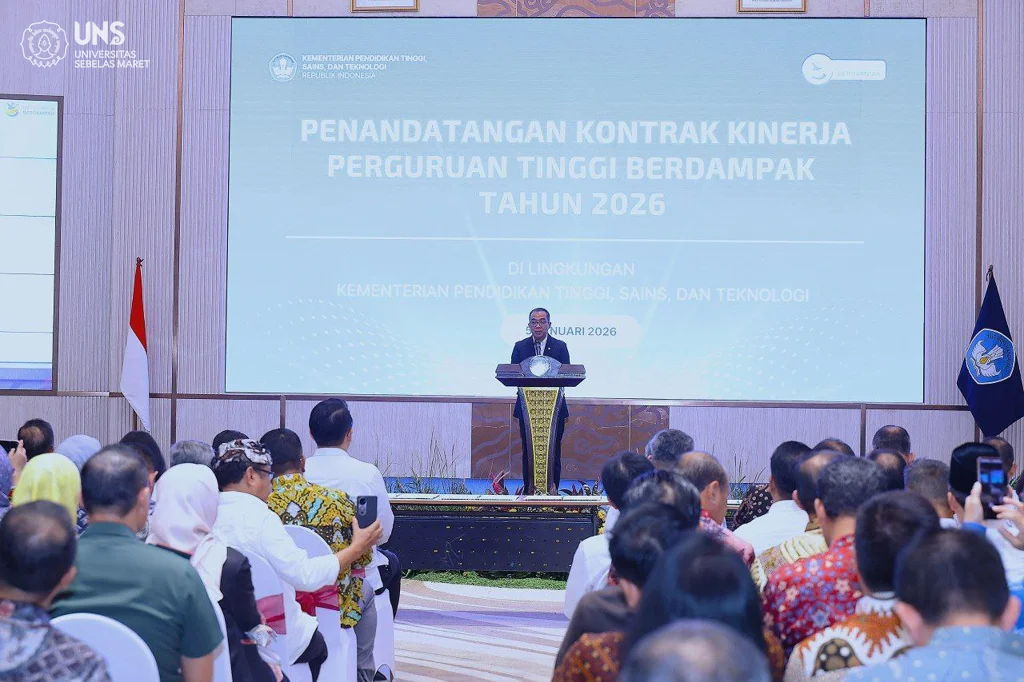
The performance contract signing was held on Monday (5/1/2026) and was directly witnessed by the Minister of Higher Education, Science, and Technology, Prof. Brian Yuliarto. The event reaffirmed the shared commitment of university leaders to deliver higher education that is not only academically excellent, but also creates real impact for society, industry, and national development.
In his remarks, Prof. Brian Yuliarto emphasized the strategic role of universities as the main drivers of innovation and national progress. According to him, higher education institutions must be able to create new breakthroughs, strengthen national industries, and accelerate the downstream application of research so that it can be widely utilized by society.
“We each have our own role in working harder to create new breakthroughs, revive advanced industries, and carry out research downstreaming. Through togetherness, we can form one national orchestra that complements one another and creates real impact for society,” said Prof. Brian Yuliarto, as quoted from kemdiktisaintek.go.id.
He also stated that Indonesia has great strategic strength through the Human Resources (HR) available on campuses. This potential must be managed consistently and with integrity to produce excellent human resources, strong research, and innovation downstreaming that supports national economic growth.
In his direction, Prof. Brian Yuliarto also emphasized that universities must continue making breakthroughs, maintaining the quality of education, and strengthening the role of lecturers as the front line in preparing future talents. Improving lecturers’ welfare, including through research incentives and strengthening the research ecosystem, is also part of the government’s focus.
“Indonesia has more than 4,400 higher education institutions, more than 300,000 lecturers, and nearly 10 million students. The economic, social, and environmental impact during the process is significant. We hope this impact can continue to grow and create a multiplier effect,” he added.
As part of strengthening research, the Ministry encourages the use of fairer research funding schemes, including a policy allowing researcher honorariums of up to 25% of research grant funds sourced from the State Budget through the Ministry’s DIPA. This policy is expected to make research more productive and impactful. Prof. Brian Yuliarto also asked universities to ensure that their research addresses real problems and contributes to the revival of science- and technology-based industries.
The performance contract includes commitments from universities to improve the quality of the tridharma of higher education, strengthen research and innovation, and support national development. The contract and policy directions will serve as the foundation for implementing strategic programs in each university.
Through this contract and policy direction, the Ministry reaffirmed its commitment to continuously support the transformation of higher education that is inclusive, adaptive, and impactful. Synergy between the government, public and private universities, and industry partners is expected to become a strong foundation for achieving Golden Indonesia 2045.
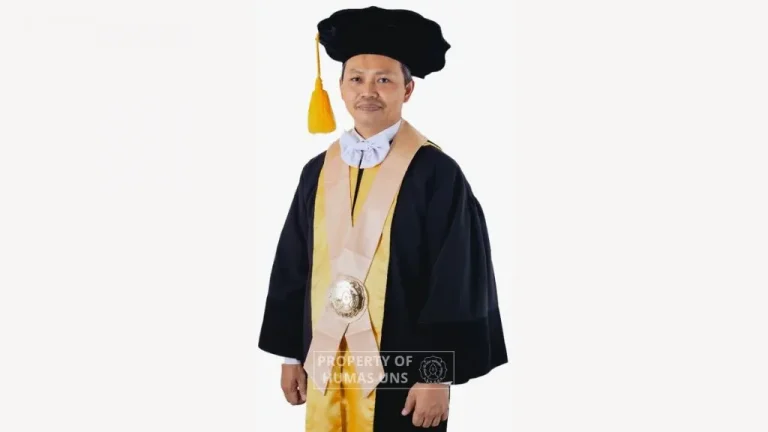
UNS Rector, Prof. Dr. Hartono, stated that UNS’s participation in signing the 2026 Performance Contract for Impactful Higher Education Institutions reflects the university’s commitment to strengthening the implementation of the Impactful Campus Program.
Through this program, UNS continues to encourage the integration of the tridharma of higher education—education, research, and community service—to produce concrete solutions to various social, economic, and environmental challenges.
As a university that is oriented toward sustainability and innovation, UNS is committed to improving the quality of graduates who are adaptive and globally competitive, strengthening research that responds to the needs of society and industry, and expanding collaboration with various stakeholders.
“This effort is expected to strengthen UNS’s contribution in supporting the achievement of national development targets toward Golden Indonesia 2045,” explained Prof. Hartono.
HUMAS UNS