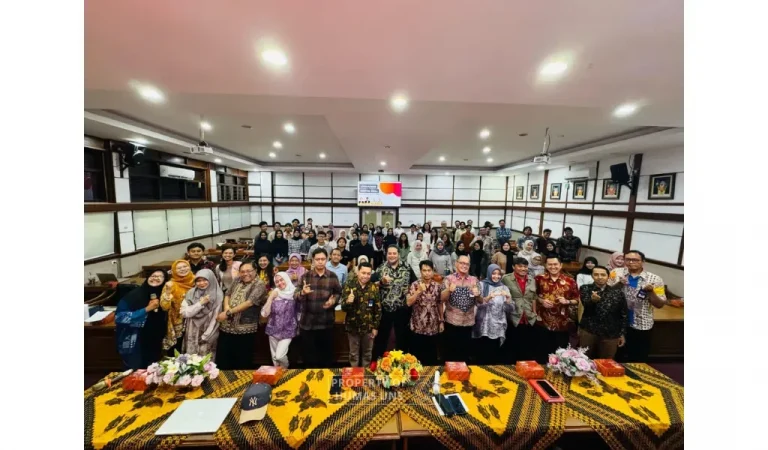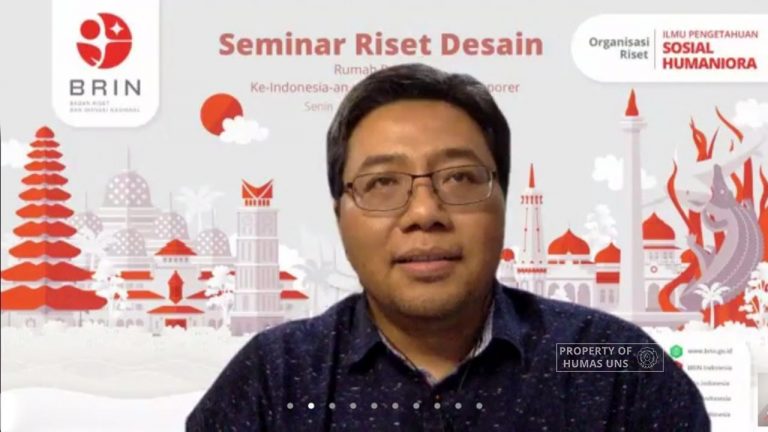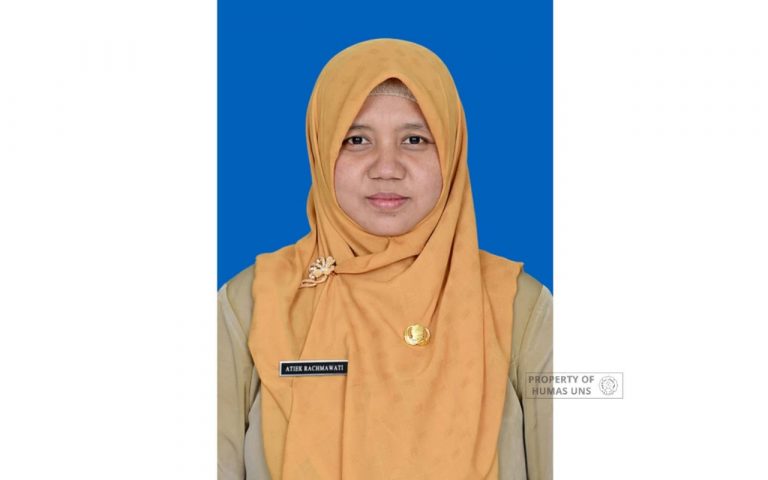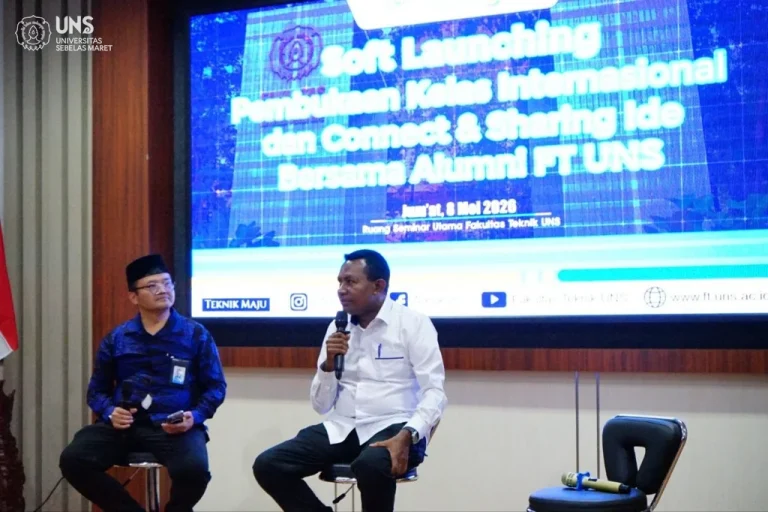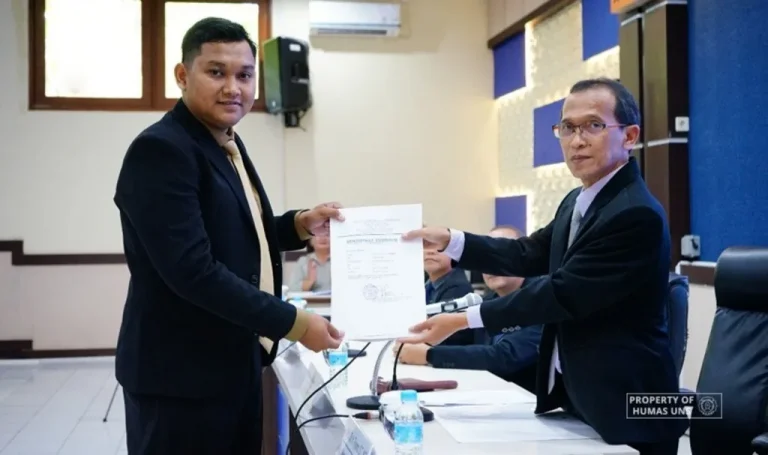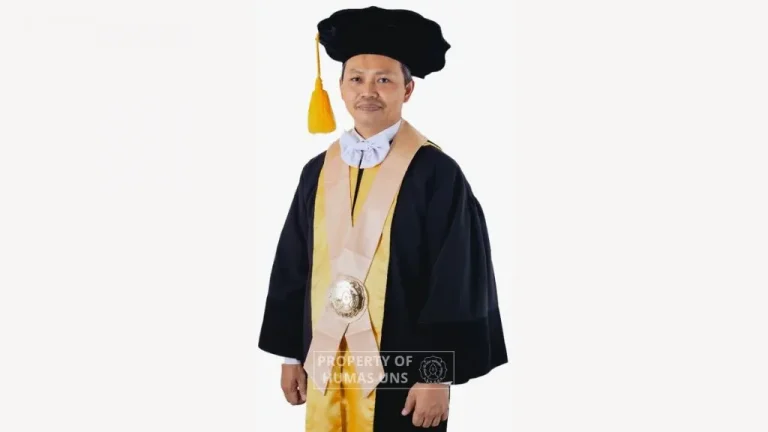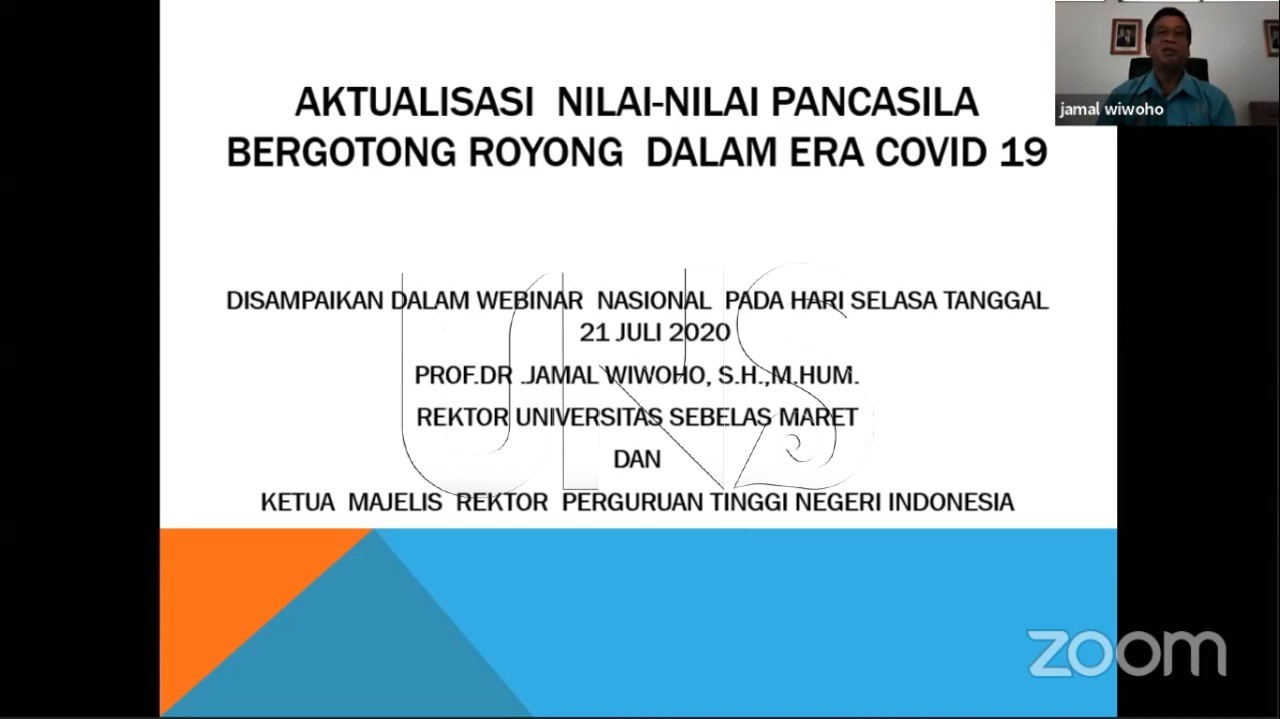
UNS – Institute of Educational Quality Assurance and Development (LPPMP) Universitas Sebelas Maret (UNS) Surakarta held a national webinar on Actualizing the Values of Pancasila amid Covid-19 Pandemic. The event was held online through Zoom Meeting application and YouTube live stream on Tuesday (21/7/2020). LPPMP UNS invited four speakers, the Rector of UNS, Prof. Jamal Wiwoho, the Chief Deputy of Research and Material Pancasila Ideology Development Board (BPIP), Prof. F.X. Adji Samekto, UNS Coordinator of Pancasila Education, Prof. Hassan Suroyono, and Vice-Dean for Academic Affairs Faculty of Law (FH) UNS, Prof. Pujiyono.
In his material, Prof. Jamal Wiwoho highlighted the importance of gotong royong (mutual cooperation) as contained in Pancasila. In the national and state life, the values of Pancasila can be actualized in subjectively and objectively. Subjectively means it is aimed for all Indonesia people, thus each person is capable of applying the values contained in Pancasila. As for objectively, it means that the implementation is conducted in the state administration president, governor, regent, and all components who hold the responsibility to run state administration.
Prof. F.X. Adji Samekto also conveyed that values are an abstract concept which determines what is considered good and bad. Values are objective for one person to another and are developed from relationships between people, the environment, and society. The values in Pacasila were developed from the relations of the Indonesian people with other nations and the motherland. These relations form values on how to protect their environment and maintain the ecosystem.
Pancasila is used as a cornerstone in implementing development which contains four main pillars of development, political sovereignty, economic independence, maintain cultural personality, and implement gotong royong (mutual cooperation). To solve poverty that might occur as an impact of the pandemic, fulfilling basic needs, and maintain food resilience are the strategic concepts that are considered plausible. There are several requirements in maintaining food resilience such as agrarian reform, securing people access to foods, sustainable use of natural resources, manage food monetization by a corporation, limit food commodification, and democratization of agricultural policy formulation.
Prof. Pujiyono and Dr. Hasan Suryono also discussed the implementation of Pancasila in solving pandemic related problems. There are ten regulations issued by the government to handle the spread of Coronavirus. One of these regulations is Presidential Decree Number 11 of 2020 concerning Establishing Public Health Emergency, which substantially has reflected the values in Pancasila. However, close cooperation among the national, provincial, district and municipal governments are needed to implement one of Pancasila value, cooperation, and helpfulness. Humas UNS
Reporter: Bayu Aji Prasetya
Editor: Dwi Hastuti