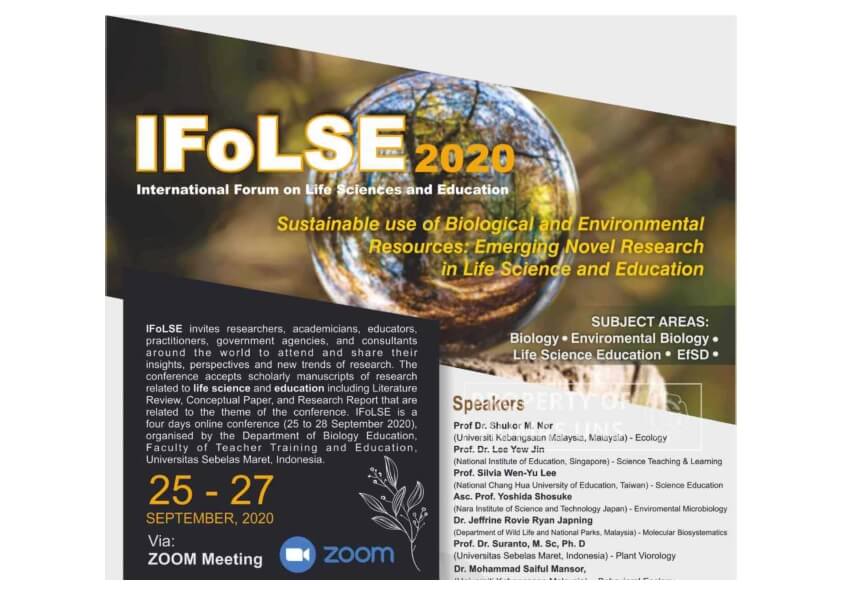
UNS — The advancement in science and technology has a great impact in various fields, including in science and education. Responding to this problem, the Biology Education Program Faculty of Teacher Training and Education (FKIP) Universitas Sebelas Maret (UNS) Surakarta held an online international conference on Sustainable use of Biological and Environmental Resources: Emerging Novel Research in Life Science and Education (IFoLSE) as a means for researchers, academicians, and practitioners to exchange information on research, ideas, and its application.
The Chief Organizer of IFoLSE, Puguh Karyanto, Ph.D., stated that this international forum will run for three days, from 25 to 27 September 2020. The international conference will have several agenda, the main session with 8 keynote speakers from Japan, Taiwan, Singapore, Malaysia, and Indonesia with expertise in science and learning. Followed by symposium and workshop and parallel session. The topics discussed in this scientific forum are, among others, conservation of genetics and biosystematics, animal and plant anatomy and physiology, horticulture and tissue culture, genetic engineering, learning and teaching biology, education for sustainable development, and other related topics,” he explained on Wednesday (23/9/2020).
The eight keynote speakers are Prof. Shukor Md. Nor from Universiti Kebangsaan Malaysia, Malaysia, Prof. Silvia Wen-Yu Lee from National Taiwan Normal University, Taiwan, Prof. Lee Yew Jin from National Institute of Education, Singapore, Prof. Suranto from UNS, Assoc. Prof. Yoshida Sosuke from Nara Institute of Science and Technology, Jepang, Dr. Jeffrine Rovie Ryan Japning from Department of Wild Life and National Parks, Malaysia, Dr. Mohammad Saiful Mansor from Universiti Kebangsaan Malaysia, and Murni Ramli, Ed.D from UNS.
Puguh further explained that through Higher Education Tri Dharma, universities have an important contribution in realizing environmentally sustainable development. Universities are the supplier for innovative products that can provide a strategic solution in the causal chain and the result chain to answer the sustainable challenge in the development. “The main objective of scientific progress is the improvement in the quality of life. It is important to understand the novelty of the research, especially in the utilization of biological and environmental resources for the advancement of science and education. Various problems faced today, one of which is that inaccurate environmental management will have an impact on human development in the present and the future,” he added.
Various scientific studies are required to solve problems in ecology, environment, and life science, and education field is expected to take a role in this effort through life science learning. Besides the keynote speakers, other scientific ideas will also be presented by participants from Indonesia and Malaysia in a panel session discussion. The outcome of this international conference is to provide a scientific contribution to the efforts to achieve environmentally sustainable. Humas UNS
Reporter: Bayu Aji Prasetya
Editor: Dwi Hastuti