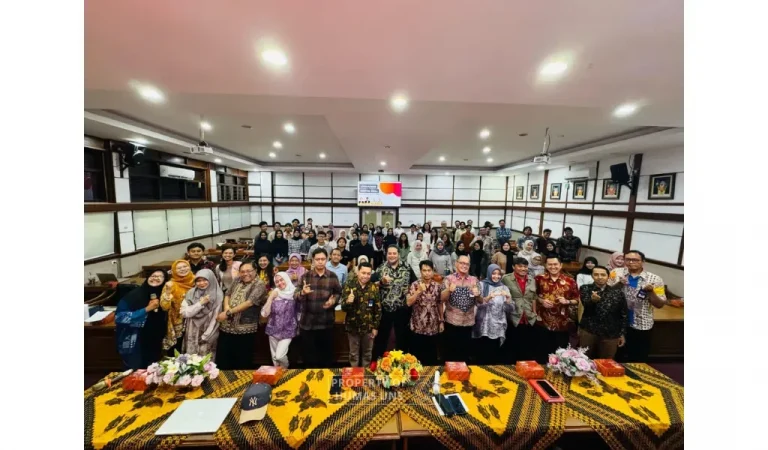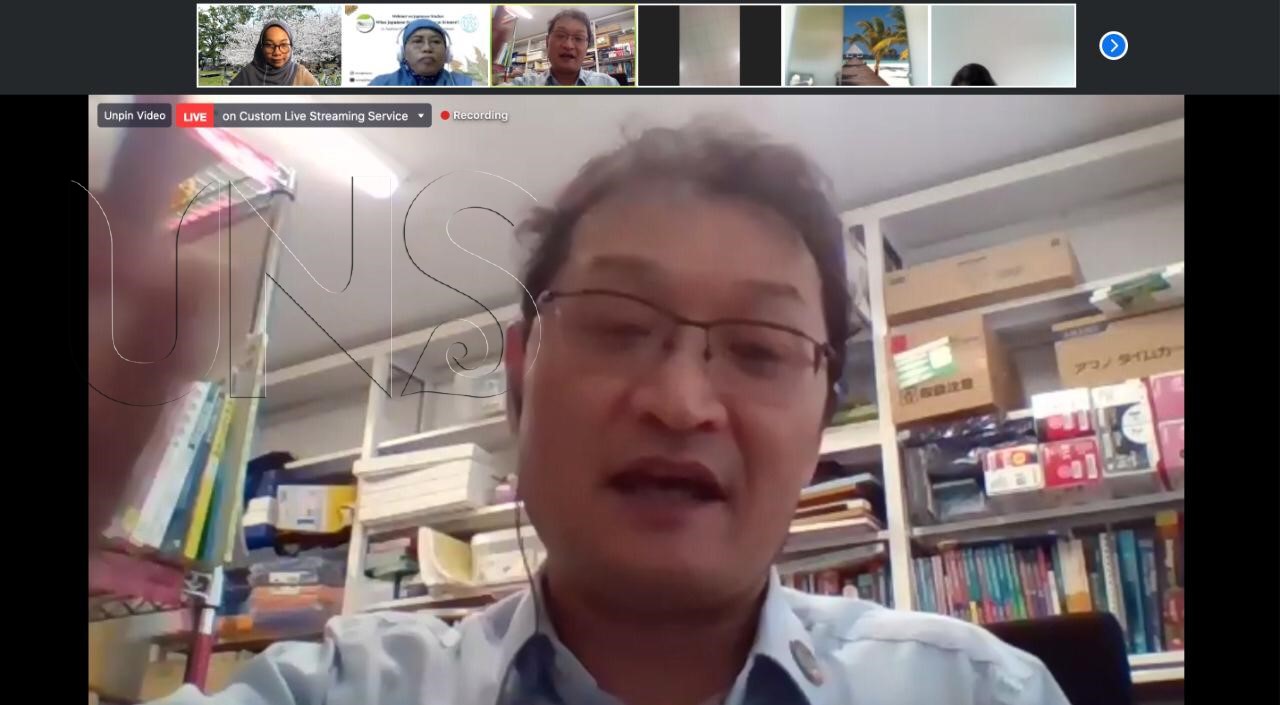
UNS – The Faculty of Teacher Training and Education (FKIP) Universitas Sebelas Maret (UNS) Surakarta, and the Center for Japanese Studies (PSJ) LPPM UNS, in collaboration with the Association of Biological Educators and Researchers Indonesia (HPPBI) and Alumni Association of Japan (PERSADA) Solo Branch Office, held a webinar on “What Japanese Students Learn in Science? An Analysis of Science Curriculum and Textbooks” on Tuesday (30/6/2020) through Zoom Meeting and YouTube Live Streaming from the Biology Education Study Program FKIP UNS Official Channel.
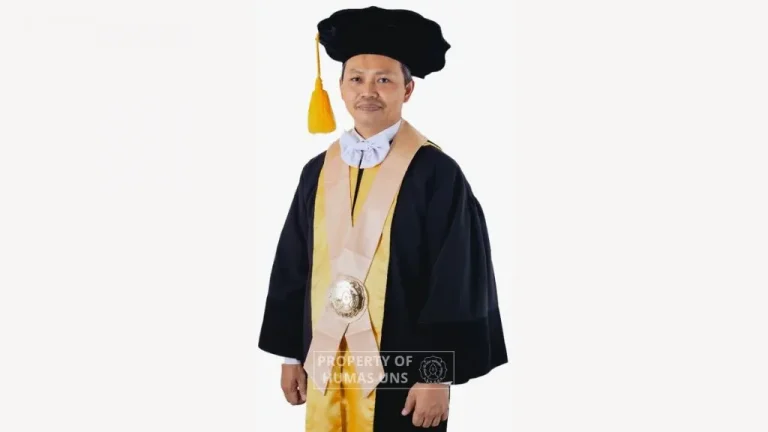
The webinar was opened by Dr. Eng Kusumaningdyah N.H, ST, MT., as the Head of PSJ, who also introduce the PSJ LPPM UNS profile. Acting as the discussion moderator Murni Ramli, Ed.D (Head of Biology Education RG – FKIP UNS), presenting Prof. Kiyoyuki Ohshika form the Department of Natural Sciences, Aichi University of Education, Japan as the speaker. This webinar was attended by more than 100 participants, including participants from Thailand, Dr. Patcharee Wichaidit along with their students. The webinar was presented in three languages, English, Japan, and Indonesia.
Prof. Ohshika explains that it is important to design education for future needs, this is why the curriculum in Japan is known as ‘Gakushuushidouryouyou’, which means that the Course of Study in Japan is designed for future needs. The newest curriculum in Japan is designed by considering three important points, namely key competencies, active learning, and curriculum management at the school level, while the previous curriculum was more focused on the content of each subject. “There are three focal points in the learning activity, first is what the students can do, second is what they learn, and third is how the students should learn,” explain Prof. Ohshika in English and Japanese, which then translated by the moderator.
In Japan, the basic idea of the new curriculum is to improve the quality and ability of students to be able to live and socialize with the community. Therefore, to realize this learning activity is strengthened with deep learning and active learning. In Deep Learning there are three focus key points namely deep learning, interactive learning, and subjective learning.
An interesting point discussed in this webinar is related to how is the process to learn science by applying the scientific inquiry process that is not only applied in the classroom, but also in science textbooks. In the science textbook, the stages of the inquiry process are mentioned and explained through simple text and figures, thus students and teachers find it easier to apply the inquiry process. Related to the inquiry process in science learning, there is an emphasis on different abilities or skills at each level. Similarly, the content in each subject matter.
The Government of Japan also includes Sustainable Development Goals (SDGs) in the school curriculum. Schools are given the freedom to design the application of SDGs at each grade level. SDGs issues are accommodated, thus the students in Japan can better understand the advantage of learning science for their daily lives, thus they are motivated to learn science.
This webinar is expected to provide an overview of curriculum and science textbooks in Japan, how is the teaching and learning process carried outs in class, which can be quite rarely found in news or scientific articles. Humas UNS/Zalfaa