UNS — To commemorate National Food Resilience Day on Friday (16/10/2020), the Faculty of Agriculture (FP) Universitas Sebelas Maret (UNS) Surakarta held a webinar on “Achieving Sustainable Food Security to Achieve Zero Hunger 2030” through Zoom Clouds Meeting.
The Head of Agriculture, Food, and Fishery Department District of Karangayar, Ir. Siti Maisyaroch, attended the event to represent the Regent of Karanganyar Drs. H. Juliyatmono, M.M to deliver material on Karanganyar District readiness as a pilot region for national food resilience. To date, one of the efforts taken by Karanganyar District to achieve food resiliency is the implementation of the agricultural corporate system. Collaboration is established to provide benefits for farmers from the upstream to the downstream through the collaboration with firms.
Mapping to maximize regional potential will be implemented by Karanganyar District such as Kebakkramat Sub-District which is designated as the center for seedlings, Tasikmadu Sub-District as the center for production, and Karanganyar Sub-District as the center for production and marketing. Additionally, Karanganyar District Government also invited the young generation, especially in the field of agriculture or the millennials farmer to develop business in this sector.
“If we do not embrace the young generation, it is possible that in the future there is nobody who continues it,” Siti stated.
The young generation has a great role in providing idea and innovation for the development of business in this sector. Several agricultural products from Karanganyar has been marketed well and entered the modern market. These products are Nasi Sehat (healthy rice) packed per kilogram with interesting packaging, Nasi Bumbu Liwet (steam rice seasoning) which ease the cooking process, and instant jamu (Javanese herbs beverages). The Women Farmers Group (Kelompok Wanita Tani) in Bumi Intapari also took a role in preparing food resilience from the smallest unit in the community by plating comestibles such as chili, tomato, and chayote in their yard.
An appreciation was conveyed by the Director of Processing and Marketing of Food Crops Products (Pengolahan dan Pemasaran Hasil Tanaman Pangan – PPHTP) Ministry of Agriculture, Ir. Gatut Sumbogodjati, M.M for Karanganyar District Government’s efforts. Further, on this occasion, Gatut shared the information on government policy in achieving national food security. In 2020 – 2021, the government aims to promote “Local Foods Diversification Movement” by setting a day without consuming rice and its derivative products. This is the government’s effort to introduce the alternatives to the community that they can be full without rice.
Strategic action is also prepared by the government to support the national agricultural and food sector. The actions can be categorized into three stages, production, post-harvest, storage and management, and last stage of marketing. The production stage includes increasing productivity, using superior and high-quality seeds, utilizing cultivation technology, and increase agricultural areas. At the second stage, the strategy used is to use post-harvest technology, production efficiency, and involving large industries and MSMEs. Lastly, in the marketing stage, the government creates local and national markets through promotion, campaign, and education for the community.
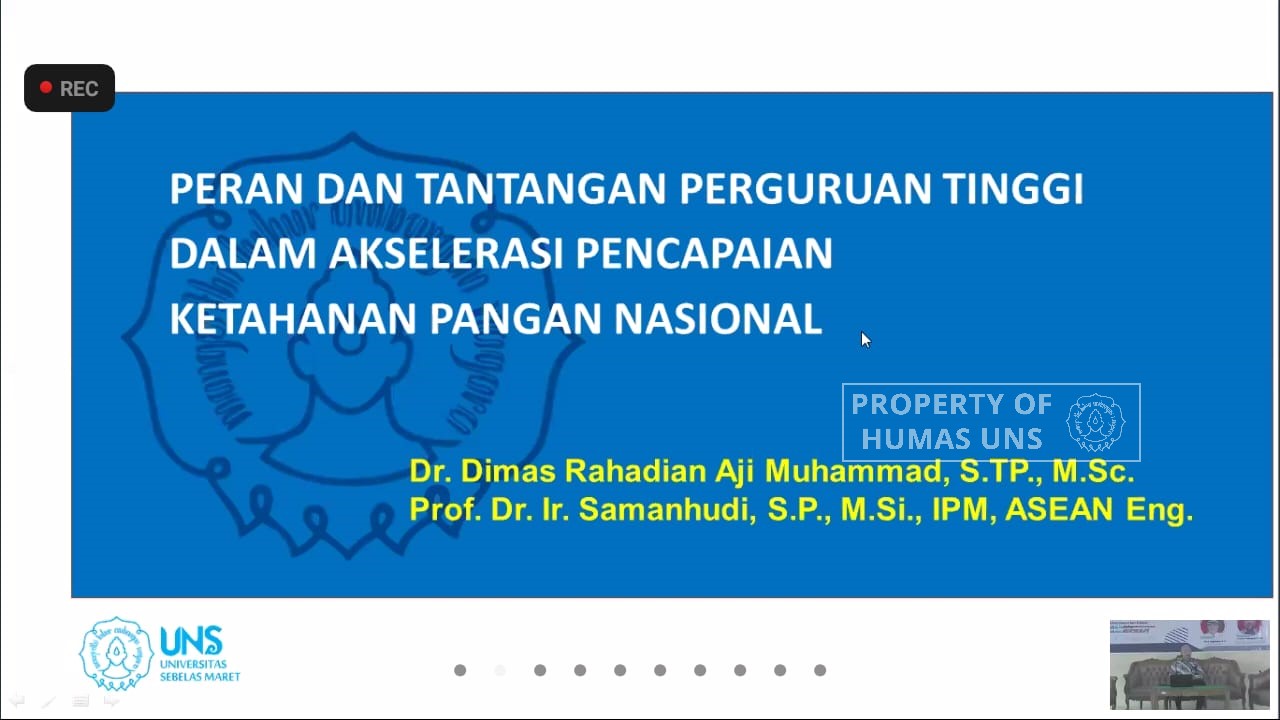
The implementation of these stages must be balanced with understanding the challenges that will be experienced. Academia point of view is required to provide an outlook in preparing national food resilience. Prof. Dr. Ir. Samanhudi, S.P., M.Si., IPM, ASEAN Eng., attended the event to discuss the three current issues in national food resilience. The three issues are people dependence on rice, Covid-19 that affect the food supply chain and warning from the Food and Agriculture Organization (FAO). These three issues indicate that currently, Indonesia should be able to fulfill its demands through food independence. The Dean of FP UNS explained that there four stages in the development of food resilience, data collection, increase in production, strengthening food reserves, and the last stage is product development and trade management. This process involves diverse components to apply it.
“Contribution from various parties, especially higher education to shape the young generation who can contribute to the agricultural sector,” Prof. Samanhudi stated.
The solution that can be implemented by the community is to encourage the use of yard as green space and to plant tubers such as cassava, sweet potato, talas, and other plants. The urban population with limited lands is also expected to implement “Urban Farming” as an alternative solution in food availability. In particular, higher education also can contribute by conducting food-independent village and food barn. HUMAS UNS
Reporter: Ratri Hapsari
Editor: Dwi Hastuti