UNS — The Faculty of Agriculture (FP) Universitas Sebelas Maret (UNS) Surakarta held a Webinar of Community Service to Commemorate UNS 45th Anniversary. In this second series, the webinar discussed “Decorative Plants and Horticulture Farming”. More than 150 participants attended it through Zoom Cloud Meeting and FP UNS Official YouTube Channel Live Stream. Participants learned how to grow Caladium, decorative plants business management, and the opportunity of horticulture farming in the webinar held on Wednesday (21/4/2021).
Ida Rumia Manurung, S.P., M.Agr., acted as the webinar’s moderator with UNS agrotechnology and agribusiness experts such as Dr. Ir. Eddy Triharyanto, M.P. and Dr. Ir. Joko Sutrisno, M.P., and Ghomsony from PT. Hibrida Jaya Utama as speakers. The Dean of FP UNS, Prof. Dr. Ir. Samanhudi, S.P., M.Si., IPM, ASEAN Eng., in his opening remark, mentioned that decorative plants are vital and exciting commodities.
The current trend of decorative plant cultivation in the community that grew since the beginning of the pandemic opened more opportunities for business in this field. After finding their outdoor activities limited by various health policies, people started to shift their interest to grow decorative plants. Prof. Samanhudi hopes that this event benefits people even though it is delivered online. “We continue to share materials that benefit the community as a contribution from the Faculty of Agriculture UNS for the people, around the campus in the particular and wider community in general, hopefully (they can) feel the benefit later,” Prof. Samanhudi hopes.
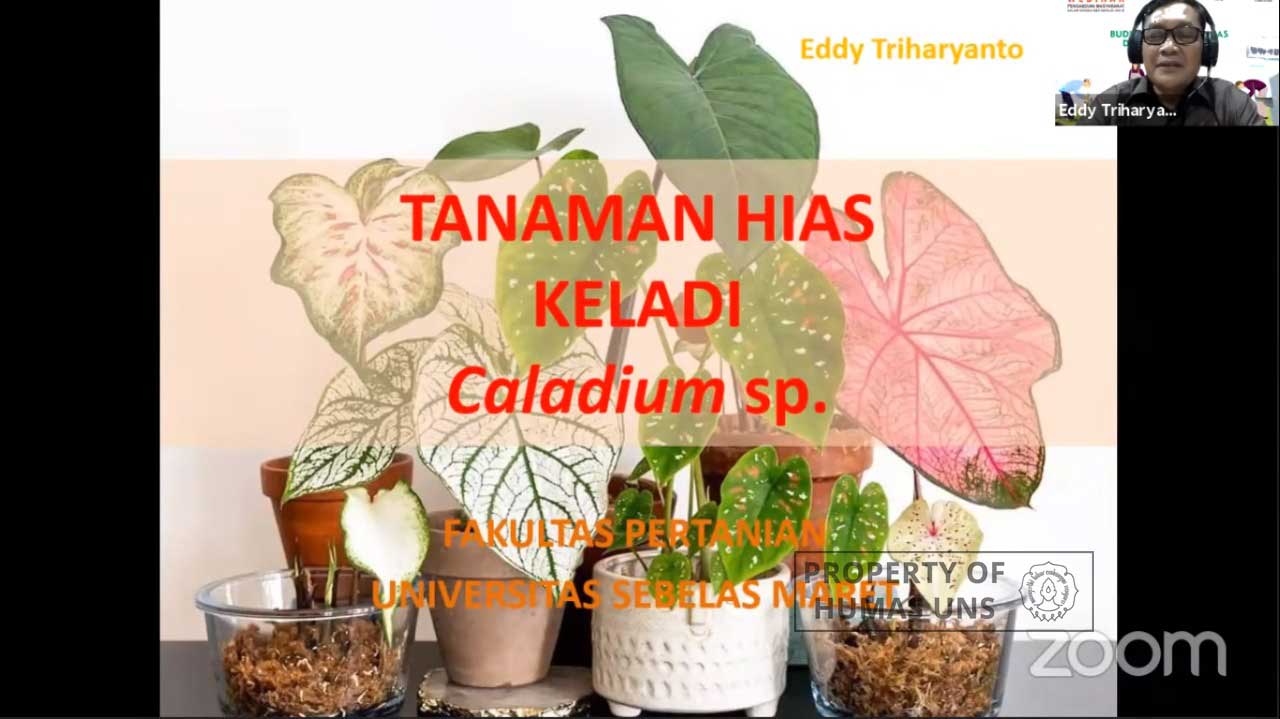
Caladium Cultivation
In general, decorative plants are often used as a business opportunity besides as a hobby. It is widely known that Indonesia has a rich biodiversity. As a speaker, Dr. Eddy stated that around 15.5% of global plants exist in Indonesia. This condition supports the utilization of biodiversity in various fields, including creating a new variant through hybridization, crossbreeding, and variegation. In terms of market opportunity, Dr. Eddy mentioned that there are national and global market opportunities. Nationally, tropical climate makes Indonesian see green plants all year long and the increase in people income can play a multiplier effect in this business. The market is further supported by the growth in the property business, decorative plant rental, and city park construction. In the global market, the demand is also increasing recently.
Caladium has two types, wild and hybrid types, with the hybrid more often cultivated. Caladium is described as a non-stemmed plant that only forms midrib or petiole, has leaves of varying shapes, grooved leaf base, and varying colors. This plant needs low needs of lights which makes it suitable for indoor plants. Caladium grows well in the mix of husks, organic fertilizer, and bamboo leaves with a 1:1:1 ratio. Caladium can be cultivated using the vegetative method (budding and tuber mutilation) or generative method.
Caladium requires caution in its maintenance. “Don’t let any stalk broken. In the windy season, if you have any broken stalk, it will cause early death. Thus, you need to make an effort to strengthen its stalks,” Dr. Eddy explained. Re-potting the plant needs to consider the size, shape, and observation of pests and diseases. Several types of hybrid Caladium are currently famous among the community, such as Keladi Barret, Aisyah Petite, Corak Tentara, Corak Dekoratif, Keladi Bawang, Fall in Love, Lidah Gajah, Double Black, and many more.
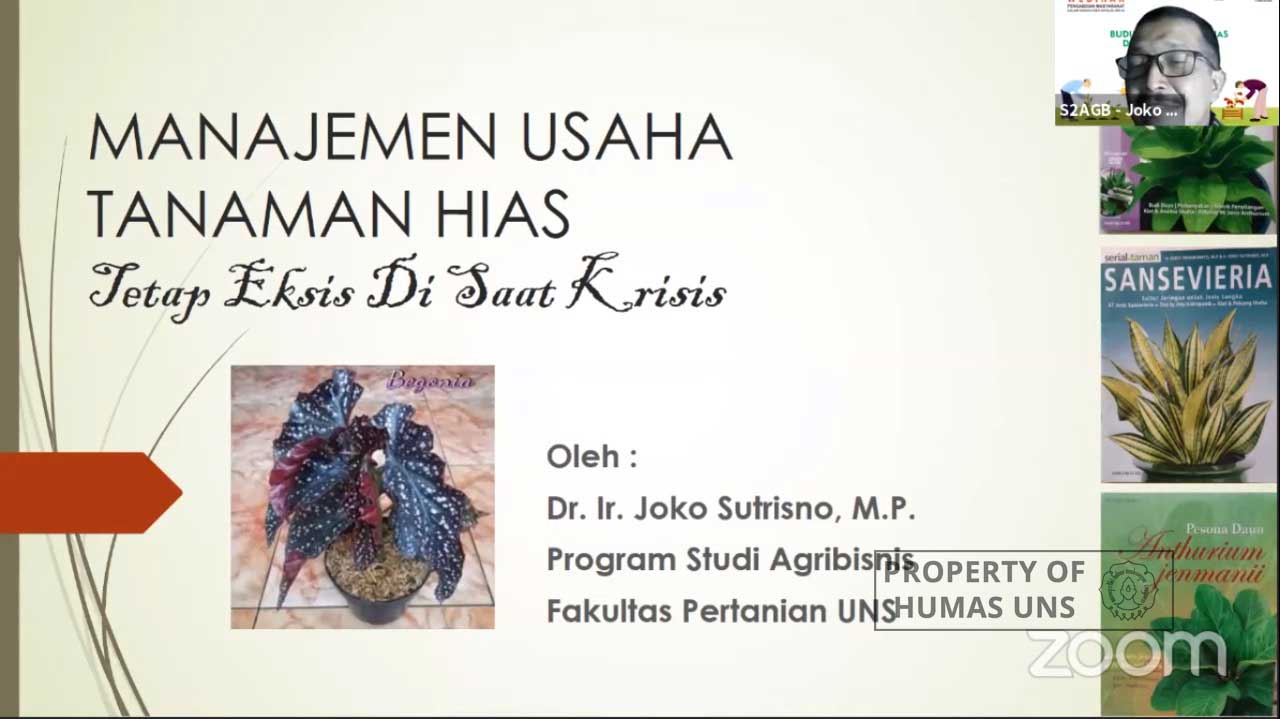
Decorative Plants Business Management
Decorative plant businesses continue to grow amid the pandemic. In his material, Dr. Joko Sutrisno explained that this business growth is likely caused by ornamental plant’s values for people, as their aesthetics and exotic sides are invaluable. Boredom from the limited outdoor activities amid the pandemic also encourages people to start cultivating decorative plants. The current trend has caused ornamental plants price to spike up, something that decorative plant entrepreneurs need to comprehend.
To further understand the opportunity served by the decorative plants business, Dr. Joko Sutrisno divided the plants into two categories, based on their aesthetics and exotic values. Each type has its garden landscape plants, indoor plants, outdoor plants, and plants that do not fall into three categories. “Going into the business, like it or not, someone needs to understand the characters of these plants, do they belong in the indoor or outdoor. Lack of understanding might cause you some loss in managing your business,” Dr. Joko explained.
The business itself has various sub-sectors such as production facilities business to support the maintenance of decorative plants, including pots, cultivating media, rack, and other tools. The seedler sector produces seeds and seedlings, the grower sector that raises plants and plant rental. The last and rarest sector in the business is the breeder sector which develops new variants from the existing decorative plants.
To run a decorative plant business, someone also needs to consider the conventionality of the plants they choose. Thus, they need to understand technology implementation in the marketing process. Concluding the material, Dr. Joko Sutrisno mentioned that this business would continue to have its opportunity that developed together with people’s creativity in exploring values through aesthetics and exotic values.

Horticulture Business Opportunity
Moving to the horticulture business, the entrepreneurs in this sector need to understand the factors that affect their business success, such as climate changes, pests and disease attack patterns, food import policies, price fluctuation, and the decrease in subsidized fertilizer for farmers. Appropriate handling of these factors will bring a positive impact on the horticulture business.
Ghomsony explained in his material that academics have a vital role in initiating a further study to find an appropriate solution for horticultural cultivation. “Higher education should be sensitive toward (the existing issues), goes to the field to observe the real condition, and find a solution,” Ghomsony hopes. Humas UNS
Reporter: Rangga Pangestu Adji
Editor: Dwi Hastuti