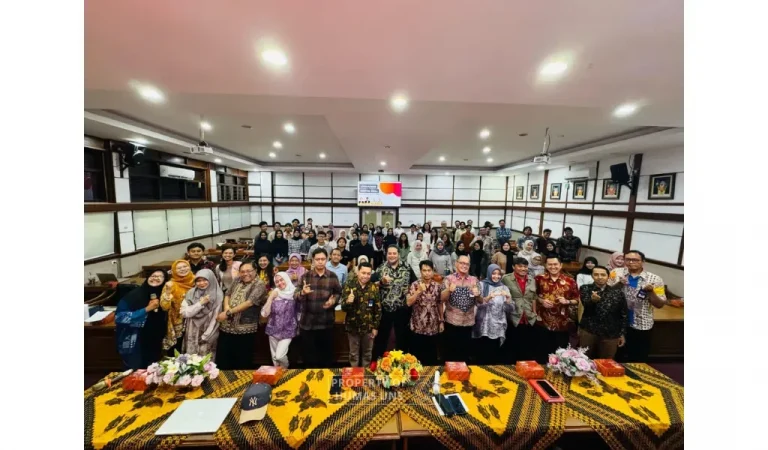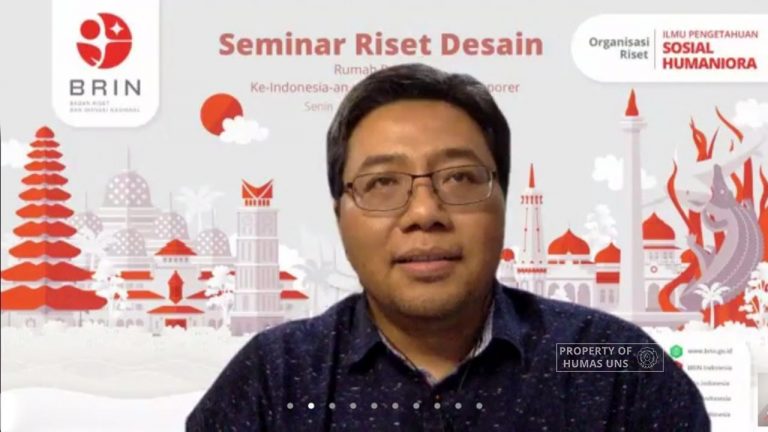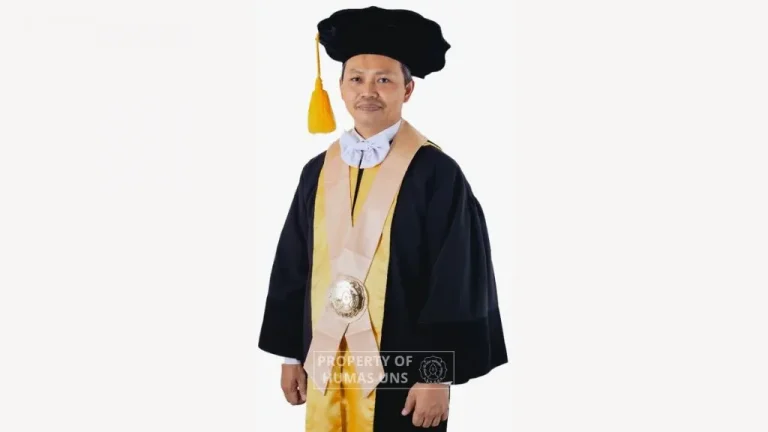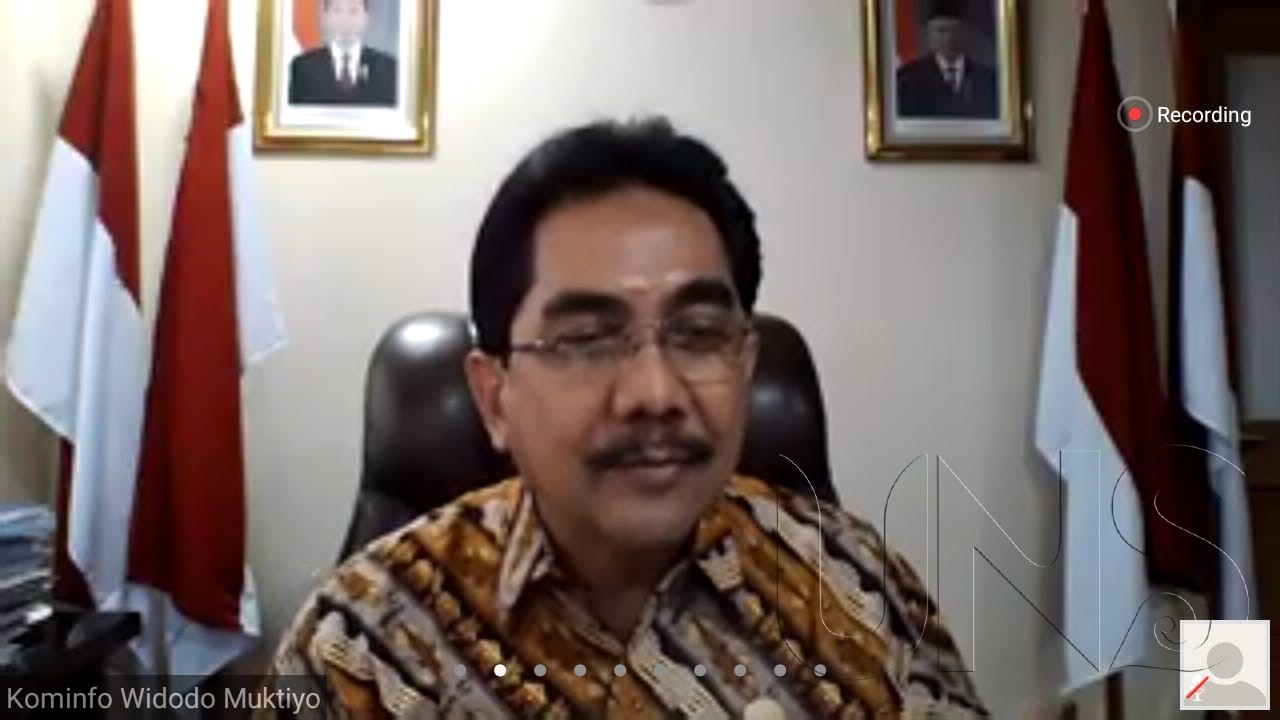
UNS – The government and media have important roles in providing information amid the pandemic. This is discussed in the Online Public Relation Discussion held by the Public Relation Laboratory (PR Lab), Faculty of Social and Political Sciences (FISIP) Universitas Sebelas Maret (UNS) Surakarta with the theme of Government Public Relation (GPR) and Covid-19 Handling. The event was held on Thursday (16/7/2020) through Zoom Clouds Meeting, moderated by Dr. Andre Rahmanto, and invited two experts as speakers, Prof. Dr. Widodo Muktiyo as the Director-General of Information and Public Communication, Ministry of Communication and Information and Editor in Chief of Kompas.com, Wisnu Nugroho.
Opening the discussion, Prof. Widodo delivered speech and condition of public relation in the government institution. Currently, the government continues to work on the right communication strategy that can be accepted by the public. In several occasions, Prof. Widodo conveyed that at the time, he and his team, is trying to improve the communication process from the inside.
“One of the ways to conduct it is by uploading positive contents by employees through personal social media account. This is an effort to reduce the number of negative contents and hoaxes that circulates in the community,” Prof. Widodo explained.
This condition cannot be avoided because currently the information concerning Covid-19 must be delivered well to the people. The challenges of the post-truth era which considers that the truth is no longer important are now taking place. The majority of information appears with made up narration as if the information is factual even though the fact is unverified. The number of people who believe this kind of narration instead of government-issued or mainstream media are plenty. To solve this condition, Kominfo has collaborated with various governmental institutions and international institutions such as the World Health Organization (WHO) and United Nations Children’s Fund (UNICEF), to provide verified information. Besides asking academicians to provide suggestions of solutions to conduct effective communication amid the pandemic. The community is also involved in strengthened information delivery. From the beginning of Covid-19 issue appeared in Wuhan, Kominfo has tried to enlighten the community. The pandemic entered Indonesia early March 2020 and the formation of Covid-19 Task Force was also informed to the people. The socialization program and the dynamic of policies from the government were updated and disseminated through various platforms.
Meanwhile, Wisnu Nugroho conveyed the results of research conducted by the Kompas.com team on the current conditions. The high intensity of unconfirmed information that circulated in the community has brought confusion and information flooding. Involving 2,103 respondents aged 16-45 years from February to April 2020, Kompas.com summarized the result under the title of “Indonesia Bingung” (Indonesia is Confused). There are five findings generated from the survey, first, Indonesians are indifferent toward a case until it occurs locally. This is proved from the information search concerning Covid-19 that increased after the first case is announced by President Jokowi in March 2020. Then, people responses were divided because they were confused with the floods of information. The majority of the community used social media to find information, besides news dissemination through a group chat that appeared as a new trend amid the pandemic.
“The good news is when social media is no longer trusted, people will go back to the trusted mainstream media to find information,” Wisnu conveyed.
The other results from the study are the role of a mother as a guard and educating her family, the acceleration of digital adaptation that resulted in the growth of online-based activities, and people who disregard ‘stay at home’ suggestions due to the economic reason.
Media becomes one of the parties that has a role in inciting responses from government. The journalist has a right to ask questions and interviewee has a right to respond. Thus, both parties are demanded to understand each other’s position without cornering each other. Both parties should deliver information to the community. Wisnu reminded that there are three things that a journalist has to perform in creating news: research, observation, and confirmation. This will minimize misunderstanding in the community. Prof. Widodo also added that digital literacy and the ability to comprehend fake news are the abilities that should be developed by the community. HUMAS UNS
Reporter: Ratri Hapsari
Editor: Dwi Hastuti