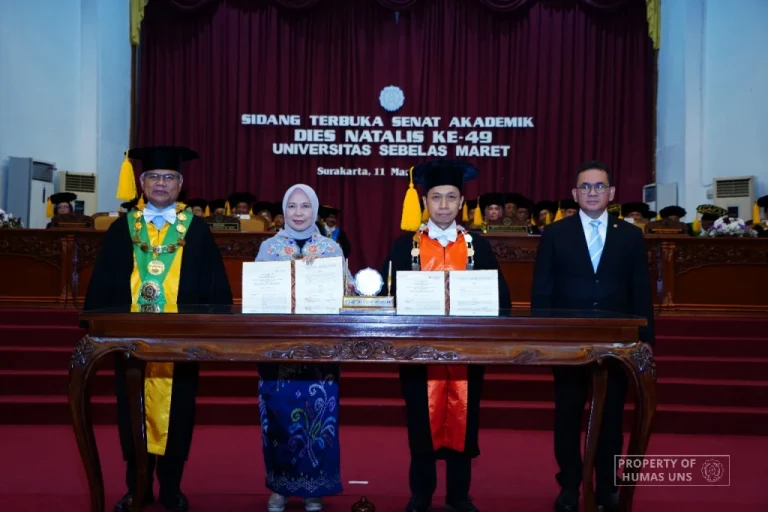
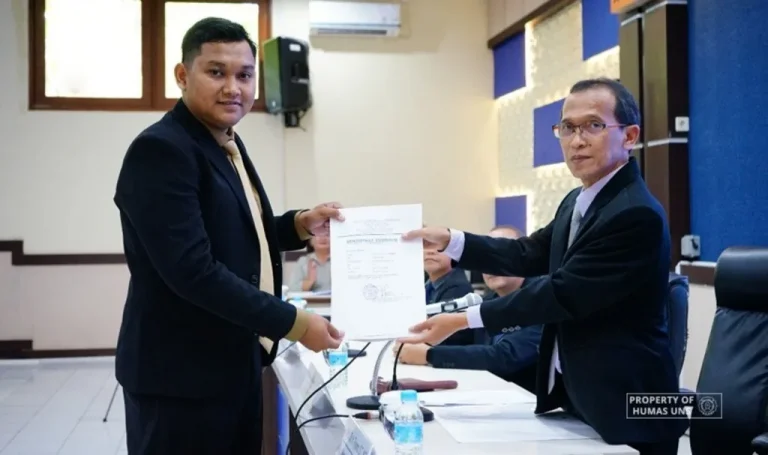
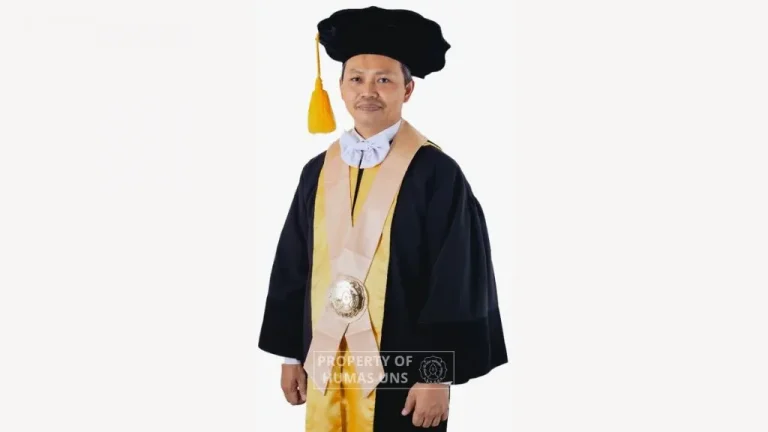
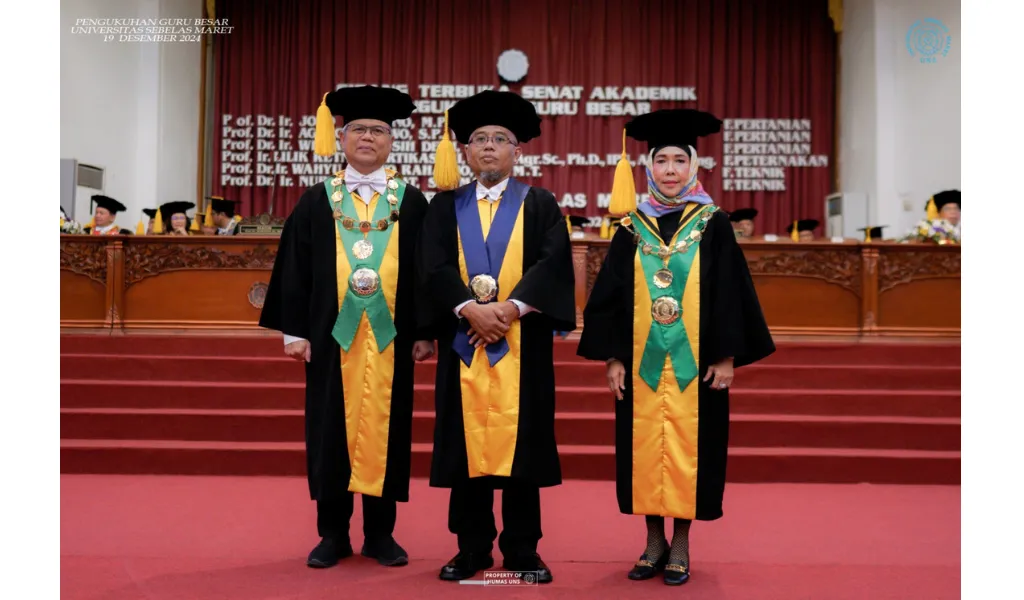
UNS – Universitas Sebelas Maret (UNS) Surakarta has added another esteemed scholar to its roster with the inauguration of Prof. Dr. Ir. Wahyu Purwo Raharjo, S.T., M.T., as a professor in the field of Manufacturing Engineering Technology. This marks him as the 28th professor of the Faculty of Engineering (FT) and the 325th professor at UNS. Prof. Wahyu delivered an inaugural speech titled “The Development of Eco-Friendly Composite Materials and Processing Technologies to Support Sustainable Development.”
The inauguration, presided over by UNS Rector Prof. Dr. Hartono, dr., M.Si., took place on Thursday (19/12/2024) in the G.P.H. Haryo Mataram Auditorium. During his remarks, Prof. Hartono reaffirmed UNS’s commitment to excellence in education, research, and community service, emphasizing the role of newly appointed professors in addressing societal and national challenges.
“This inauguration is a moment of pride for the professors being honored and for the entire UNS academic community. Let us use this occasion as inspiration and motivation to enhance the quality of education, research, and innovation at UNS,” Prof. Hartono said.
In his speech, Prof. Wahyu explained the classification of materials in engineering, which includes metals, ceramics, polymers, and composites. Polymers, characterized by their carbon-chain structure, are generally soft, less strong, and less rigid, with low resistance to high temperatures and ultraviolet light. Despite these limitations, the low density and melting point of thermoplastic polymers reduce manufacturing costs, making them widely used for products with limited lifespans.
Composites are materials composed of a combination of multiple components, typically including a matrix—accounting for the largest volume fraction—and reinforcements or fillers that enhance material properties. While composite matrices can be made from metals, ceramics, or polymers, polymers are often preferred due to their lower density and melting point, reducing structural weight and fabrication costs. Reinforcements can include particles, short fibers (whiskers), or long fibers, with higher strength achieved by increasing the length-to-diameter ratio of the reinforcement. Both synthetic and natural fibers are commonly used to strengthen composites.
Biocomposites, a subset of composites, feature at least one component—matrix or reinforcement—derived from natural, eco-friendly sources. Meanwhile, eco-friendly composites are entirely composed of natural materials. Environmentally friendly matrices, such as PLA, bio-polyester, and bio-derived polyethylene, remain relatively expensive. Natural reinforcements, like plant, animal, or mineral fibers, provide cost-effective alternatives. Among these, plant fibers are abundant, diverse, and affordable, sourced either from primary plants cultivated for their fibers or secondary plants where fibers are by-products.
The mechanical properties of composites depend on several factors, including the strength and rigidity of the matrix and fibers, fiber volume fraction, effective fiber length, fiber orientation, and the compatibility between matrix and fiber. Achieving compatibility between hydrophilic natural fibers and hydrophobic synthetic polymers often requires fiber treatment to reduce hydrophilicity.
Fiber treatments are generally categorized into chemical, physico-chemical, and biological methods, with chemical treatments being the most widely used due to their efficiency and simplicity. Key chemical treatments include alkali treatment, coupling agents, esterification, and bleaching. However, alkali treatment, while effective in removing hemicellulose, raises environmental concerns. Alternative methods, such as fumigation and sodium bicarbonate treatments, are more eco-friendly but less effective than alkali treatments.
“Challenges in utilizing polymer-natural fiber composites include low resistance to humid environments and ultraviolet exposure, as well as the limited lifespan of bio-polymer matrix composites,” Prof. Wahyu noted.
His expertise aligns with efforts to achieve Sustainable Development Goal (SDG) 15, which focuses on sustainable ecosystems on land. HUMAS UNS