UNS — Disaster Study Center (PSB) Institute for Research and Community Services (LPPM) Universitas Sebelas Maret (UNS) Surakarta held the Online Discussion Seri 8 “The Effectiveness of Covid-19 Vaccination and the Readiness for Face-to-Face Learning,” on Saturday (24/4/2021). Ninety-four participants attended the event through the Zoom Cloud Meeting platform.
The discussion was opened with Indonesia Raya song and moderated by Lintang Ronggowulan, S.Pd., M.Pd. The speakers in the discussion are dr. Tonang Dwi Ardiyanto, Sp.PK., Ph.D., as the Deputy Director of Education and Research UNS Hospital and Farida Hidayati, S.Psi., M.Si., as PSB LPPM UNS Board of Experts. The Chief of LPPM UNS, Prof. Dr. Okid Parama Astirin, M.S., in her remark, mentioned that this online discussion is expected to bring benefits for all the participants.
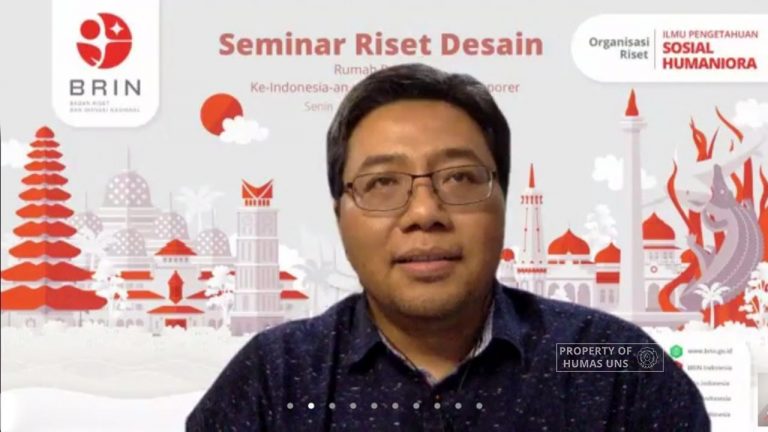
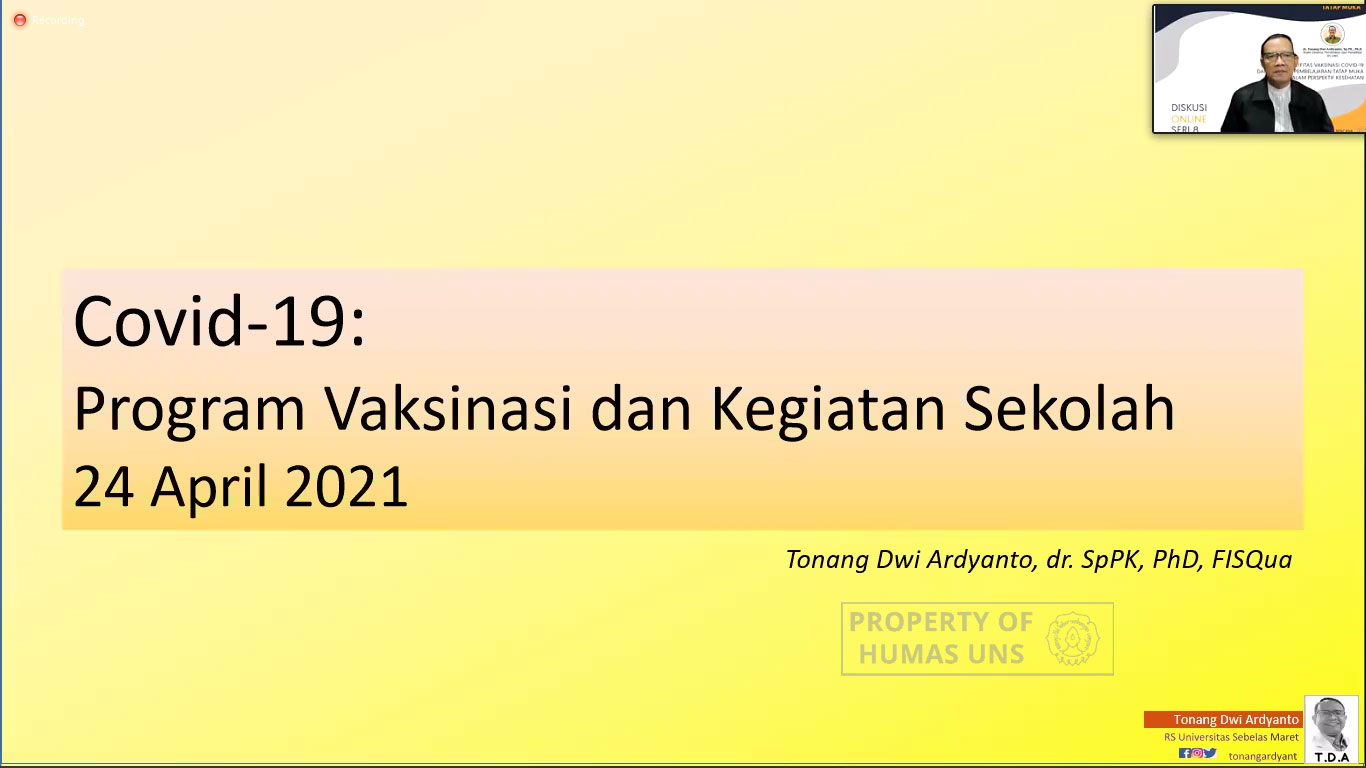
dr. Tonang delivered the first material on “The Effectiveness of Covid-19 Vaccination and the Readiness for Face-to-Face Learning under Health Perspective” and opened his discussion with the general views of the Covid-19 pandemic as a disaster. The loss caused by Covid-19 has exceeded the impacts of annual natural disasters, with 1.6 million Indonesian people tested positive and moderate daily cases that tend to decrease. The decreasing trend requires careful response considering the unrepresentative data.
Dr. Tonang continued with the vaccination process in Indonesia that has reached the second stage, prioritizing public workers and the elderly. This includes educators, school and university teachers, and academic staff. To this date, 44.88% of public workers in Indonesia have received the first dose of vaccine, and 23.80% have received their second dose. dr. Tonang added that if the second stage of vaccination runs well, it is expected that all academic-related employees were vaccinated as a factor that supports the education readiness to conduct face-to-face learning.
Regarding the efficacy level of the vaccines, dr. Tonang mentioned that it is highly related to the vaccination process. Vaccine efficacy is the comparison between the risk for a vaccinated and unvaccinated person. An efficacy of 65.3% means vaccinated bodies have three times stronger immune systems than unvaccinated bodies, which is likely to increase if a vaccinated person could maintain a healthy lifestyle. “If after vaccinated (they) continue to be careful (and) maintain (healthy lifestyle) it’s not impossible (the efficacy is) not only 65%. It can be 95% even 100%; all people are saved is possible,” dr. Tonang revealed.
dr. Tonang also explained how vaccination could protect the community because personal immunity is not sufficient. Communal immunity is needed to protect the whole community and must be achieved before face-to-face learning starts to reduce Covid-19 infection in the education sector.
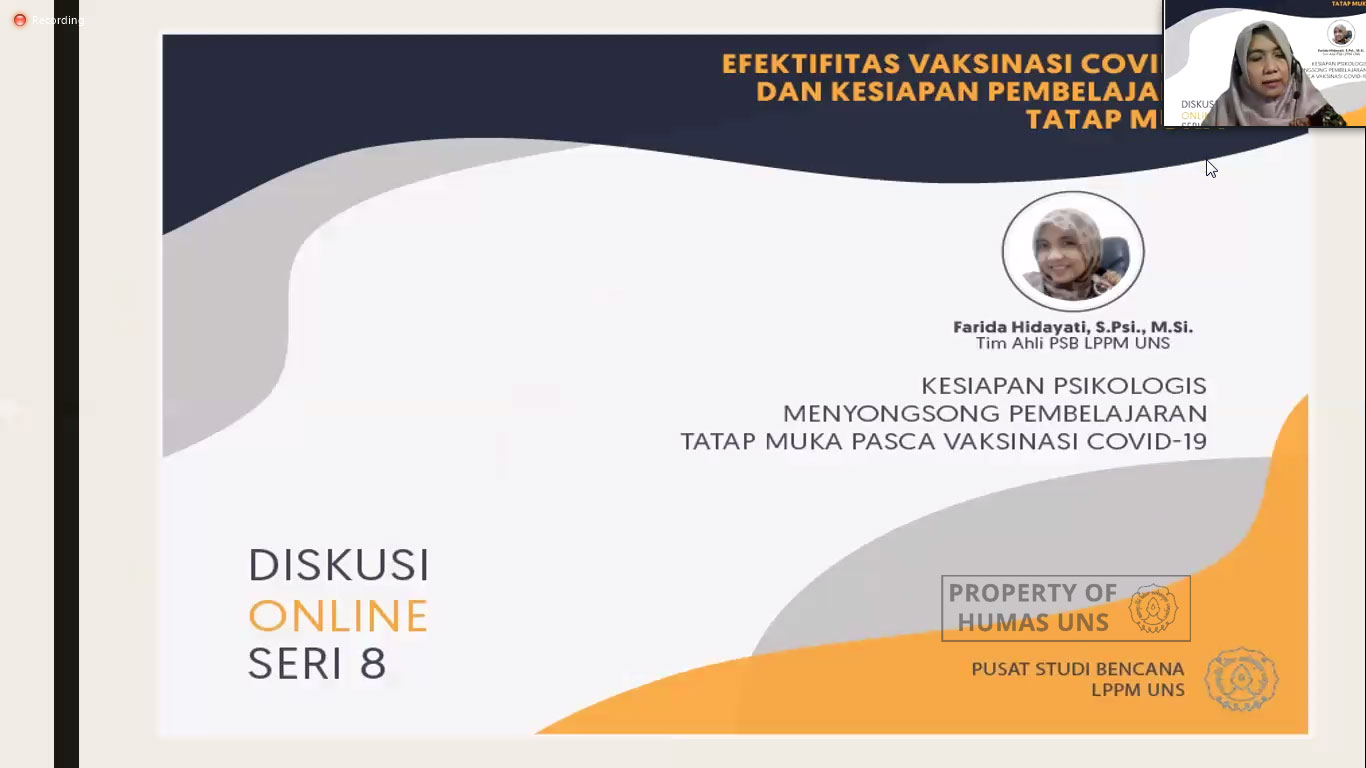
Farida Hidayati, S.Psi., M.Si., delivered the second material on “Psychological Readiness for Face-to-Face Learning Post Covid-19 Vaccination”. Farida emphasized the importance of a face-to-face learning system, including timeliness in starting offline learning, learning condition, and the learning processes. She mentioned that schools need to identify its readiness, sustainability, and resilience of the system before opening offline learning. Preparation of facilities and infrastructures are also required to support learning sustainability and preparedness for the impacts of future crises.
Vaccination is expected to increase the school community’s immunity as close communication between school and parents is needed to ensure online learning success. According to Farida’s survey, 68.6% of university students stated that they are more comfortable with offline learning. However, to create safety and comfortable learning process, health and education should walk hand in hand. Farida emphasized the importance of maintaining mental health and psychological wellbeing as a supporting aspect in face-to-face learning. The ability to handle the community’s stigma will help students avoid stress and strengthen their immune systems.
“Therefore, we need to pay attention to student’s and teacher’s mental wellbeing and health. It is a part that we need to consider in supporting face-to-face learning,” Farida said. Humas UNS
Reporter: Rangga Pangestu Adji
Editor: Dwi Hastuti