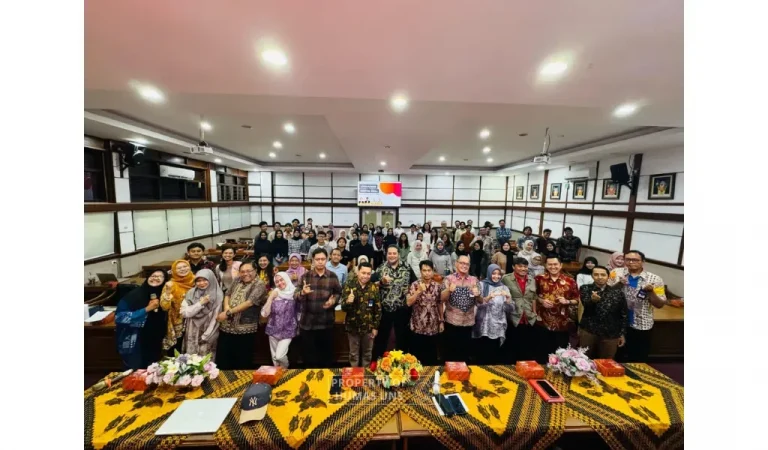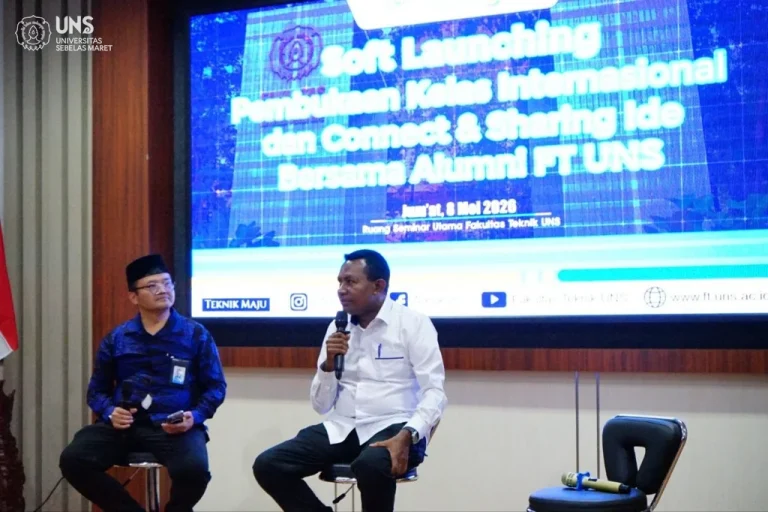
UNS — Entering series 9, the Online Discussion of Disaster Study Center (PSB) Institute of Research and Community Services (LPPM) Universitas Sebelas Maret (UNS) Surakarta discussed the “Local Wisdom in Disaster Adaptation and Mitigation”. This event was held online through the Zoom Cloud Meeting and was attended by 277 participants from students, faculty members, Disaster Study Center, Regional Disaster Mitigation Agency, and other institutions and universities.
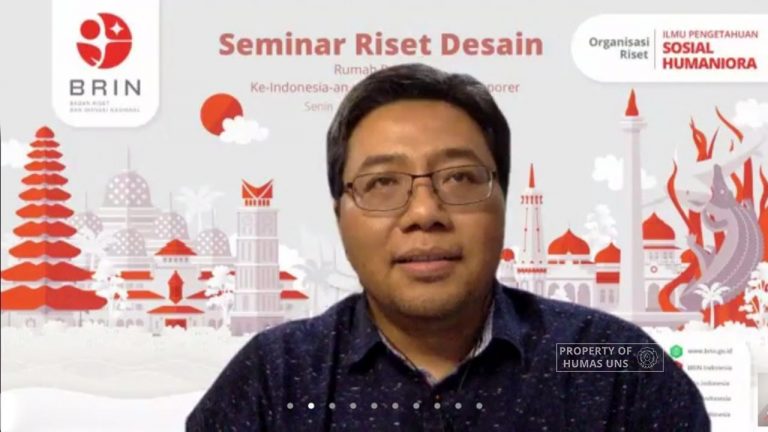
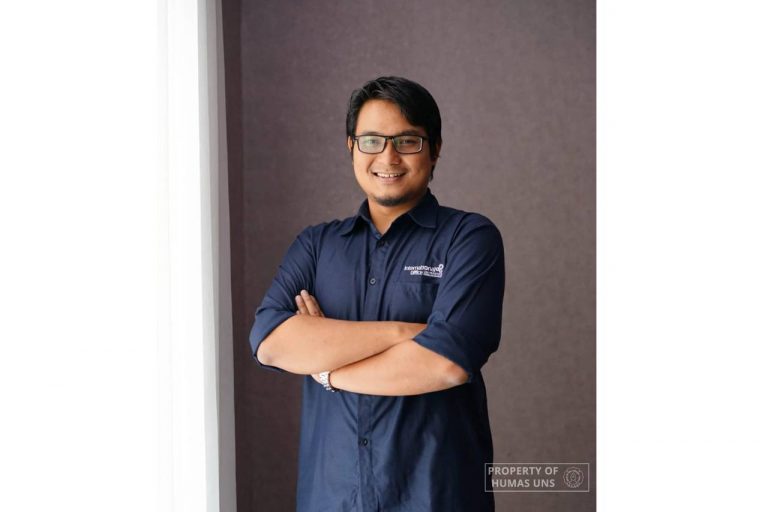
This online discussion invited Dr. Imam Hilman, S.Pd, M.Pd. (Geography Education Universitas Siliwangi) and Dr. Yasin Yusup, S.Si., M.Si. (PSB LPPM UNS Expert) as the speakers. This event was led by Seno Budhi Ajar, S.Pd., M.Si, PSB LPPM UNS Staff, as moderator.
Dr. Imam Hilman, S.Pd., M.Pd., opened the discussion with material on “Local Wisdom of Indigenous People in Disaster Adaptation and Mitigation”. In his material, Dr. Imam Hilman stated that disaster adaptation and mitigation is an interaction between local wisdom and indigenous people in the region. Local wisdom and customs are developed based on the experiences of the community. Community experiences on disasters create an adaptation process in mitigation. Dr. Imam provided several examples of local wisdom that related to disaster adaptation in Indonesia regions. In Sunda, there is a saying that “Gunung teu meunang dilebur, sagara teu meunang diruksak, buyut teu meunang dirempak” which means human should not damage the environment and should align with the environment. There is also “Alam jeung lingkungan leuwung lain tumpakeun tapi leuweung rawateun rohmateun” philosophy that means forest is not for residence but to be protected. This philosophy is implemented in a protected forest in Ciamis that has strict regulations.
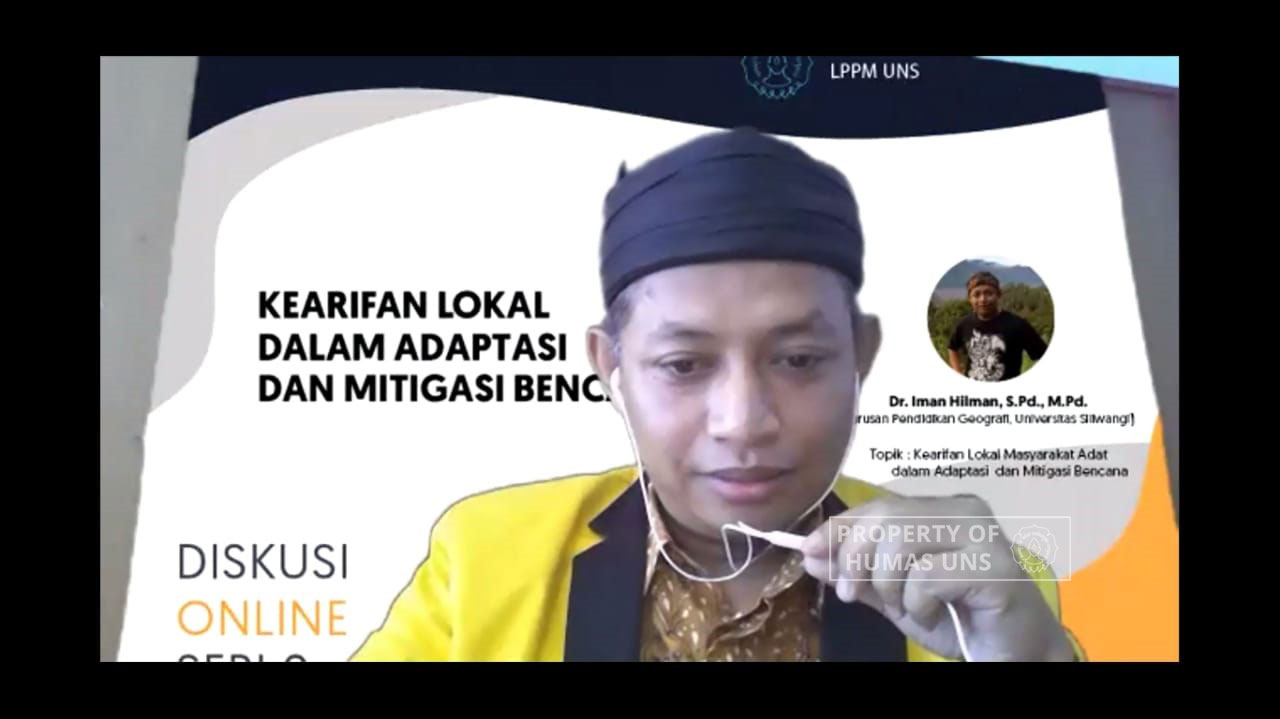
“Leuwung Ruksak caik beak manusia balangsak” means indigenous people’s efforts to respect and protect a forest. West Java also has the Kampung Naga with a good spatial design and water drainage maintained by indigenous people. The people do not believe in disasters except for those caused by humans. Concluding his material, Dr. Iman Hilman, S.Pd., M.Pd stated that we need to learn from the indigenous people, and a collaboration between local wisdom and the existing regulations is vital. “We adopt the good thing and avoid the bad thing,” he added.
In the second session, Dr. Yasin Yusup, S.Si., M,.Si delivered material on “Empan papan – Empan Wektu: Adaptation Mechanisms for Living in Harmony with Threats and Blessings”. Dr. Yasin mentioned that danger refers to disaster vulnerability in Indonesia, and risk is affected by social and natural construct. He added that according to Gilliard, local wisdom should be adopted in risk assessment as it might assist or hamper disaster mitigation or even considered contradicts the religious belief. An example of this phenomenon is Mount Merapi Eruption. Culture could be considered in risk mapping, local wisdom considered in socio-cultural vulnerability. At the time, Mbah Marijan, appeared as a person who brought a sense of security, and people in his area refused to be evacuated.
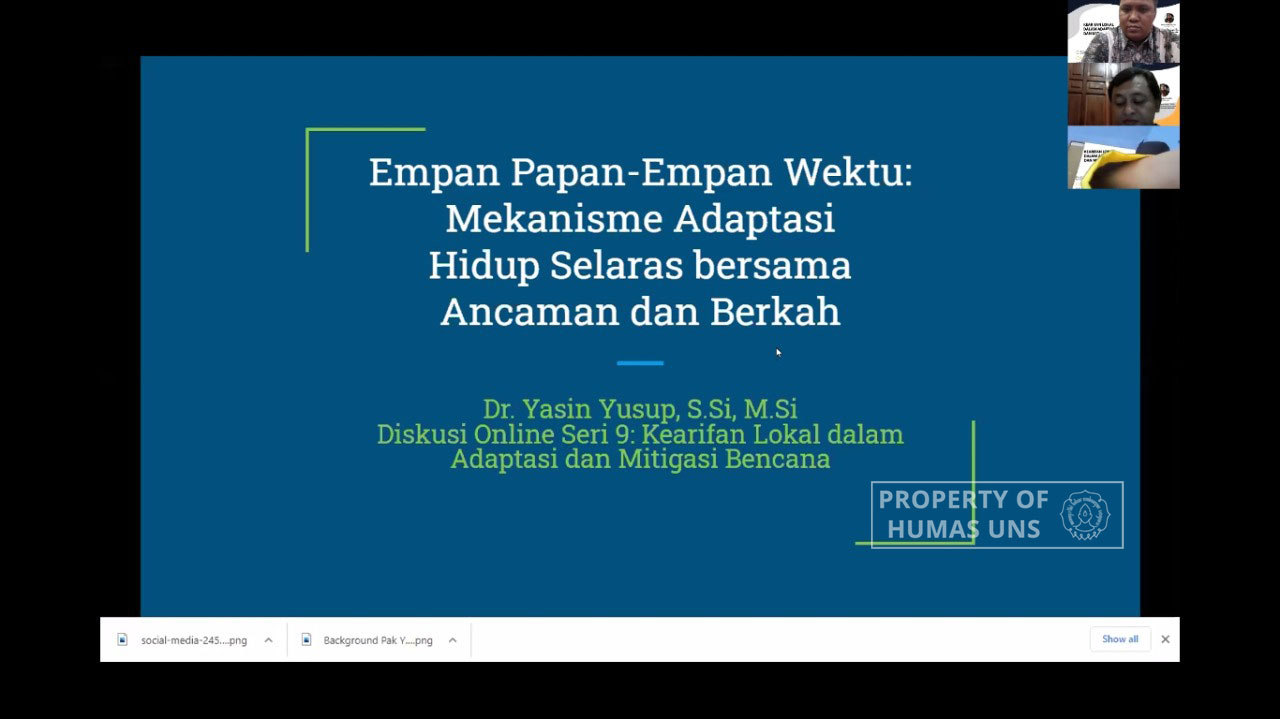
Dr. Yasin added that the pyroclastic flow was a disaster during the eruption, but later, it provides natural resources, sand and stone mining, or gifts. “People could use it,” he added. Dr. Yasin concluded his session with various jargon used by people around Mount Merapi, such as “Hidup selaras dengan acaman” (living together with threat) and “Waktunya menyingkir ya menyingkir dan waktunya kembali ya kembali tidak perlu meninggalkan pertanian” (we go and come back when it is the time). Humas UNS
Reporter: Rangga Pangestu Adji
Editor: Dwi Hastuti