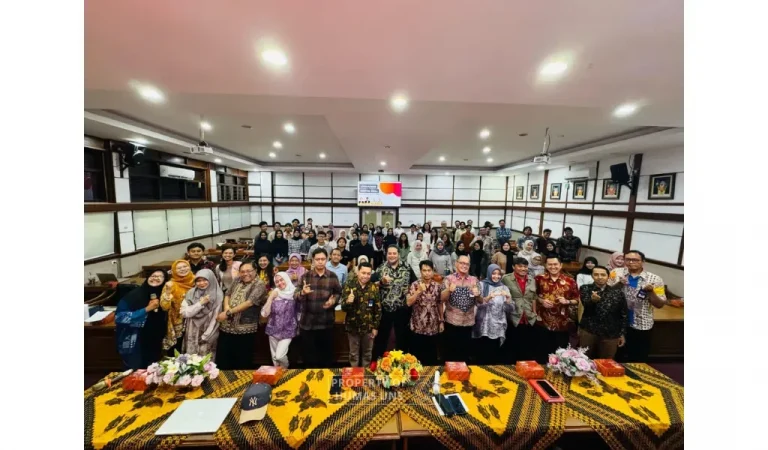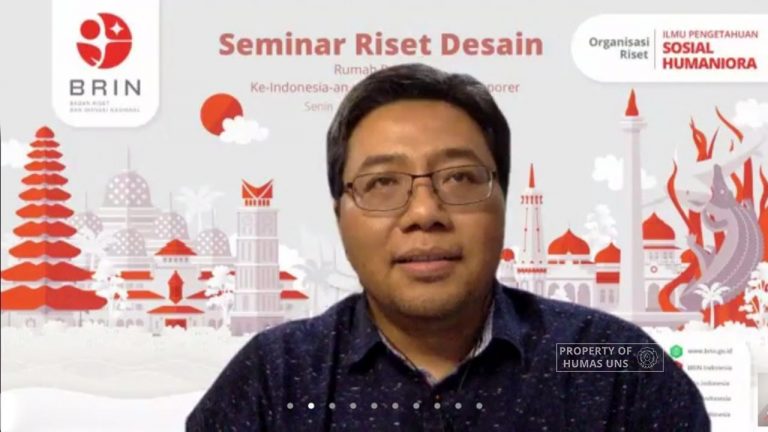
UNS – The Biotechnology and Biodiversity Research and Development Center (P3BB), Institute for Research and Community Engagement (LPPM) Universitas Sebelas Maret (UNS) Surakarta held a webinar in ‘Implementation of Technology for Orchid Agrobusiness’ through a Zoom Meeting and YouTube live streaming on Wednesday (24/6/2020).
Three speakers were invited to the webinar, they are Prof. Dr. Endang Semiarti, M.S., Ir. Lila Natasaputa, and Prof. Dr. Ir. Sri Hartati, M.P. Discussion was led by a lecturer from the Faculty of Agriculture (FP) UNS, Dr. Ir. Endang Yuniastuti, M.Si. Attended by 500 participants, the webinar was started with material on Natural Orchid Conservation Techniques, presented by Prof. Dr. Ir. Sri Hartati, M.P., who currently is the Chief of P3BB LPPM UNS and a Professor in FP UNS.
Prof. Sri explains that there are several potential problems in Indonesian orchid genetics resources. The factors that have the potential to be the reason for orchid extinction in Indonesia are the conversion of forest area, forest fires, landslides, and poaching. Meanwhile, the rescue effort undertaken by the government is by issuing Government Regulation No. 7 of 1999 regarding the protection of endangered plant and animal species.
There are two types of Natural Orchid preservation, the in situ, where natural orchids are protected in their natural habitat, and ex-situ preservation, where the orchids are protected outside of the natural habitat. There are some protected natural orchids such as Ascocentrum miniatum, Corybas fornicatus, Dendrobium d’albertisii, Cymbidium hartinahianum, and Coelogyne pandurata.
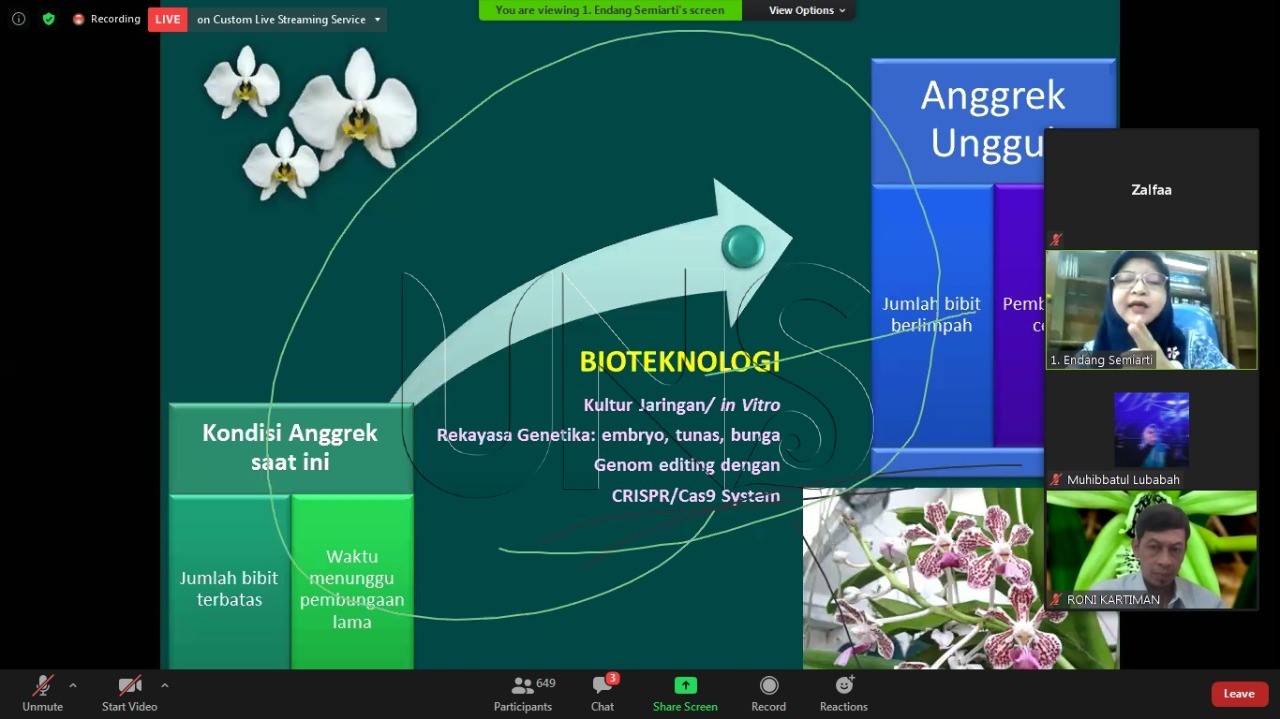
The next material on Biotechnology Innovation in the Production of Superior Orchid was delivered by Dr. Endang Semiarti, M.S., a lecturer from Biology Study Program, Universitas Gadjah Mada (UGM). “Orchids are ornamental plants that have high economic value because of the beauty of its flowers, the uniqueness, and its durability. Some orchids give off a fragrant odor, while the stems, leaves, and roots contain medicinal ingredients,” explains Dr. Endang.
Orchid biotechnology can be carried out using mass propagation consisting of the generative and vegetative methods. Furthermore, generating new traits in the form of new varieties consisting of mutations, somaclonal variations, and genetic engineering.
Lastly, the owner of Green Leaves Orchid, Ir. Lila Natasaputa, discuss the Development of Care Techniques and Opportunities for Orchid Business Success. Orchids need appropriate sun rays, irrigation, fertilizing, and reporting. “The need for sunlight is adjusted to the type of orchid. For example, Phalaenopsis belongs to the low shade group, which needs about 25% of the incoming light. A shade design model that can be changed, added, or subtracted,” explains Ir. Lila.
When you want to water the orchids, usually it is done manually, watering time adjusted to environmental conditions. Watering can be done by soaking the orchids. The system that can be applied for orchid watering is the gutter system. When planting orchids, choose a media material that is strong in holding or storing water. Humas UNS/Zalfaa/Dwi