By: Dr. Deddy Whinata Kardiyanto, S.Or., M.Pd (FKOR UNS Faculty Member) and Team
The Republic of Indonesia Law Number 3 of 2005 regarding National Sports System (UUSKN) Chapter XIII article 74, mandated that the development of Science and Technology for Sports is implemented under the following requirements: “(1) Central government, local government, and/or the community conducted sustainable science and technology development to develop national sports; (3) Science and technology development as mentioned in paragraph (1) is held through research, study, technology transfer, socialization, scientific meeting, and collaboration with national and international research centers focuses in sports science and technology; (4) The result of science and technology development as mentioned in paragraph (1) is socialized and implemented for sports development…”.
In the Republic of Indonesia Regulation Number 16 of 2007, regarding the Implementation of National Sports Training, Chapter IX article 72 on Sports Science and Technology also emphasized that “The central government, local government, and community is responsible for implementing the development of planned and sustainable sports science and technology to develop national sports.” Science development is inseparable from scientific study and/or research. Additionally, many issues in sports science, such as the effective training method physically, technically, and psychologically; athlete’s nutritional issues; training location and climate; and other issues, could be solved through research activities. Research is a method to solve the problem which results could be accounted for scientifically. Through intensive and strict research, especially those conducted abroad, many mysteries on sports training aspects have been revealed, and the findings could be implemented to develop athlete’s performance. In several countries with developed sports science and technology, there is always a laboratory as sport science centers or institutes of sports. This laboratory is a center to apply sports science and technology principles to athletes in training to improve their performance. In Indonesia, the implementation of sports research finding on athlete’s training process still faced challenges because there is no center for implementation and no integration of such program in athlete’s training program. There is also resistance from practitioners in the fields, who finds it hard to apply research findings in the training as they consider such practice to be disturbing for the training process. Meanwhile, they are not open enough and have low awareness to absorb the information on the science and technology development from the scientific journals of the scientific forum because they are busy with their field activities.
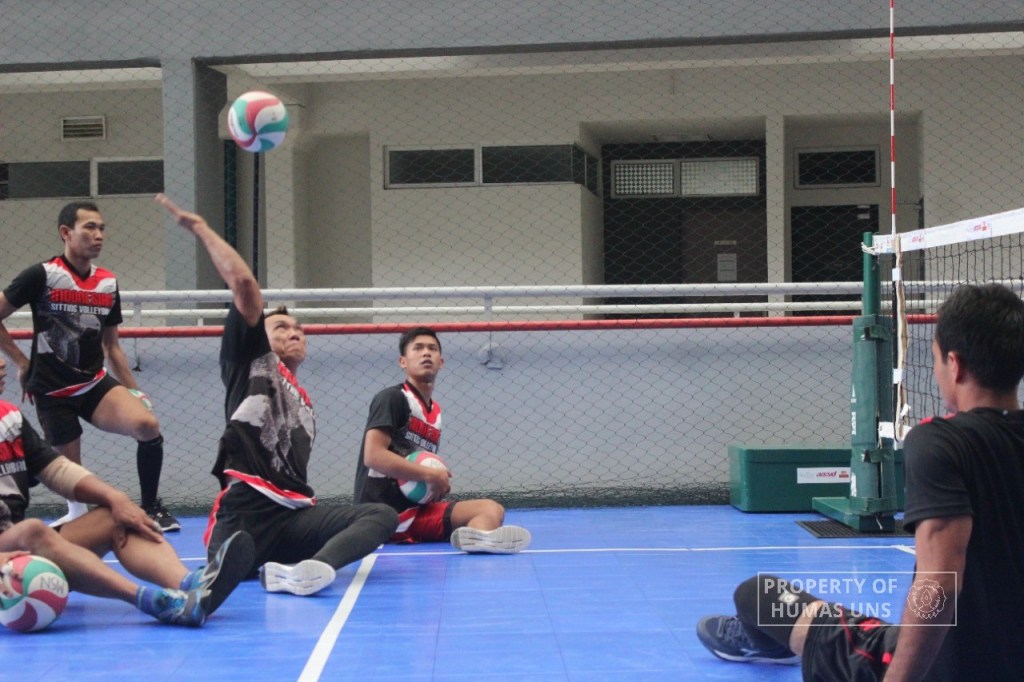
As an effort to optimize the research findings from national and international researchers and to support the implementation of sports science and technology, Indonesia has tried to apply research findings on national sports training, especially for National Paralympic Committee Indonesia athletes. This implementation provides an opportunity for trainers and academics to work together and adopt collaborative approaches.
Profile of Partners
National Paralympic Committee (NPC) Indonesia is an organization for athletes with disabilities in Indonesia. NPC is a branch of an international organization named the International Paralympic Committee (IPC). Currently, four international level organizations specifically regulate athletes with disabilities: CPISRA (Cerebral Palsy International Sport and Recreation Association); IBSA (International Blind Sports Association); INAS-FID (International Sports Federation for Persons with Intellectual Disability); and IWAS (International Wheelchair and Amputee Sports Federation). These organizations are incorporated in IPC established on 22 September 1989 and now have 160 NPCs (National Paralympic Committees) members from five continents and have the same level as the IOC (International Olympic Committee) for able body sports. As an organization responsible for the development of national sports for people with disabilities, NPC has a great responsibility. Similar to other sports organizations, NPC also conducts training for people with disabilities. This training is implemented in line with the Law on National Sports System. Through sports, people with disabilities could strive and optimize their abilities in sports. Sports training for people with disabilities is implemented and directed to improve health conditions, self-confidence, and sports achievements. Further, in the same regulation, Article 30 mentioned that sports training and development for people with disabilities is implemented through an organization of sports for people with disabilities (NPC). The training is implemented through a leveled and sustainable program at the local, national, and international levels.
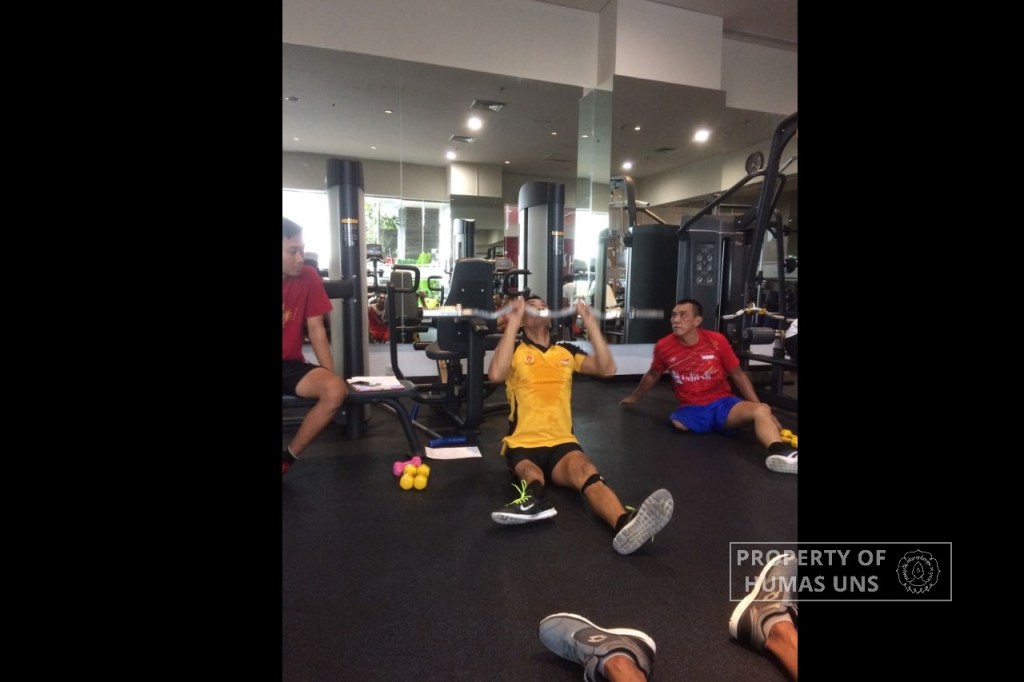
To achieve this objective, the central government, local government, or disabled sports organization in the community is responsible for forming a center for training and development of sports for people with disabilities. The coverage of this training is held at educational sports, recreational sports, and performance sports matched with athlete’s physical and/or mental conditions.
Analysis of Partner’s Issues
Expressively and implicitly, people with disabilities have an appropriate portion to show their existence in health, fitness, productivity, and achievement. However, to this day, the policy, implementation, facilities, infrastructures for people with disabilities and its accessibilities, and the development of training for athletes with disabilities received little attention compared to the able body sports. An athlete’s achievements could be determined from the beginning of their career. Starting from recruitment and training, achievement improvement, and other interconnected processes, need support from multidisciplinary research. Without overlooking the basic movement elements (basic movement technique) from sitting volleyball sport, bio motoric component is also a vital and integral component in athlete’s achievements. According to Brown (2005), “almost all sports branches require rapid body and body parts movements because speed and agility could improve movement accuracy”. This opinion supported the need for bio motoric components in high sports achievement.
Solution for Partner’s Problems
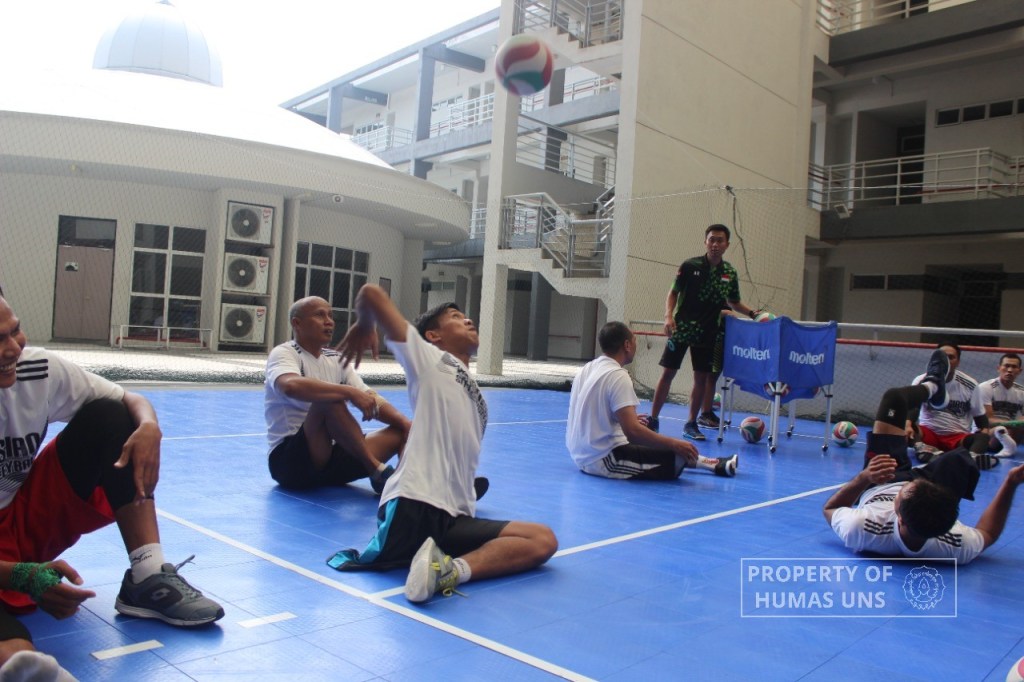
Based on a study conducted over the partner’s problem, a community service program is prepared to offer a solution developed by both the academic and the partner (trainers and managers of Sitting Volley Ball Team National Paralympic Committee Indonesia). This community service program’s focus is assistance that applies the research findings to the identified issues regarding implementing the scientific conclusions for physical training. The program also aims to develop a high level of confidence in improved athlete’s achievements due to science and technology application in athlete’s training in National Paralympic Indonesia. The community service also allows the transfer of knowledge or the changes in the trainer’s behaviors during training.
This program aims to shape optimum bio motoric condition of athletes in the National Paralympic Committee Indonesia in facing multievent or single events at the international level. The program was implemented by a team led by Dr. Deddy Whinata Kardiyanto, S.Or., M.Pd. and team members: Hendrig Joko Prasetyo, S.Pd., M.Or., Pomo Warih Adi S.Pd., M.Or., Drs. Bambang Wijanarko M.Kes, Waluyo, S.Or., M.Pd., Tri Winarti Rahayu, S.Pd., M.Or., and Slamet Widodo, S.Pd., M.Or., all are Faculty Members of Faculty of Sports (FKOR) UNS.
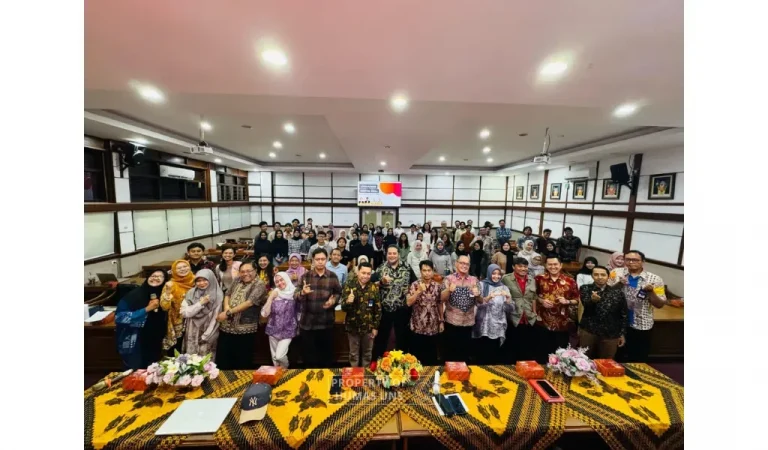
The team hoped that this assistance would produce an applicable training model to improve national sports achievements based on the science and technology implementation. The program was implemented in the Center National Paralympic Committee Indonesia (NPCI) in Solo, Central Java, in May 2021. Through this community service, the team shared their knowledge on the method to analyze the dominant factors in bio motoric abilities of athletes with disabilities using a statistical program (SPSS version 20). The fundamental principles of this assistance are: (1) Problem solving through collaboration between academics and trainers; and (2) Collaboration is based on the common ground of roles and responsibilities between the academics and trainers.
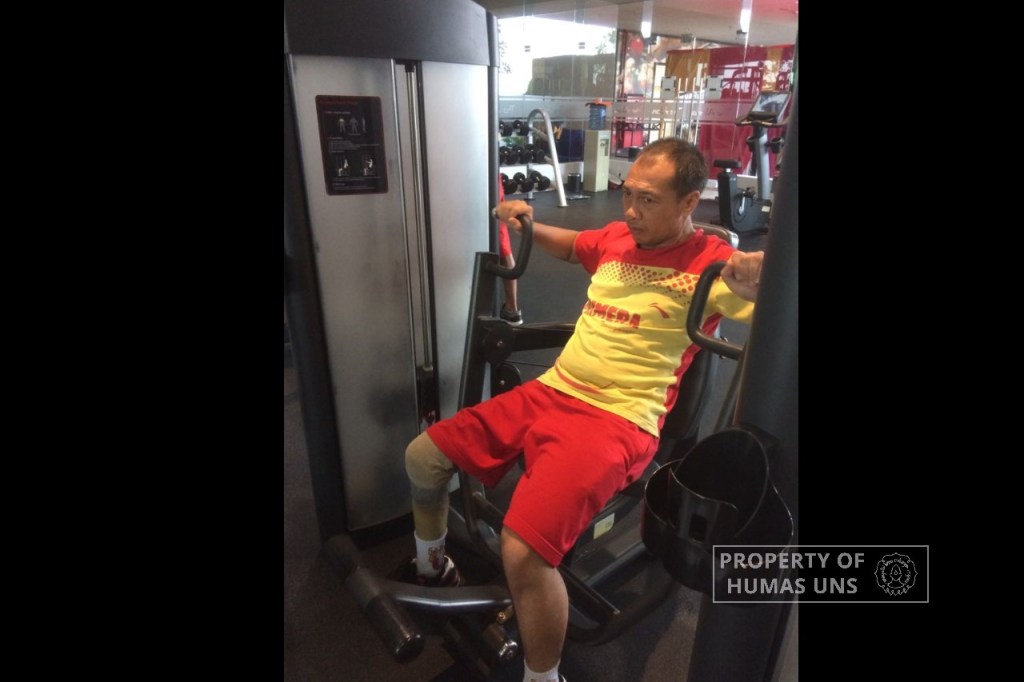
The training assistance was held to observe the physical training process in NPC Indonesia. During the observation, the team noticed that managers and trainers focus on training and have not paid much attention to the components of dominant physical conditions that affect athlete’s achievements, especially in Sitting Volleyball sports. Twenty managers and trainers understand the dominant bio motoric factors of athletes with disabilities based on the assistance and training adjusted to athletes with disabilities characteristics. A questionnaire is distributed to measure the dominant factors in physical training, including the reach test (cm), modified sit-ups (times), modified abdominal endurance (seconds), modified push-ups (times), dominant hand grasping strength (kg), non-dominant hand grasping strength (kg), plate leads test for hands dominant hand (sec), plate lead test for non-dominant hand (sec), and right shoulder flexibility (cm) left shoulder flexibility (cm).
Three statements are used to assess the comprehension of dominant bio motoric factors in athletes with disabilities. The statements were the importance of modified physical tests for athletes with disabilities, the importance of assistance and training for physical condition training, and analysis for dominant bio motoric factors that will assist trainers and managers in improving athlete’s physical condition according to their characteristics. Fundamentally, managers and trainers were trained on the dominant physical condition factors of athletes with disabilities. The managers and trainers were enthusiastic about the training, and further training is a vital follow-up. This finding is supported by the interview results with the managers, trainers, and athletes. Most of the interviewees stated that this training has a positive impact in determining the main physical components of athletes with disabilities according to athlete’s personal characteristics. Further training is needed to improve NPC athlete’s achievement to compete at the national and international levels. Therefore, further PKM is required in National Paralympic Committee Indonesia. (***)