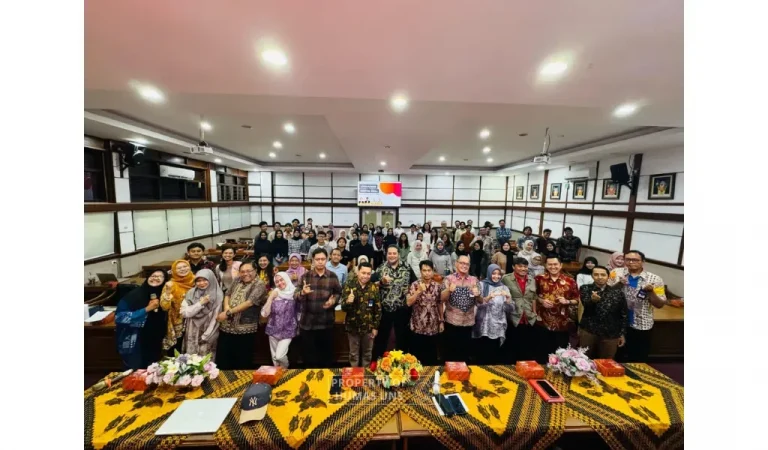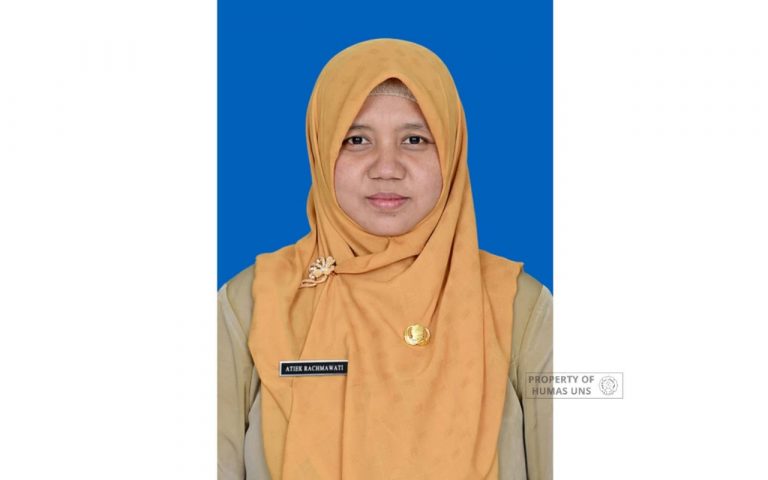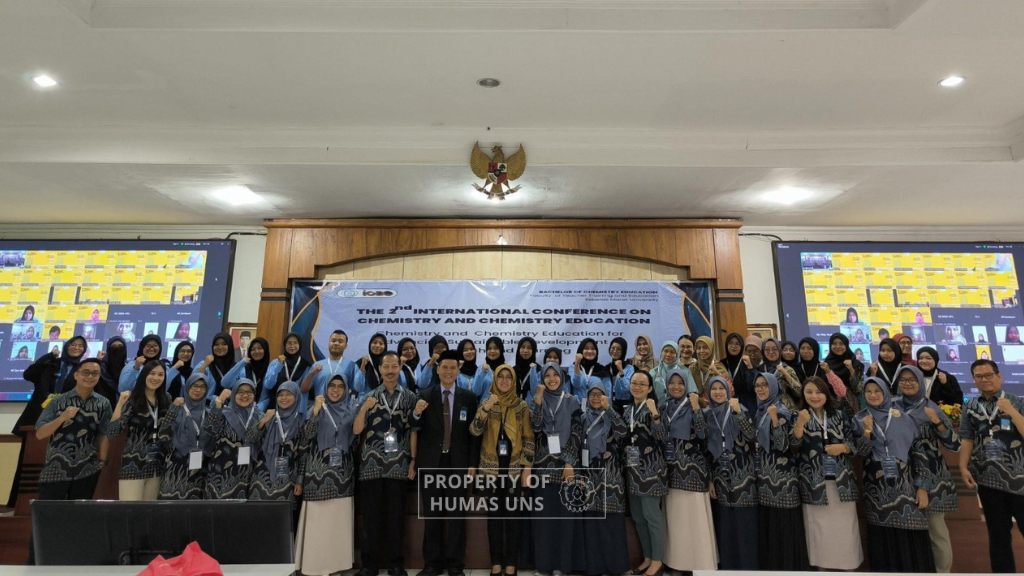
UNS — The Undergraduate Chemistry Education Program at the Faculty of Teacher Training and Education (FKIP), Universitas Sebelas Maret (UNS) Surakarta, held an international conference on chemistry and chemistry education. The event, known as the International Conference on Chemistry and Chemistry Education (IC3E), was organized for the second time and featured scholars from around the world on August 23-24, 2024. The two-day conference was conducted in a hybrid format, with in-person sessions at the FKIP Graduate Building and online meetings. It served as a platform for researchers, lecturers, and students to share knowledge and experiences. Dr. Maria Ulfa, S.Si., M.Si., Chair of IC3E 2024, explained that the theme, “Chemistry and Chemistry Education for Advancing Sustainable Development of Research and Learning,” emphasized the importance of sustainable chemistry and chemistry education. “This conference will highlight the crucial role of sustainable chemistry and education,” Dr. Maria Ulfa told uns.ac.id on Wednesday (4/9/2024).
Dr. Maria Ulfa, S.Si., M.Si. also mentioned that this event is held every two years, regularly inviting renowned international speakers to broaden perspectives through scientific discussions and expand collaboration among researchers. The conference, held at the end of August 2024, began with opening remarks from the Chair of the IC3E Committee, the Head of the Chemistry Education Program, the Dean of FKIP UNS, and the Vice-Rector for Academic and Research Affairs. One of the highlights of the conference was the presence of key speakers, including Prof. Shin-ichiro Noro from Hokkaido University (Japan), Prof. Agnieszka M Ruppert from Lodz University of Technology (Poland), Prof. Maija Aksela from the University of Helsinki (Finland), Prof. Dr. David-Samuel Di Fuccia from the University of Kassel (Germany), Dr. Paed. Nurma Yunita Indriyanti, M.Si., M.Sc. from Universitas Sebelas Maret (Indonesia), and Lina Mahardiani, S.T., M.M., M.Sc., Ph.D. from Universitas Sebelas Maret (Indonesia).
Prof. Shin-ichiro Noro from Hokkaido University, Japan, delivered a presentation on porous metal complexes, a type of porous material with unique characteristics and high structural flexibility. These properties make it an intriguing material, offering previously unseen capabilities and high performance. In addition, Dr. Paed. Nurma Yunita Indriyanti, M.Si., M.Sc. from UNS gave a presentation on students’ understanding of green chemistry. She emphasized the crucial role that green chemistry and educational issues play in sustainable development, highlighting the specific challenges posed by its social aspects.
Prof. Agnieszka M. Ruppert from Lodz University of Technology, Poland, discussed the benefits of biomass waste, which contains numerous platform molecules that can be used sustainably across various industrial sectors. Additionally, Prof. Maija Aksela from the University of Helsinki, Finland, presented her research on the opportunities and challenges of implementing education for sustainable development (ESD) through collaboration between teachers, researchers, and the community, along with practical examples of its application.


In addition to presentations from the keynote speakers, the conference also provided presentation sessions for participants to showcase their research findings, allowing attendees to interact directly with others in the same subfield. On the first day, three teams presented their research in the field of inorganic chemistry.
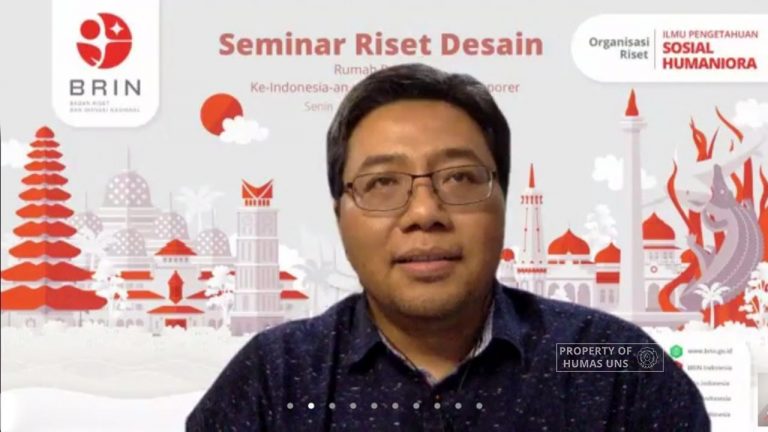
On the second day, the conference began with a keynote presentation by Lina Mahardiani, S.T., M.M., M.Sc., Ph.D. from UNS, who discussed the comparison between adsorption and photocatalytic methods for the degradation of wastewater containing crystal violet (CV), methylene blue (MB), and CV-MB mixtures using nanofibers modified from sugarcane waste. This was followed by participant presentation sessions, where attendees were divided into five rooms, each focusing on a different subfield.
Each room, focusing on a different subfield, featured invited speakers who delivered presentations aligned with their areas of expertise. The subfields included Organic Chemistry & Biochemistry; Environment, Pharmacy, and Public Health; Analytical Chemistry & Physics and Material Chemistry; Inorganic Chemistry, Chemistry Education & STEM Education; and Science Education. Notable invited speakers included Prof. Tatsufumi Okino (Hokkaido University, Japan), Prof. Dr. Edy Cahyono, M.Si. (Universitas Negeri Semarang, Indonesia), Prof. Dr. Sumari, M.Si. (Universitas Negeri Malang, Indonesia), Dr. Nanik Dwi Nurhayati, M.Si. (UNS, Indonesia), and Dr. Ari Syahidul, M.Pd. (UNS, Indonesia). After the participant presentations, the conference continued with a keynote speech by Prof. Dr. David-Samuel Di Fuccia from the University of Kassel, Germany, who discussed his research on the opportunities and challenges of using virtual reality (VR) in chemistry education.
According to Dr. Maria Ulfa, S.Si., M.Si., the conference aims to foster stronger collaborations between academics, researchers, and practitioners in chemistry and chemistry education from various countries. “Through this forum, participants can share knowledge, experiences, and the latest research findings, enriching insights in chemistry and chemistry education. Additionally, this conference opens new opportunities for international research collaborations that could lead to significant innovations in chemistry and chemistry education,” Dr. Maria Ulfa stated.
HUMAS UNS
Editor: Dwi Hastuti