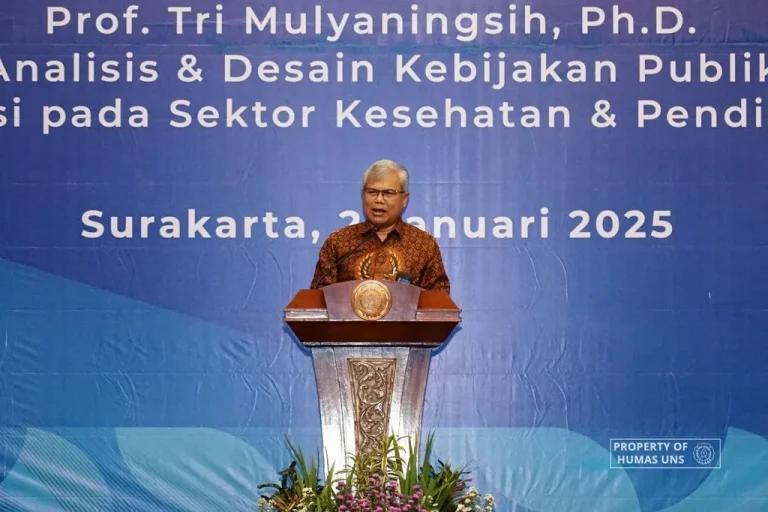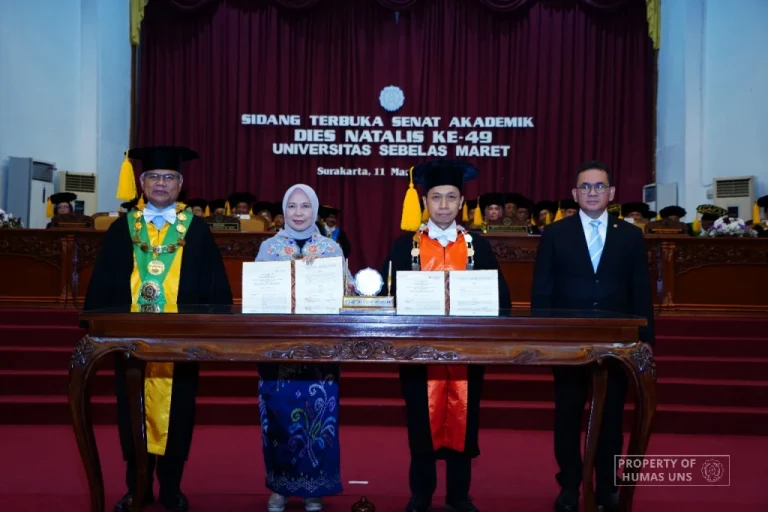
UNS—Dr. Tri Mulyaningsih, S.E., M.Si., Ph.D., a lecturer at the Faculty of Economics and Business (FEB), Universitas Sebelas Maret (UNS), Surakarta, has been inaugurated as a professor in health economics expertise. The inauguration ceremony took place on Tuesday (17/12/2024), at the G.P.H. Haryo Mataram Auditorium of UNS. Her inaugural speech, titled “Malnutrition: Economic Losses and Policy Design to Improve the Nutritional Status of Children and Adolescents,” addressed pressing issues surrounding malnutrition.
In her remarks, Prof. Tri highlighted Indonesia’s transformation from a low-income country to a developing nation and a member of the G-20. Despite this progress, she noted that development remains noninclusive, with high economic growth failing to fully eradicate poverty or address limited access to basic infrastructure. Economic growth has also widened the gap between the wealthy and the poor.
This lack of inclusivity has led to a double burden of malnutrition, where half of children and adolescents experience stunting, wasting, or obesity. While government policies primarily focus on addressing stunting in children, adolescents remain largely overlooked. Malnutrition in adolescents hinders their transition to adulthood, delays the benefits of their second growth spurt, and affects the health of their offspring.

“Malnutrition imposes significant economic costs by reducing cognitive abilities and lowering workforce productivity. It also increases the risk of obesity and cardiovascular diseases, leading to higher healthcare expenses,” Prof. Tri explained.
To reduce the prevalence of adolescent malnutrition, Prof. Tri emphasized the need for school-based intervention policies that consider nutritional transitions. Adolescents are increasingly consuming processed foods, reducing dietary diversity (particularly fruits and vegetables), and facing limited access to nutritious foods in school environments while unhealthy options remain abundant and affordable.
Policy design for addressing adolescent malnutrition should incorporate principles of behavioral economics, where policymakers act as choice architects to influence adolescents’ consumption behaviors. A key approach is implementing nudge strategies to encourage healthier dietary choices among adolescents.
Adolescents often require guidance in their consumption decisions, as they frequently make suboptimal choices, such as poor eating habits or smoking. This is largely due to irrational decision-making processes, where adolescents may lack sufficient attention, access to complete information, or self-control at the moment of decision-making (incomplete self-control).
“We have researched school-based intervention programs to increase the consumption of healthy food by influencing students’ preferences through nutritional literacy and agency, which includes giving students the right to choose their food and improving their purchasing power with subsidies for healthy food. We tested the ‘nudge’ approach in the form of food subsidies and agency for adolescents using a Randomized Control Trial (RCT) method,” Prof. Tri Mulyaningsih said.
Research shows that nutritional literacy combined with food subsidies reduces the consumption of unhealthy food. The intervention is more effective when combining nutritional literacy and nudges in the form of agency, particularly among younger and lower-income adolescents. Therefore, the nudge intervention, which is simple and relatively inexpensive, proves effective in improving healthy food preferences among adolescents, especially those from lower-income groups.
Several policy recommendations suggest that nutritional literacy is effective in influencing healthier eating preferences. However, food subsidy programs alone are insufficient to impact adolescent healthy eating behaviors. School-based programs for adolescents that involve leaders, teachers, and cafeterias are quite effective. An effective program is a combination of nutritional literacy accompanied by food subsidies that grant agency rights to adolescents. Thus, an effective malnutrition policy design for adolescents could adopt nudges and target groups that are responsive to interventions, with an understanding of adolescent behavior and economic backgrounds.
To the newly inaugurated professors, UNS Rector Prof. Dr. Hartono, dr. M.Si., expressed his highest appreciation for their dedication, commitment, and efforts in achieving the highest functional position of a lecturer. The title of professor carries a significant responsibility to continue contributing to the advancement of science, education, and national development. In addition, professors also have a moral responsibility to provide contributions, participation, and work for the progress of higher education institutions and society.
“Formally, a professor is expected to produce significant works in the three pillars of higher education. In the coming years, increase your contributions to advance UNS and enhance its national and international reputation,” Prof. Hartono said.
HUMAS UNS
Editor: Dwi Hastuti