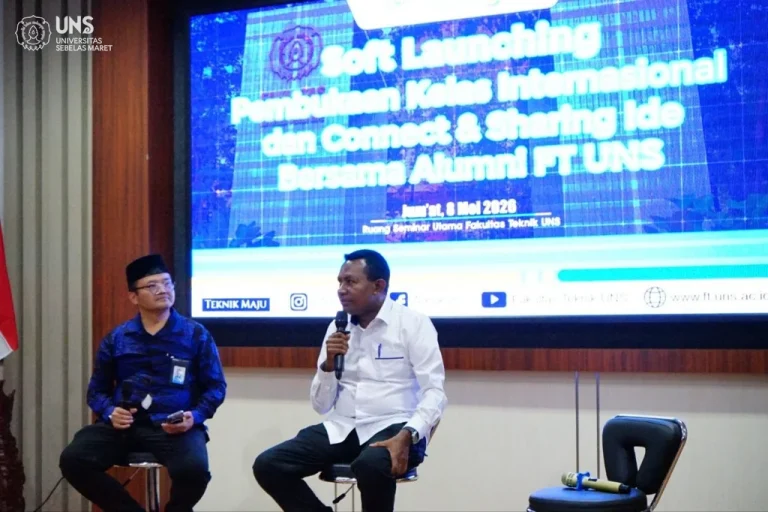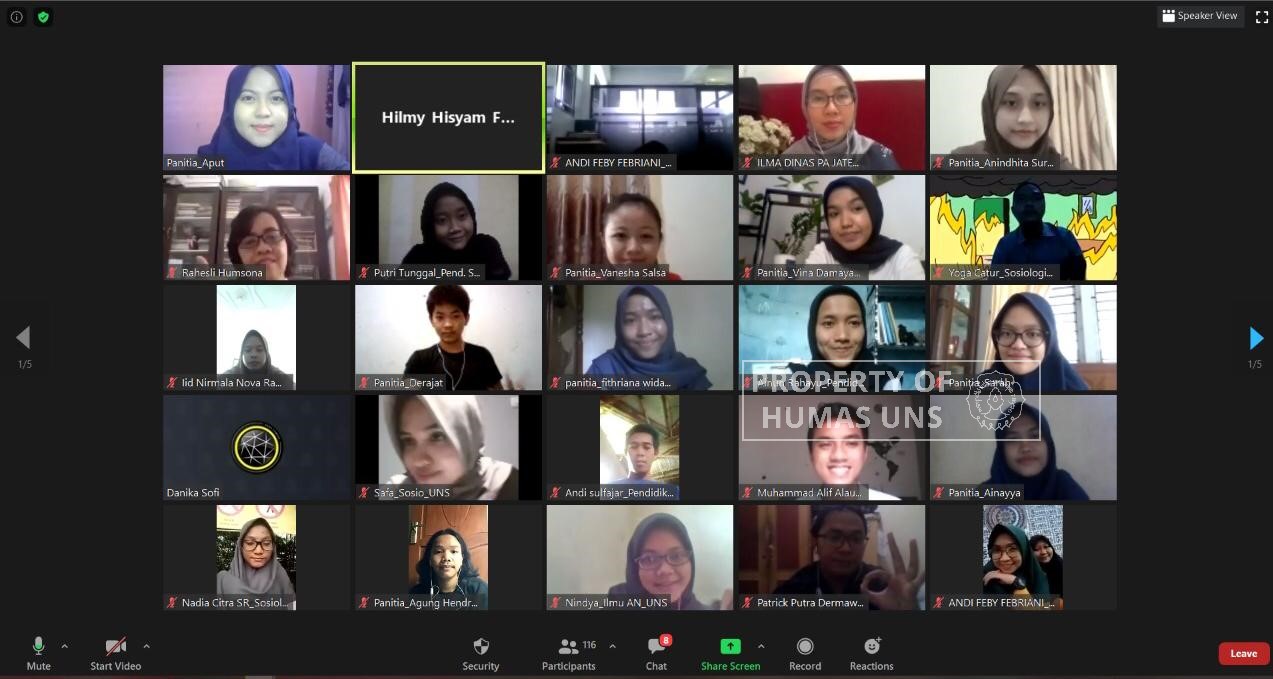
UNS — The Sociology Study Program Student Association (Himasos), Faculty of Social and Political Sciences (FISIP) Universitas Sebelas Maret (UNS) Surakarta, organized a national webinar on Saturday (21/11/2020). The webinar entitled ‘The Increase of Violence Toward Children During Pandemic: Dad, Mom, Why I am not Loved?’ was hosted through the Zoom Cloud Meeting. Attended by more than 271 participants, Himasos FISIP UNS invites 3 (three) speakers, namely Dra. Rahesli Humsona, M.Si., Isti Ilma Patriani, S.Psi., M.Psi., Psikolog., and Patrick Putra Dermawan.
Isti Ilma Patriani, S.Psi., M.Psi., Psikolog., (Division Head of Child Protection, Women and Child Development Office, Central Java), is presenting the first material regarding the online system as a learning alternative that can lead to conflict between children and parents. “In the education field, the online system becomes an alternative learning process. However, not all parents have the capacity to teach their children like a school teacher. This can be a potential where parents pour out frustration on the child,” Isti explains.
According to her, the role of parents is crucial in the parenting process, especially related to education and positive effect. When a child is in the golden age, they will actively absorb both positive and negative matters. If there is physical violence, child condescension, recurring stigmatization, and labeling, negative expression to the child will affect their behavior. Isti suggested that parents listen and understand their children, providing love and positive expression, as well as practicing good communication.
The second speaker, Dra. Rahesli Humsona, M.Si. (lecturer of Sociology Study Program FISIP UNS), states that during the ongoing pandemic, children face various threats.” During this pandemic, children face multiple threats. First, the danger related to the pandemic, second, they are pressured by their parents if they become disobedient, and third, children got pressure from the education institution. The Work from Home (WFH) and Study from Home (SFH) setting make the family spend a long time staying at home,” Dra. Rahesli explains.
Further, she adds that uncertainty during the pandemic creates anxious felling, worried, boredom, exhaustion, or even depression for children. Under this condition, children become the weakest member in a family and the most impacted one. Violence toward children can make the child have low esteem. Sociologically, children will have low trust in other people. While physiologically, violence can causing injury, physical disability, and even death.
Last material delivered by Patrick Putra Dermawan (student of Sociology Study Program class of 2018) related to the causes of child abuse.” Based on the 1st Period of Simfoni PPA from January 1st to August 21st, 2020, there are 4,859 cases of violence toward children. The causes are economic constraints, lack of parental education, gadget usage, poor communication between children and parents, and feeling bored and tired that triggers anger,” Patrick explains. Humas UNS
Reporter: Zalfaa Azalia Pursita
Editor: Dwi Hastuti