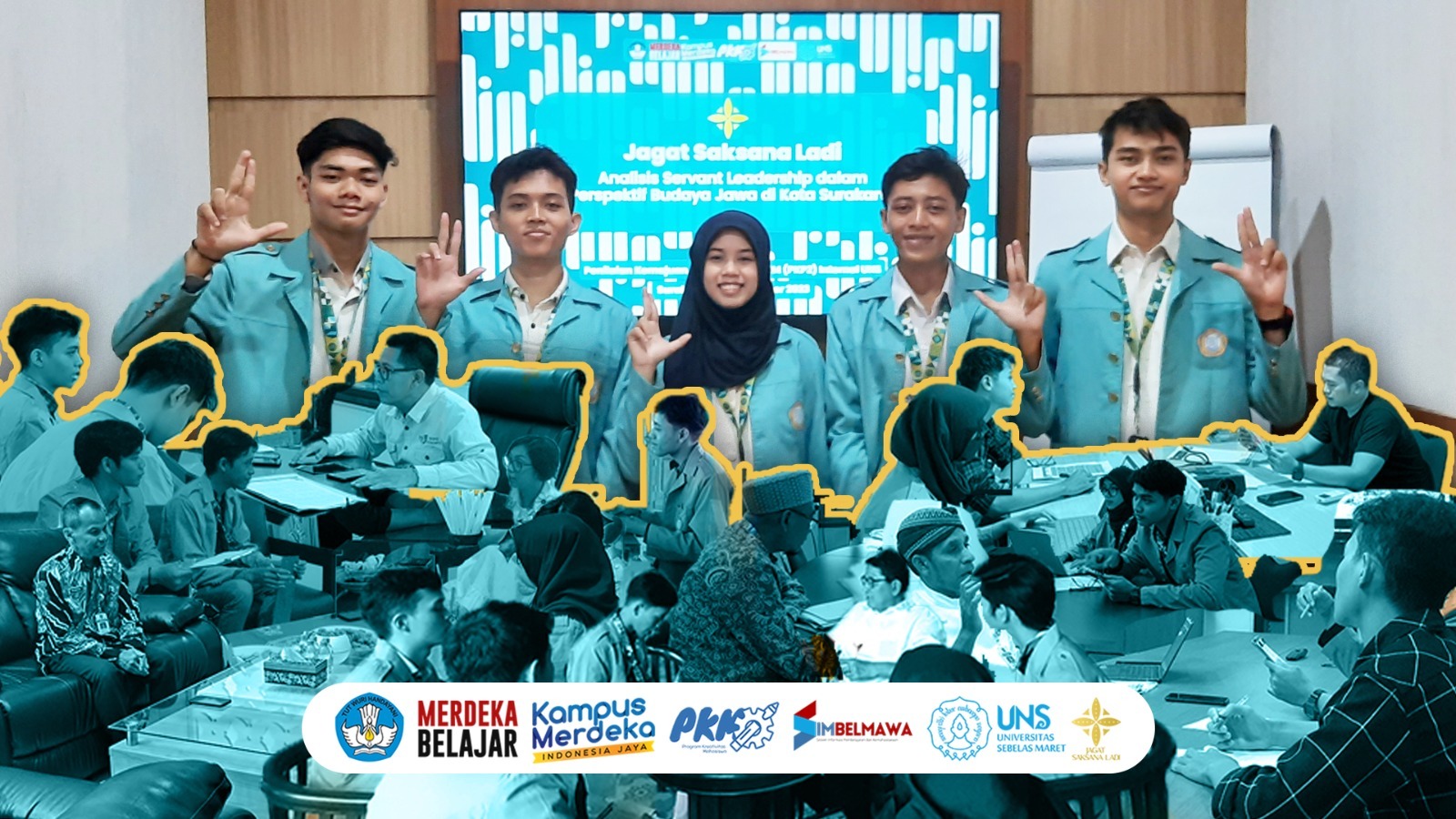
UNS – Five students from the Faculty of Social and Political Sciences (FISIP) Universitas Sebelas Maret (UNS) Surakarta were interested in exploring the application of the servant leadership concept. They found that the leadership paradigm has undergone significant development. The fading of feudal-style leadership has given rise to the concept of servant leadership, which is leadership oriented towards service.
The exploration of servant leadership was carried out with a perspective on Javanese culture, a culture rich in noble leadership values and philosophies. Their interest and curiosity were channeled into research under the Student Creativity Program (PKM) for Social Humanities Research (RSH), which subsequently secured funding.
The RSH PKM team is from the Public Administration Study Program of FISIP UNS. The UNS students involved are Ivan Aditya, Anang Akbar Rizky Putra Halyandi, Aditia Permana Aji, Muhammad Robeeth Fauzal Haq, and Noor Rizky Tiara Putri. The research was supervised by UNS lecturer, Dr. Asal Wahyuni Erlin Mulyadi, S.Sos., MPA.
Their research is titled “Jagat Saksana Ladi: Analysis of Servant Leadership in the Perspective of Javanese Culture in Surakarta City“. Over five months, from June to October 2023, they delved into the servant leadership concept from the perspective of Javanese culture.
Research on Public Organization Leaders in Surakarta
The PKM RSH UNS Team’s exploration was conducted using a phenomenological approach. Through this method, they conducted interviews with various public organization leaders in Surakarta as their informants.
During the research, the PKM RSH UNS team successfully interviewed 25 informants who were leaders of public organizations in Surakarta. The research informants came from various backgrounds, such as religion, academia, bureaucracy, non-governmental organizations (NGOs), politics, and special public organizations.
Discovering Noble Leadership Philosophies
Based on their research, they found that the informants understand and apply the concept of servant leadership in Javanese culture through noble philosophies. Leaders of public organizations in Surakarta adhere to the practices of the philosophies of Ing Ngarsa Sung Tuladha, Ing Madya Mangun Karsa, and Tut Wuri Handayani. These noble philosophies of Ki Hadjar Dewantara are applied through the creation of a service-oriented organizational culture that promotes individual growth.
Furthermore, the research results indicate that leaders of public organizations in Surakarta understand the importance of self-awareness, morality, and service as the main aspects of leadership. They do this by setting a good example and being role models, having insight and a broad mindset, and applying the principle of humanizing humans through empowerment and competence improvement. These findings show that these leaders have demonstrated how the concept of servant leadership based on Javanese cultural values is embodied.
“This research is not only about achieving achievements but also about how our (students’) contribution to the scientific field is based on local wisdom. We hope that the results of this research can be a starting point for efforts to explore leadership from a cultural perspective, especially Javanese culture, which we encapsulated by introducing the concept of Jagat Saksana Ladi,” Ivan Aditya, the Head of the PKM RSH UNS Team, concluded on Tuesday (7/11/2023). Humas UNS
Reporter: R. P. Adji
Editor: Dwi Hastuti