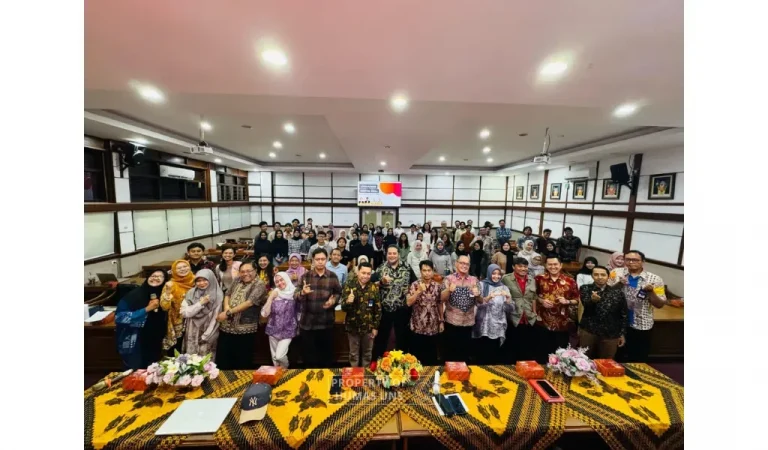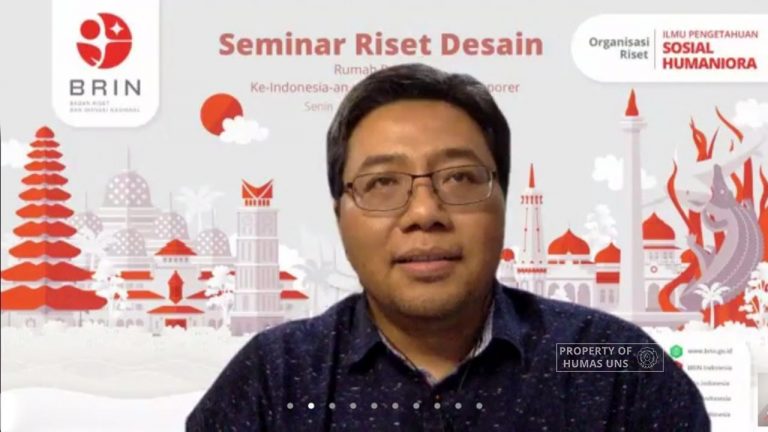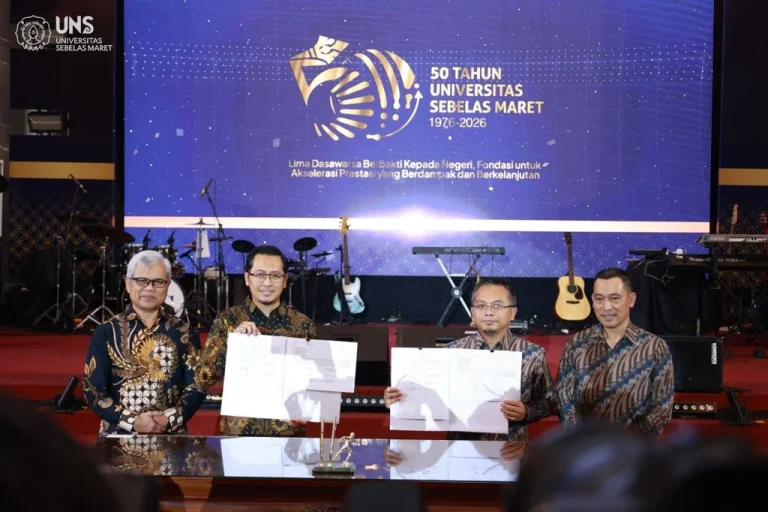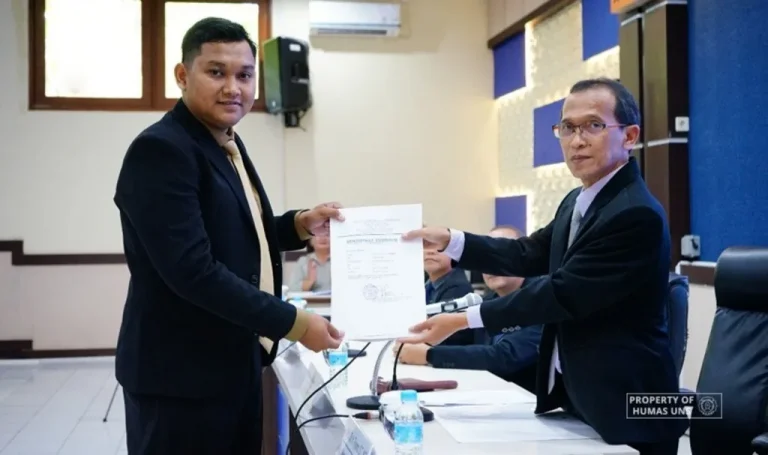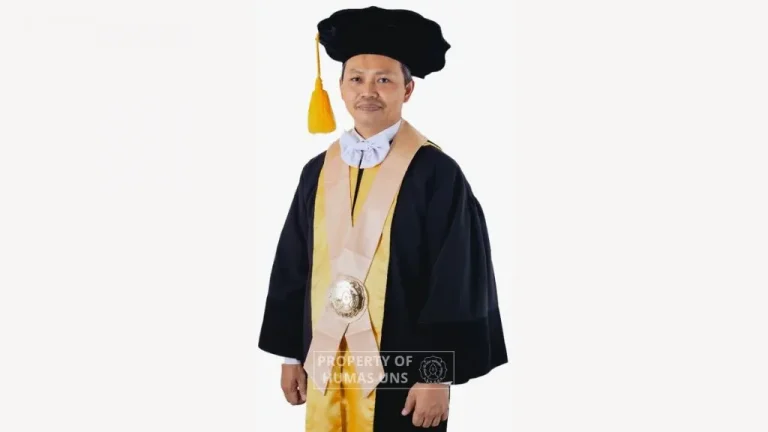
UNS — The alumni of Universitas Sebelas Maret (UNS) in Alumni Association (IKA) UNS held a Wedangan discussing “Six Years of Joko Widodo (Jokowi) Administration” online on Wednesday (5/11/2020). This event was opened directly by IKA UNS Chairman, Ir. Budi Harto and was attended by the Rector of UNS, Prof. Jamal Wiwoho and the Governor of Central Java, Ganjar Pranowo.
In this occasion, Ganjar stated that the development of technology and the current pandemic become a moment to reflect that the health management in Indonesia is yet to be considered as strong. Even though the efforts to observe and learn from the past outbreak such as SARS, Spanish Flu and other illnesses have been conducted, but in reality, it has not served a significant impact. Ganjar gave an example of mask problems early in the pandemic and the lack of Personal Protective Equipment (PPE). “Currently, the role of universities is highly needed to provide a solution for the existing problems,” he explained as the keynote speaker.
Five speakers attended the event, Dr. M. Qodari, M.A, the Executive Director of Indo Barometer, Abdul Kohar, S.Sos from Media Group, Prof. Dr. Zudan A.F. S.H., M.H, the Director-General of Population and Civil Registration (Dukacapil) Ministry of Internal Affairs (Kemendagri), Dr. Drajat Tri Kartono, Sociologist and Senior Advisor to UNS Rector and also attending the event was the Deputy Chairman of Commission I of Dewan Perwakilan Rakat (DPR) (House of Representatives) of the Republic of Indonesia (RI), Dr. Abdul Kharis, M.Si. Ak.
The Executive Director of Indo Barometer, Qodari delivered the result of a national survey conducted on 10-17 October 2020 on the First Year Performance of Jokowi – Ma’ruf Amin administration and Covid-19 in Indonesia. The general assessment based on the survey showed society’s views on the matters that need to be solved immediately. The survey results showed that the top three problems that require prompt actions from the government are people’s economy (28.6%), jobs (20.2%) and stability of staple foods price (10.9%). “Turned out that Covid-19 face for Indonesian people is the economy,” Qodari stated.
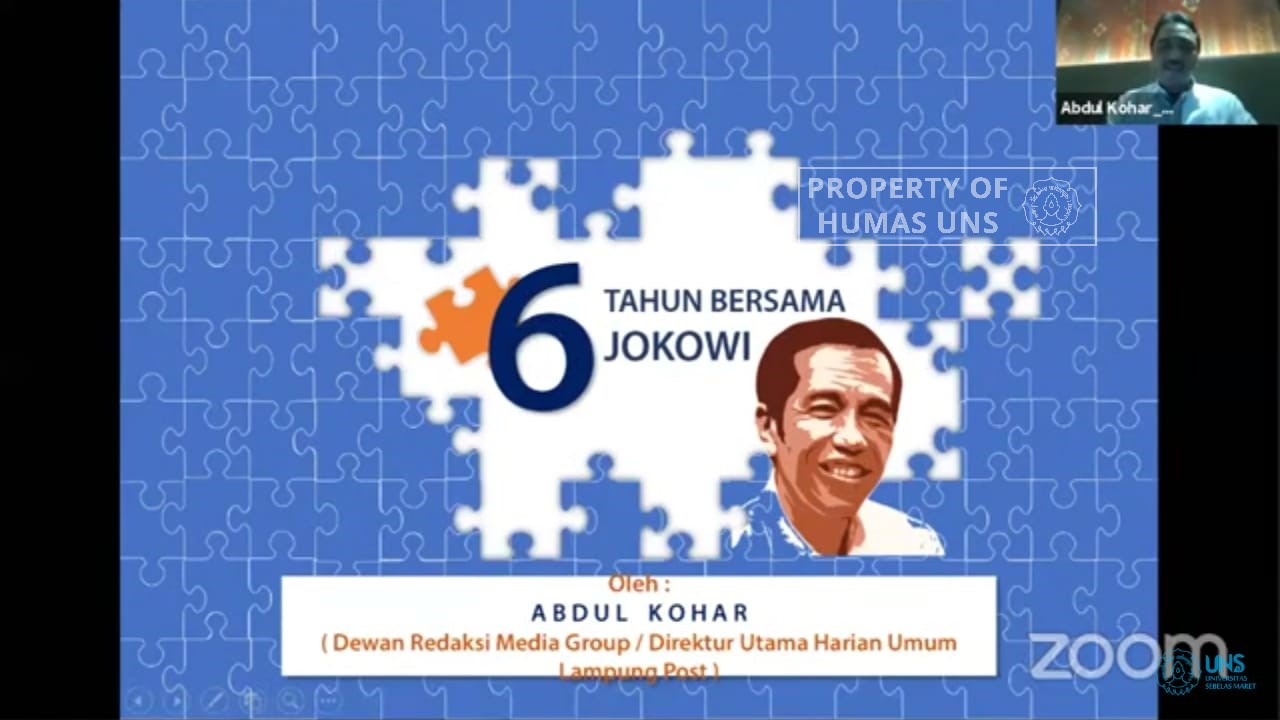
The second presentation from Abdul Kohar discussed the facts that have been summarized into a theme “Six Years with Jokowi”. Several points discussed in his presentations are the corruption perception index used to assess the efforts in corruption alleviation. The Human Development Index which considers the health, education, and life expectancy. And lastly, democracy index and Indonesia economic growth, the increasingly hot topic along with the increasing age of the government. During the six years of Jokowi administration, Abdul Kohar stated, it is apparent that people can give him blue rapport (passed) and not red (failed). “If we assess from a fair and objective point of view regarding the existing facts,” he added.
Prof. Zudan as the third speaker entered the discussion by providing an opinion on the new values which Jokowi tried to bring into his administration. The values that Prof. Zudan considered as positive are modesty, quick thinking or responsive, and the courage to act out of the box. Prof. Zudan gave the example of modesty performed by Jokowi through his simple appearance which prioritizes the work process. Then, responsive; when problems arose, Jokowi responded with quick thinking in processing and taking a decision. Lastly is Jokowi courage in taking new policies that are out of the box.
Supporting Prof. Zudan notions who shared the new values brought by Jokowi, Dr. Drajat tried to discuss the phenomenon from the sociological perspective which theoretically assessed that the direction of the country is the network society and will develop into smart society marked by the community that become smart and have digital-based activities. Dr. Drajat stated that currently, the community need to be open and balanced this with the evenly distributed information. People should feel free to share their views. Therefore, the government is expected to show its assertiveness in its identity as a government when responding toward the current condition.
Lastly, the constructive critic was delivered by Dr. Abdul Kharis Almasyhari who stated that currently, Indonesia has a good relationship with other countries. However, in two other fields, the defense and information and communication, Abdul Kharis considers that Jokowi does not show full support for the field of national defense. As an example, several transgressions performed by neighboring countries on Indonesia sea and air borders. This can become a point to consider because if the government does not solve this problem, it might lower other countries’ recognition over Indonesian territory. He added that Kemenkominfo (Ministry of Communication and Information) cannot deliver information smoothly and tend to create rackets in the community. For example, concerning the peduli lindungi app (covid-19 tracking app) which has flaws such as limited access for certain gadgets. Abdul Kharis also considers that this institution is not ready to maximize the use of digital communication which leads to the large numbers of hoaxes that appear in the community. Kominfo tends to fix a problem after it occurs instead of preparing good planning to prevent a problem. HUMAS UNS
Reporter: Ratri Hapsari
Editor: Dwi Hastuti