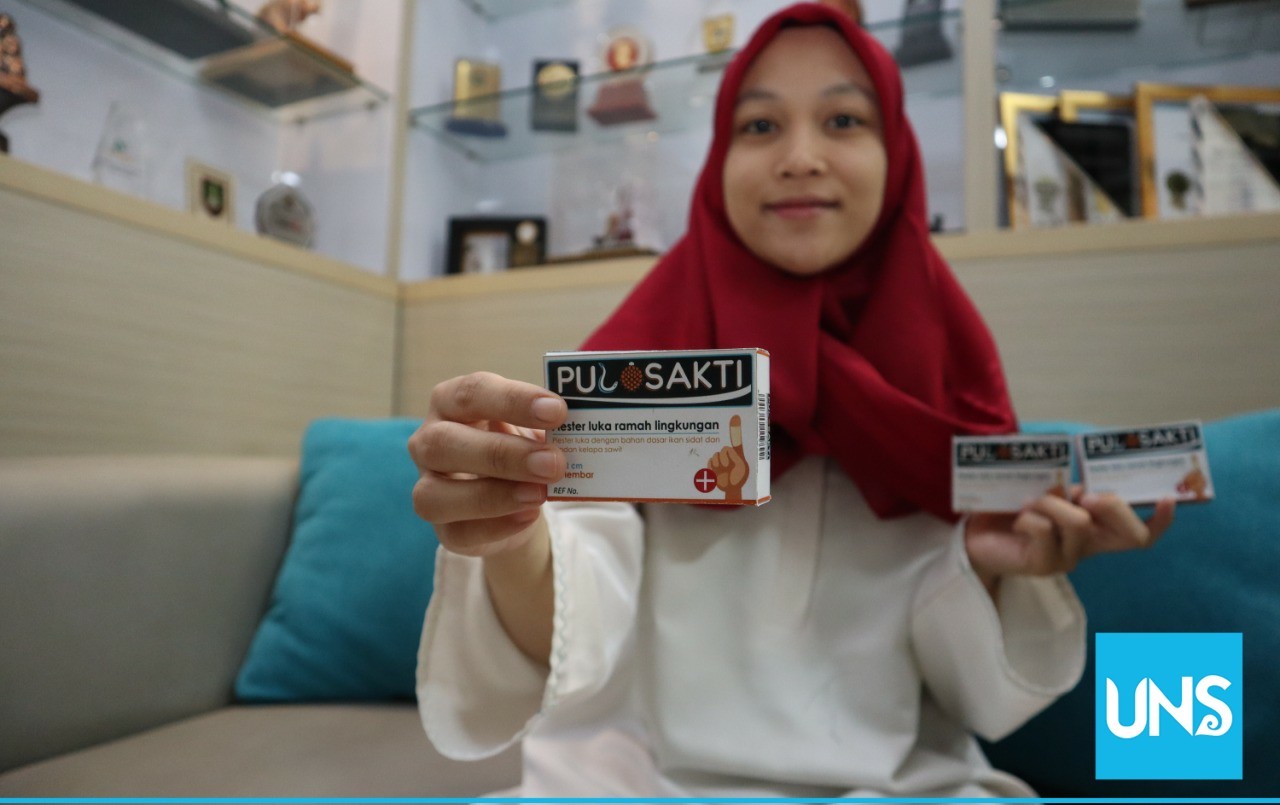
UNS – Students of Chemistry Department of Faculty of Mathematics and Natural Science (FMIPA) Universitas Sebelas Maret (UNS) Surakarta managed to form a Strip Plaster made with Empty Fruit Bunch of Oil Palm Tree and Freshwater Eel or abbreviated as Pulosakti. This research is conducted by Alfiyatul Fithri and Wahyu Puji Pamungkas then supervised by Dr. rer. nat. Maulidan Firdaus, M.Sc. It achieved IDR 20 million (USD 1.373,87) of funding from Indonesian Oil Palm Estate Funds (BPDPKS).
To the reporters, Fithri told that in order to qualify for research funding from BPDPKS, they had to compete with hundreds of students from various universities. Out of 400 research proposals submitted to BPDPKS, only 20 passed and received funding from BPDPKS.
“Yes it feels great because the proposal qualified and obtained funding to conduct the research,” said Fithri.
The reason behind Fithri and her team carried out this research is because FAO (Food and Agricultural Organization) has claimed Indonesia and Malaysia as the greatest oil palm producers and exporters in the world. Unfortunately, the oil palm manufacturing process in Indonesia is not optimal due to the issue of the empty fruit bunches. It still considered as waste so they utilize the empty fruit bunches of oil palm as the basic material of hydrogel. In addition, freshwater eel contains high albumin and it is abundant in Indonesia. It is a reason why they chose eel as one of the components to produce hydrogel.
“Oil palm tree has always been cultivated for the fruit while the empty bunches were left and causing tons of waste or made as charcoal. Therefore, my team initiates to transform the empty fruit bunch of oil palm into strip plaster and add albumin from eel which can fasten the healing process of a wound,” Fithri explained.
She added that Pulosakti is an eco-friendly modern strip plaster based on hydrogel. Hydrogel is made of waste of empty fruit bunches of oil palm. Meanwhile, eel fish is an additional component to fasten the healing process of a wound because of the high amount of albumin.
The application of Pulosakti is quite simple by pasting the strip to the wound after sterilizing the wound with clean water or alcohol to get rid of the dirt and blood. The effectiveness of this product was obtained from wound test of white mice. The performability to accelerate wound healing is observed and compared to conventional wound plasters and gels. Based on the result of the test above, Pulosakti is effectively functioned as a first aid kit.
Pulosakti has excellent power to speed up the wound healing which is economical, eco-friendly, mild, no chemical harmful substance, and easily removed without leaving scratches.
After the research has been organizing for six months, Pulosakti had been laboratory tested and it is safe to use. “The product is available and gel-formed but solid like the conventional strip plasters. After the research process is complete, this product will be ready to be mass-marketed. Moreover, we have already held Intellectual Property Rights (HAKI) for this product,” she concluded. Humas UNS/Try