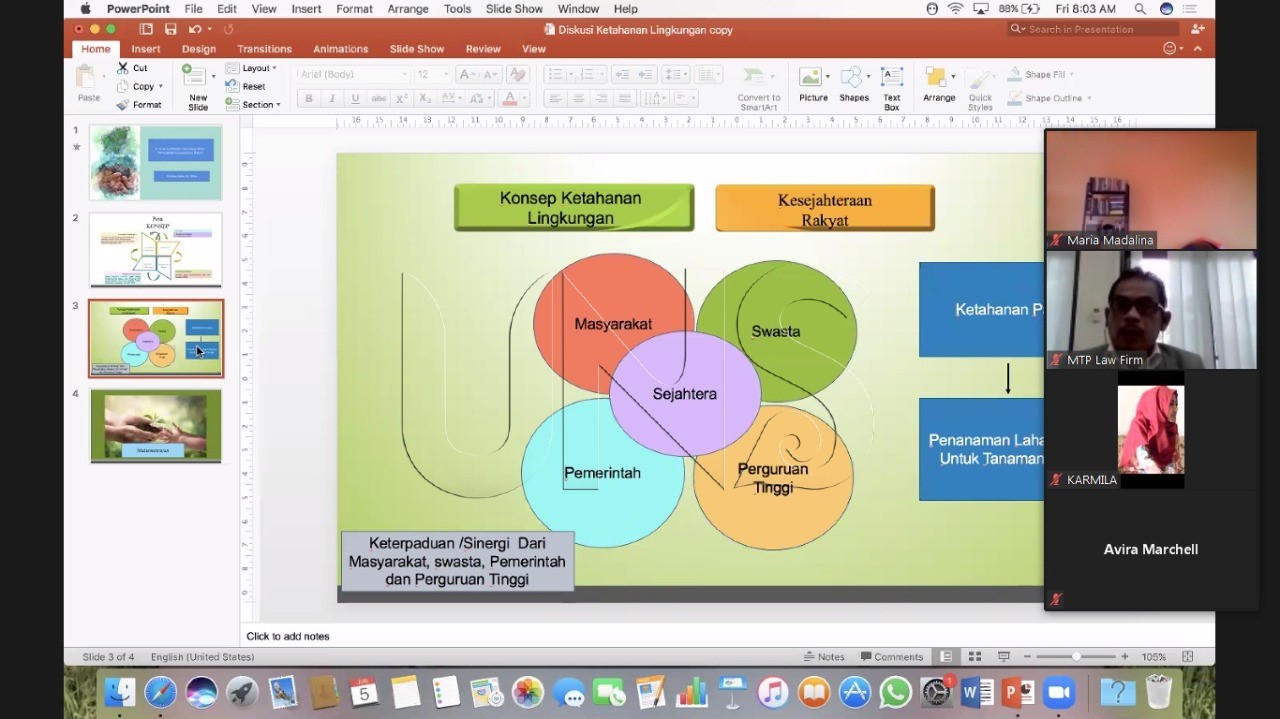
UNS – The Democracy and National Resilience Study Center (Pusdemtanas), Institute for Research and Community Engagement (LPPM), Universitas Sebelas Maret (UNS) Surakarta, held an interactive discussion webinar regarding the democracy in Environment Resilience Concept to Achieve Community Welfare, on Friday (5/6/2020).
The webinar that was held through a Zoom Meeting, was presenting Dr. Rahayu Subekti, S.H., M.Hum., Dr. Muhammad Taufiq, S.H., M.H., and Prof. Dr. Pujiyono, S.H., M.H., as speakers. Also present Prof. Dr. Jamal Wiwoho, S.H., M.Hum., as the keynote speaker, and the discussion was led by the Chief of Pusdemtanas LPPM UNS, Dr. Sunny Ummul Firdaus, S.H., M.H. The webinar was attended by more than 90 participants, either student, lecturers, and the general public.
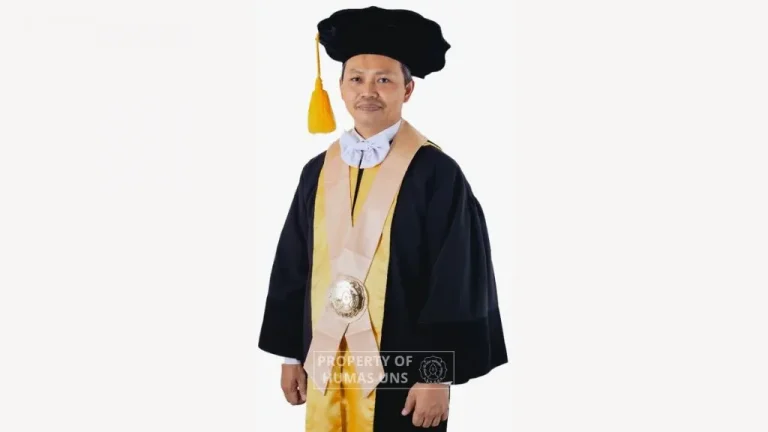
The discussion was opened by Dr. Rahayu Subekti, S.H., M.Hum., as a lecturer from the Faculty of Law (FH) UNS. Dr. Rahayu explains that there are issues that brought to the spotlight such as environmental damage, poverty, environmental security, and people’s welfare. She adds that poverty and environmental damage is interrelated. “Environmental damage and poverty are interconnected,” said Dr. Rahayu.
Environmental damage is a change, either directly or indirectly, that happened to the physical, chemical, and biological characteristics of the environment that exceed the environmental damage criteria. Related to this, two types of poverty are discussed, namely structural and absolute poverty. Structural poverty is related to the system and policy made by the government, while absolute poverty refers to the living quality standards where someone is unable to fulfill their basic needs. Unwanted environmental damage will arise if poverty is not properly addressed.
The next point is related to environmental resilience to achieve community welfare. When the effort to ensure public safety in a proportional manner is achieved, from both natural and human error due to accident and misconduct, then community welfare in the form of adequate physical and spiritual conditions can be achieved. This is where synergy among the community, private sector, government, and university is needed.
The second speaker, Dr. Muhammad Taufiq, S.H., M.H., from Muhammad Taufiq and Partners Law Firm, opens his presentation with Javanese proverb “Luwih becik pager mangkok, tinimbang pager tembok,” said him.
The proverb means that a good relationship with neighbors is better than brick and mortar fence. This is an approach developed in the lower middle class that governs how to engage in society, which indirectly requires an affluent person to share food to establish a harmonious relationship and avoid conflict.
Dr. Muhammad Taufiq explains that the environmental resilience concept is a part of national resilience. The national resilience refers to the capability and its toughness to be able to guarantee its survival towards the glory of the nation and state. The national resilience of a nation reflects a picture of the national identity.
“National resilience in all of its aspects reflect who this state is and how this state is managed. This implies that national resilience needs to be improved, no one should be left while the others are forgotten because each is closely related,” explains Dr. Muhammad.
One of the threats to environmental resilience is the decrease in forest and green vegetation area coverage. Other than that, there is also environmental pollution, urban development, industrialization, and human activities that lead to natural imbalance.
Afterward, Prof. Dr. Pujiyono, S.H., M.H., discuss legal compliance. There are many regulations that connect environmental management by the private sector and the general public, but the implementation still constrained. So far, the one that took charge of the environment condition is corporations and not society, this has become a problem after the corporations earn their takings, the society does not gain anything. There should be a Government Regulation that governs what the society can gain from a legal dispute, thus legal compliance can be implemented.
Prof. Jamal Wiwoho, S.H., M.Hum., as the keynote speaker states that basically, a nation has its own way to achieve community prosperity and the government need to always strive for development. “The government needs to strive for development and maintain the environment quality,” explains Prof. Jamal.
Prosperity can be realized through productivity in all sectors. Meanwhile, development must consider the environment condition, where the design will not destroy the environment condition. Development in Indonesia needs to consider several factors such as better access to education, equal opportunities in markets, labor, and business, social harmony and equality, access to good health, and intergenerational justice. Humas UNS/Zalfaa