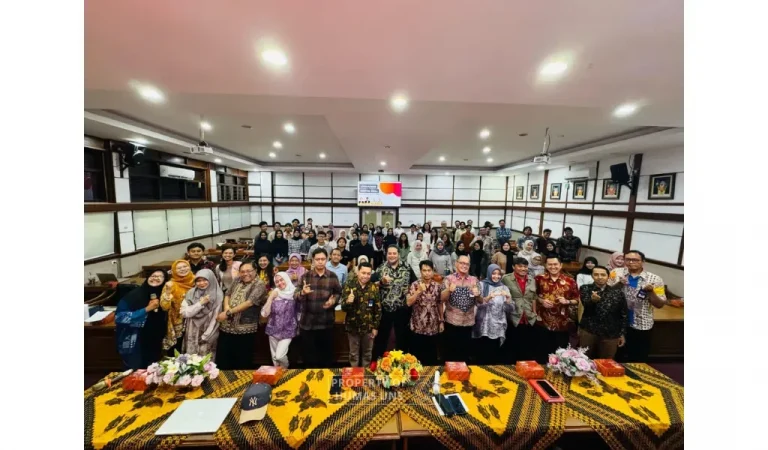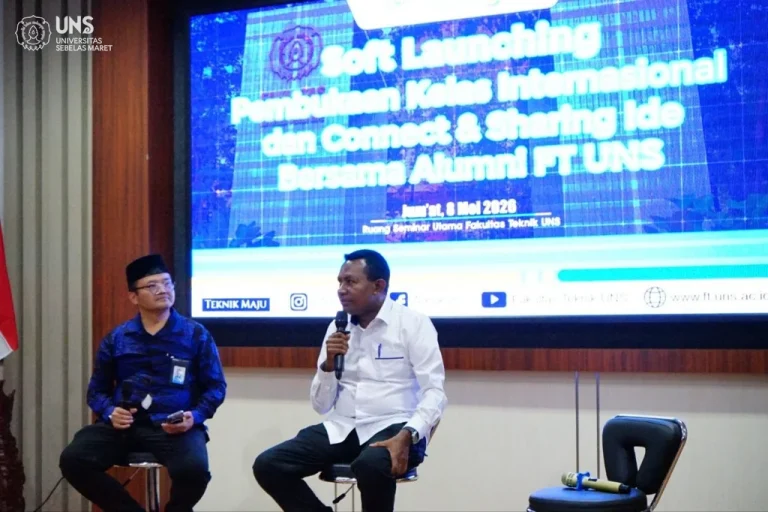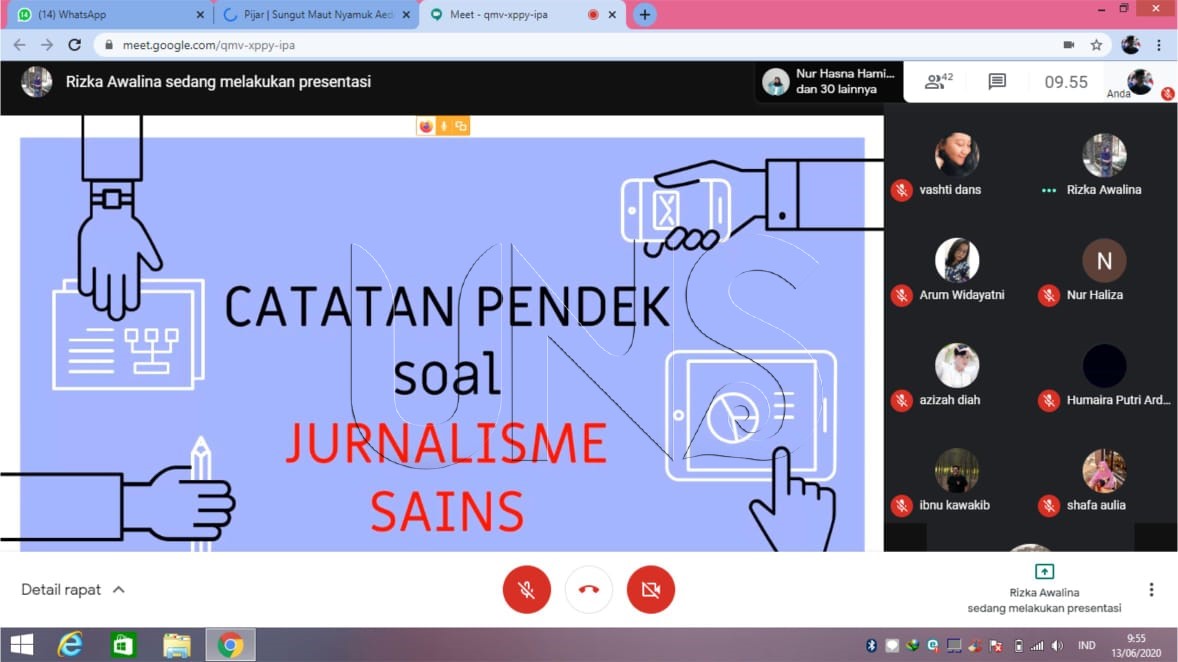
UNS – Communication Science Student Association (Himakom) in collaboration with Student Press Agency (Lembaga Pers Mahasiswa-LPM) VISI Faculty of Social and Political Sciences (FISIP) Universitas Sebelas Maret (UNS) Surakarta, organize a webinar entitled “Getting to Know Science Journalism”, on Saturday (13/6/2020). This webinar aims to discuss in-depth the world of science journalism, which is to be heard in Indonesia.
On this occasion, Himakom FISIP UNS specifically invites one of the science journalists, Dewi Safitri, as the main speaker. Dewi Safitri who currently is active as CNN Indonesia journalist has been in science journalism for 10 years.
Opening her presentation, Dewi introduces science journalism to 95 webinar participants through Google Meet. Based on her experience, she understands that the world of science journalism in Indonesia is still unknown to many people.
“Almost 40% of us never heard of this term or do not know what science journalism is like. Not only in Indonesia but also in many countries in this world, it is the same. Science journalism just developed for the last 40-50 years, as a genre in journalism and is not yet matured,” explains Dewi Safitri.
Before knowing further regarding science journalism, one needs to understand the real meaning of science. One of the main points mentioned by Dewi is related to the understanding regarding the position of science, which refuses subjectivity. For her, science does not consider personal preference, ethnic, racial, and religious differences.
Another point mentioned in the position of science journalist for society. Dewi explains that their position is to deliver knowledge to the society to help the community to gain benefit from science.
“Science is related to all matter to form an honest description of the universe. Science journalists need to develop art to ensure that the audiences do not become the victims of bad, fake, or deceptive science,” she added.
Dewi who has worked as a journalist for 21 years, states that the biggest enemy in journalism is hoax news and pseudoscience. She gave an example when some community groups took action against the national vaccination week due to hoax news regarding the content of vaccines, which rumored to be not halal.
Referring to that example, the position of a science journalist becomes important because they must straighten the hoax news that circulates in the community through the smart news. Moreover, in reporting, a journalist must also cover the broadest possible area. The point is, through the news they wrote, science journalists need to explain clearly the impact or other benefits that can be obtained from science. Humas UNS/Yefta/Dwi