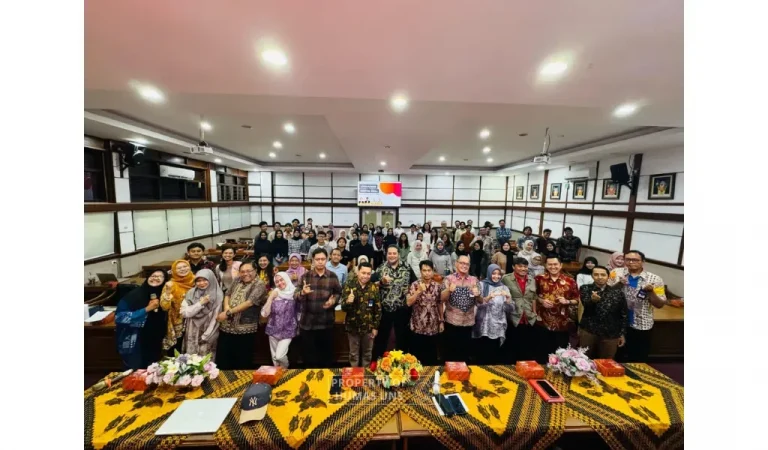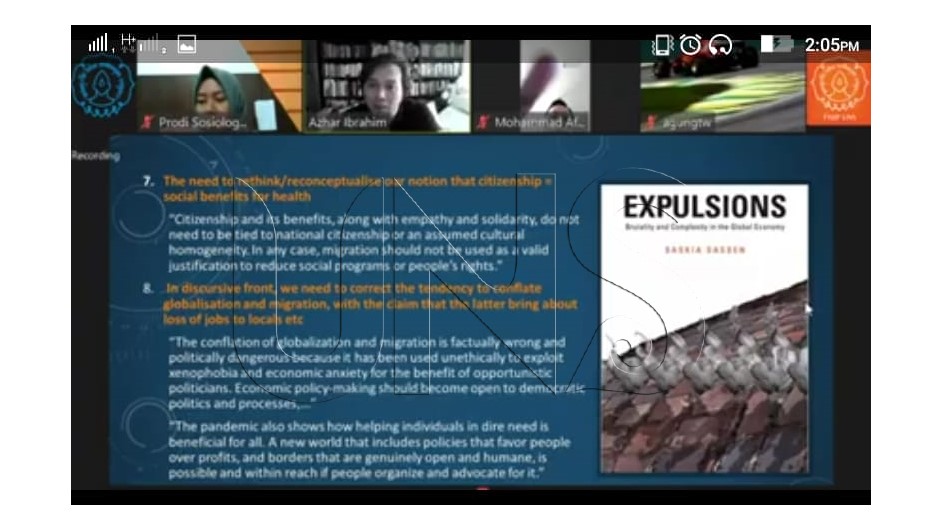
UNS – Xenophobia or fear of unfamiliar and foreign nations become one of the effects of COVID-19 Pandemic. Further discussion regarding this matter, the Sociology Study Program, the Faculty of Social and Political Sciences (FISIP) Universitas Sebelas Maret (UNS) Surakarta, held a Webinar ‘Nglaras Sosiologi (Enjoying Sociology) #5 Covid-19 and The Rise of Xenophobia’ on Tuesday (30/6/2020).
Opening the discussion, Yuyun Sunesti, a Lecturer of Sociology Study Program FISIP UNS, explains the emergence of local xenophobia in Indonesia. Namely, xenophobia in the form of the rejection toward the corpse of a coronavirus positive patient, people who come from outside the region, and vulnerable people contracted by the virus such as medical personnel. The main factor of this local xenophobia in Indonesia is, according to Yuyun, is the lack of information and awareness. No health information related to Covid-19 reached the grassroots or the community.
“For instance, rejection toward the corpse of coronavirus positive patient. Information that when the body is handled according to the Covid-19 protocol will be safe does not really reach the community,” explains Yuyun.
This including social stigma from the Sociology point of view. Something can be categorized as social stigma and xenophobia when there are differentiation and labeling. This manifested in the assumption that some people are different and dangerous to a social community, thus they should not be in that community. Afterward, there are restrictions on the words ‘we’ and ‘them’, which eventually cause harm to ‘those’ who are discriminated against. “It is normal to be scared of Coronavirus, but do not let that fear to detriment the other social groups who have the same rights in our social life,” said Yuyun.
Meanwhile, Azhar Ibrahim Alwee, a lecturer from Malay Indonesian Sociological Studies at the National University of Singapore, emphasized the important role of universities in dealing with xenophobia.
According to him, the academic members of a university should perform and mitigate this problem. One of the measures that can be taken is by fostering and disseminating critical concepts in the public sphere, both in the media and in various online conversations.
Moreover, the university can actively study xenophobia using a biosocial approach, which integrates social sciences and medical science as the core of COVID-19-related research. Alwee considers that, until now, people who are engaged in the medical field are more focused on technical matters, while social science academics never touch the public health topic, which actually has the opportunity to be examined.
“We do not collaborate with one another, there is no cross-interdisciplinary. Social science academicians should be able to discuss public health. There are many problems in front of our face, thus we need to perform with a critical social perspective. All this time, social sciences often appear high but do not touch the existing problems. Similarly with the medical science, must also be familiar with the social realm,” explains Alwee.
Mitigation on xenophobia stigma can be done by establishing society trust on hospital and isolation center is provided as a healing place, not for death. Alwee also mentioned the importance of international coordination to fight xenophobia. Humas UNS/Kaffa/Dwi