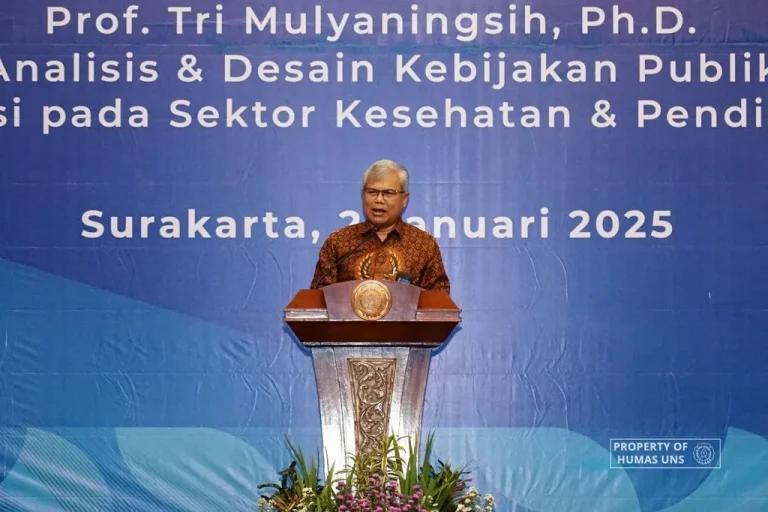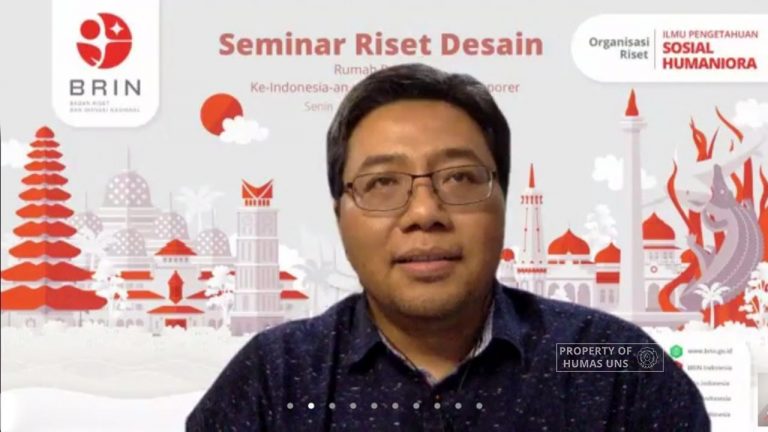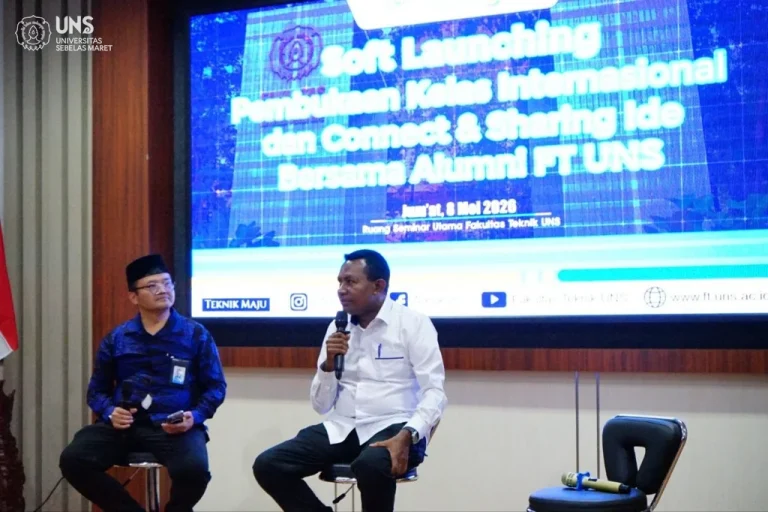
UNS – A professor from Universitas Sebelas Maret (UNS) Surakarta and the Head of Magister Program of Public Health, Prof. Bhisma Murti discussed the Trans-Theoretical Model application in health promotion in the webinar ‘Implementation of Trans-Theoretical Modal on Health Promotion based on Neuro-Linguistic Programming (NLP)’ held by the Magister Program of Public Health UNS, Saturday (4/7/2020).
The Trans-Theoretical Model also integrates several theories, three of which are the theory of planned behavior, social cognitive theory, and health belief model. The three have a reciprocal relationship that influences each other or a reciprocal determinism. Prof. Bhisma explained that the first construct of the Trans-Theoretical Model is the stages of change model. A change in one’s behavior has stages and require time to develop. The lowest or earliest process in the pre-contemplation, in this stage, someone has not changed their behavior and have not realized the importance of behavior change. In the pre-contemplation stage, a facilitator can provide knowledge and information while taking into account people’s feelings and subconscious thoughts that might inhibit the process. The next stage is contemplation, in which an individual made a plan to perform certain behavior in the next 6 months.
“At this stage, an individual is at the ambivalent stage between doing or not doing an action by considering its benefits and losses. For example, procrastinating behavior,” he added.
The following stage is preparation. In the theory of planned behavior, this stage is the intention to perform a behavior. For example, someone who wants to stop smoking starts to choose friends who do not smokes, choose an environment that can help them to stop smoking. However, this stage is not a regular action, someone has not settled into the new behavior. To reach sustainability it needs stability, self-regulation, and to prevent relapse, this stage is the maintenance stage, when no changes occur, the individual reaches the termination stage.
At the decisional balance, the decision to adopt new behavior is conducted by considering the benefits and losses. New behavior will be adopted when benefits exceed the losses. There are several ways to change a behavior, through motivational interviewing, or a client-centered collaborative counseling approach that aims to assist the client in solving problems and ambivalence so that client changes his/her behavior to achieve their objectives. A good relationship between client and health promotion officer, or a rapport; empathy or listening intently to the client. The officer must point out the disparity between the client’s objective and current behavior, thus, offering healthy behavior to close the gap.
Neuro-linguistic programming or NLP is one of the programs that can be adopted in this process. NLP is a collection of techniques to identify, learn, develop personal excellence models, mindset, communication methods, and behavior of successful people to be reproduced or carried out by others towards clients. Humas UNS
Reporter: Bayu Aji Prasetya
Editor: Dwi Hastuti