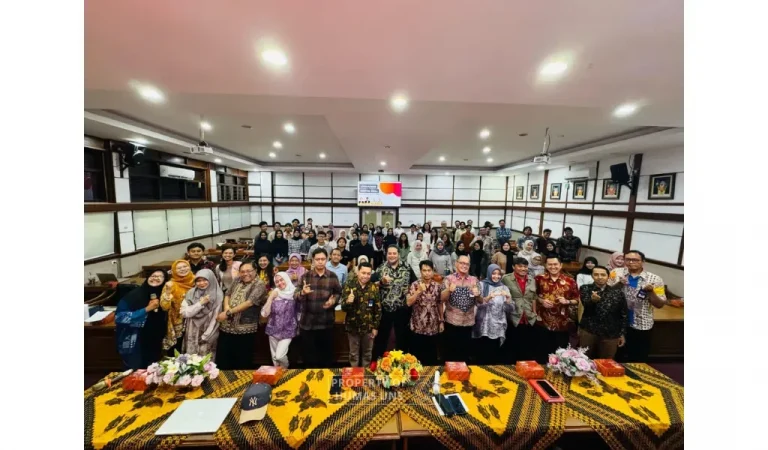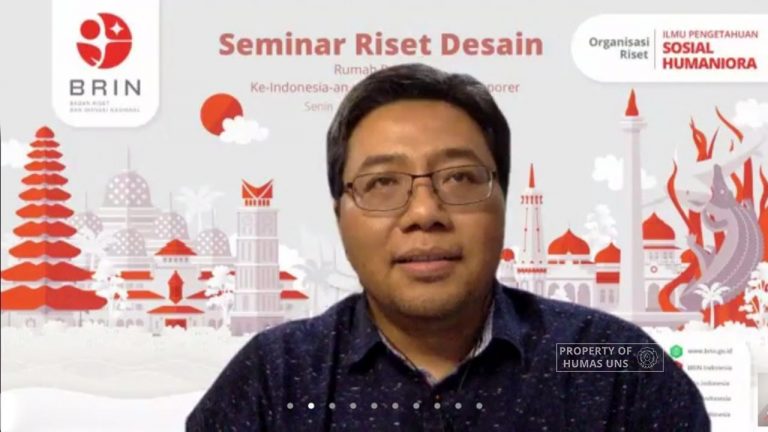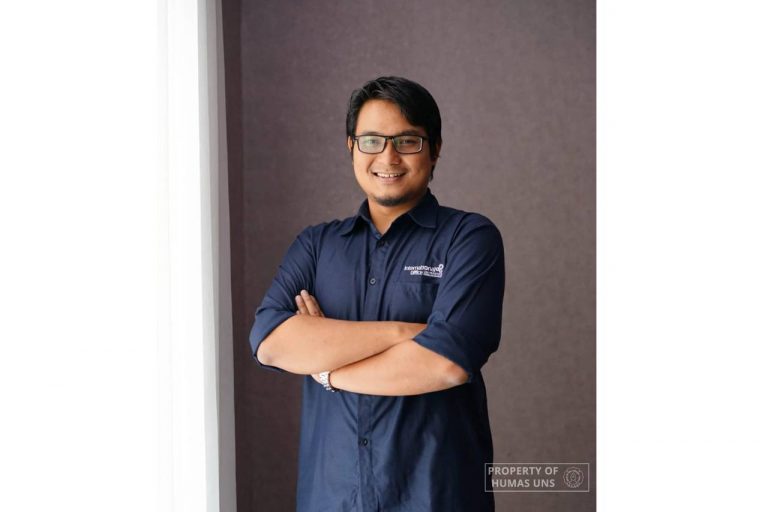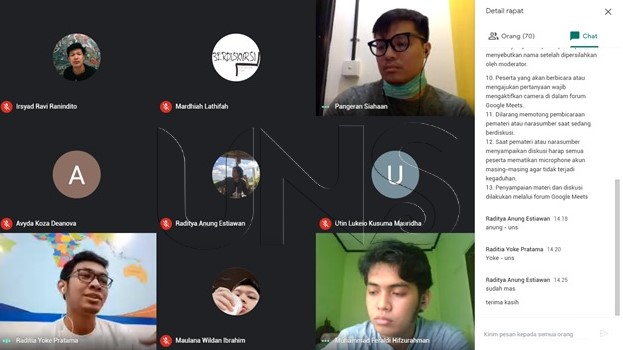
UNS – Student Executive Board (BEM), the Faculty of Social Studies (FISIP), Universitas Sebelas Maret (UNS) Surakarta held a ‘Gelar Tikar Virtual’ on Friday (10/7/2020). The event was held through Google Meet and YouTube Live stream, with total participants around 235 people. Bringing up a theme on “Crisis Communication and Essential Media”, the FISIP UNS BEM presented Pangeran Siahaan, the Chief Executive Officer (CEO) of Asumsi, as the main speaker.
Opening the discussion, the moderator of the event, Muhammad Feraldi Hifzurahman, delivers an outline for crisis communication, which is crucial during the ongoing pandemic. This encompasses how the government delivers crisis-related information to the society and the steps will be taken in dealing with the crisis. Currently, there are many parties commenting on government effort in implementing crisis communication, where the government is considered less decisive in their action, which resulted in much gray news and ignorant response from the communities toward the existing news and reporting. This condition is compounded by the number of news circulated in social media that more focused on the quantity instead of the quality of news. This condition is in contrast with the ideal condition where society needs the essentials, transparent, and valid information in order to understand the current condition of the crisis.
However, according to Pangeran Siahaan, there is one aspect of crisis communication that is seldom discussed, the socio-cultural factor. In simple terms, this can be seen from the communication patterns formed in each country. “It is actually a, how do you call it, maybe we can suspect that this is political rhetoric, but in the process of political communication, a sense of guarantee is something abstract but is necessary. Is it really done in my opinion, that is for the next discussion. But for the public or the community it is necessary to see who is in charge,” explains Pangeran Siahaan in the middle of the discussion.
The crisis communication implemented by the government is considered a little bit miscalculated at the beginning but showing a favorable movement afterward. Another point to consider is the purpose of the information conveyed, the sender only plays a small role when the message has been perceived by the recipient. This, according to Pangeran Siahaan, is important because people now tend to ignore the truth of information, but rather put more emphasis on who they believe.
On the next discussion topic regarding “Essential Media”, Pangeran as the CEO of Asumsi reveals that the firm itself returns to its media business models, one of them is value. During the crisis, the media industry is also affected, thus attention can be gained by playing play paid headlines. This can be done with the compatibility between headlines, captions, content, etc., by prioritizing the truth and do not distort it within the news. Another important thing is to follow the needs of the community itself.
During the discussion, the participants are actively delivering their questions to Pangeran Siahaan through the chat room, such as what improvements can be done by the government at this time, highlighting transparency issues that need to be improved.
Concluding the discussion, Pangeran Siahaan delivers a message to the participants that being critical in all matters and fields is something that is not a luxury that belongs to everyone. Do not forget the technological aspects of the development of science and technology. The combination of critical thinking and technological aspects is the factor that, later, can make someone go further. HUMAS UNS
Reporter: Ratri Hapsari
Editor: Dwi Hastuti