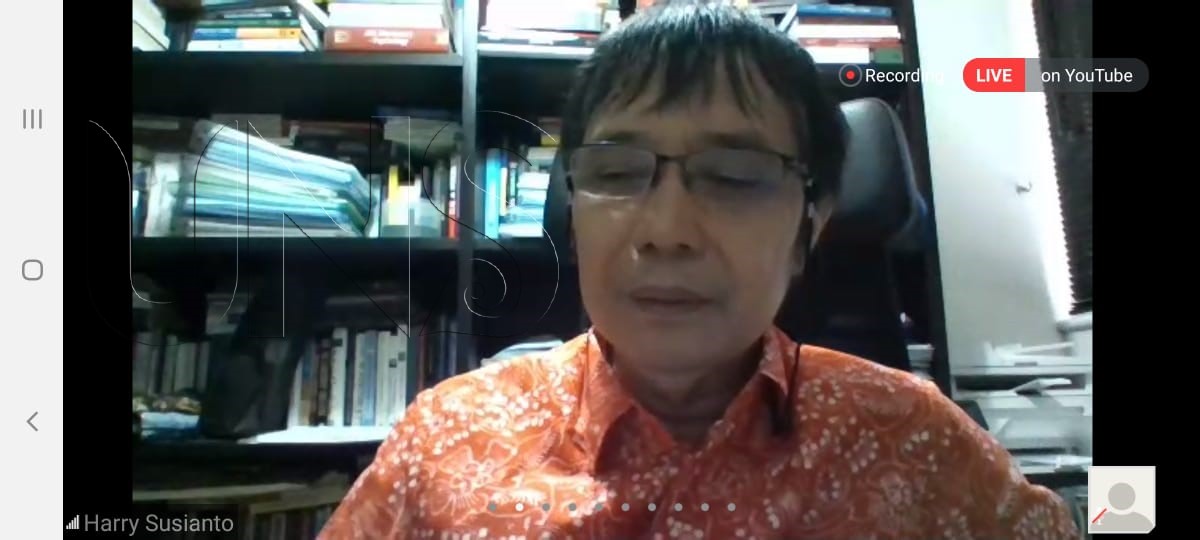
UNS – The Master Program in Management (MM) and Master Program in Economics and Development Studies (MESP), Faculty of Economics and Business (FEB) Universitas Sebelas Maret (UNS) Surakarta, held a webinar on Behavioral Economics (BE), Principle and Application of Prospect Theory, Saturday (18/7/2020).
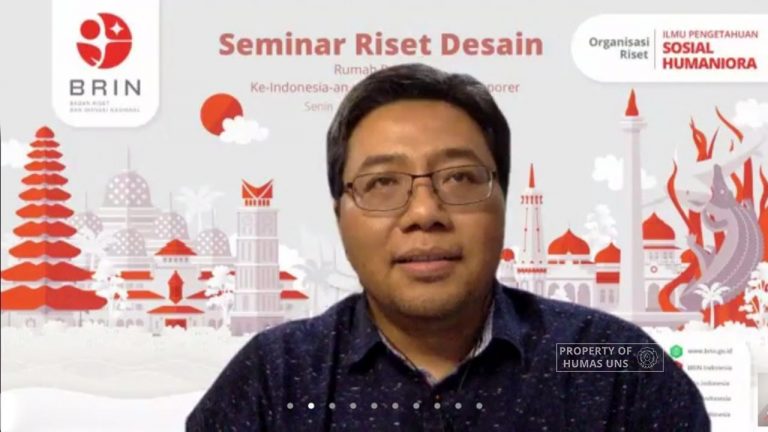
According to the release received by uns.ac.id, this event is the second webinar within the Business Webinar Series, with total participants of 107, presenting Harry Susianto, Ph.D., Economics and Consumers’ Psychologist from the Universitas Indonesia (UI).
Dr. Harry states that Behavioral Economics (BE) attempts to combine the basic principles of economics with the reality that are frequently influenced by human psychology. “The scope of the BE domain is to study the irrational decisions of people, in this case, is users,” Dr. Harry explains.
He further added that BE is similar to psychology, where the majority use experiment, true experiment, with randomization and manipulation. “In Indonesia, there are many studies that use surveys, while it is rare to find studies that use experiments. Actually, through experiments, we can claim a causal effect. However, many think falsely by using survey and Structural Equation Modelling (SEM) to analyze the causal effect. Even though SEM is only a statistical test tool. We can claim a causal effect if the research uses experimental design, if not, then we cannot,” he added.
The discussion continues as Dr. Harry explains the use of Nudge (theory) to influence the economic decisions, which is the monumental work of Richard H Thaler. Nudge can effectively regulate the decisions of individuals, groups, or communities without coercion, its nature is more to arouse through the subconscious. How to control someone without making them feel like they are being controlled or influenced. Nudge itself is divided into two types educative Nudge and non-educative Nudge. The idea of the educative Nudge is improving a person’s capability, resuscitated, reminded, from not knowing to know. Thus, if there is a change, then the change is realized by that person and it must be done.
What is more interesting, according to Dr. Harry is the non-educative Nudge, where we are not trying to improve a person’s capability. The object manipulated in this is the environment, it is expected that people’s behavior will change along with the change in the environment. Humas UNS
Reporter: Dwi Hastuti