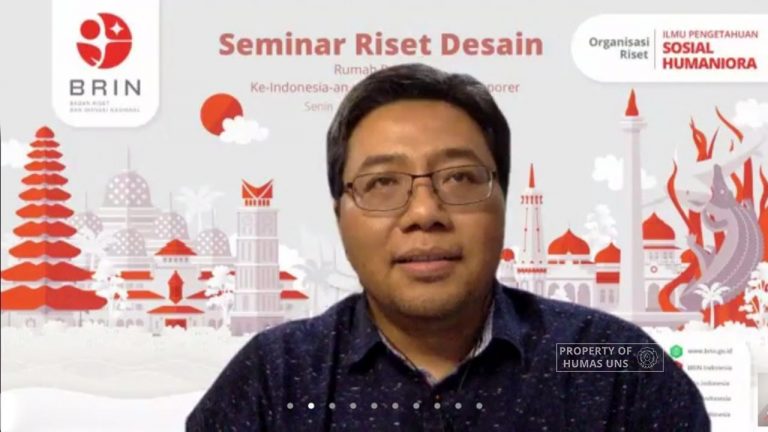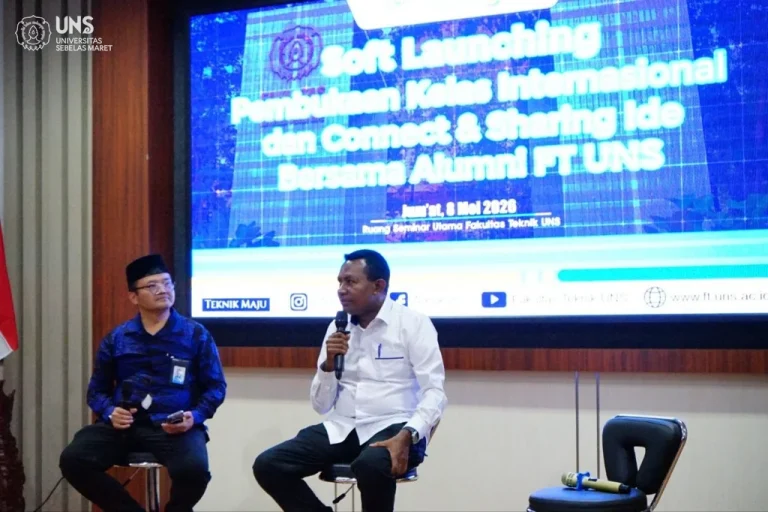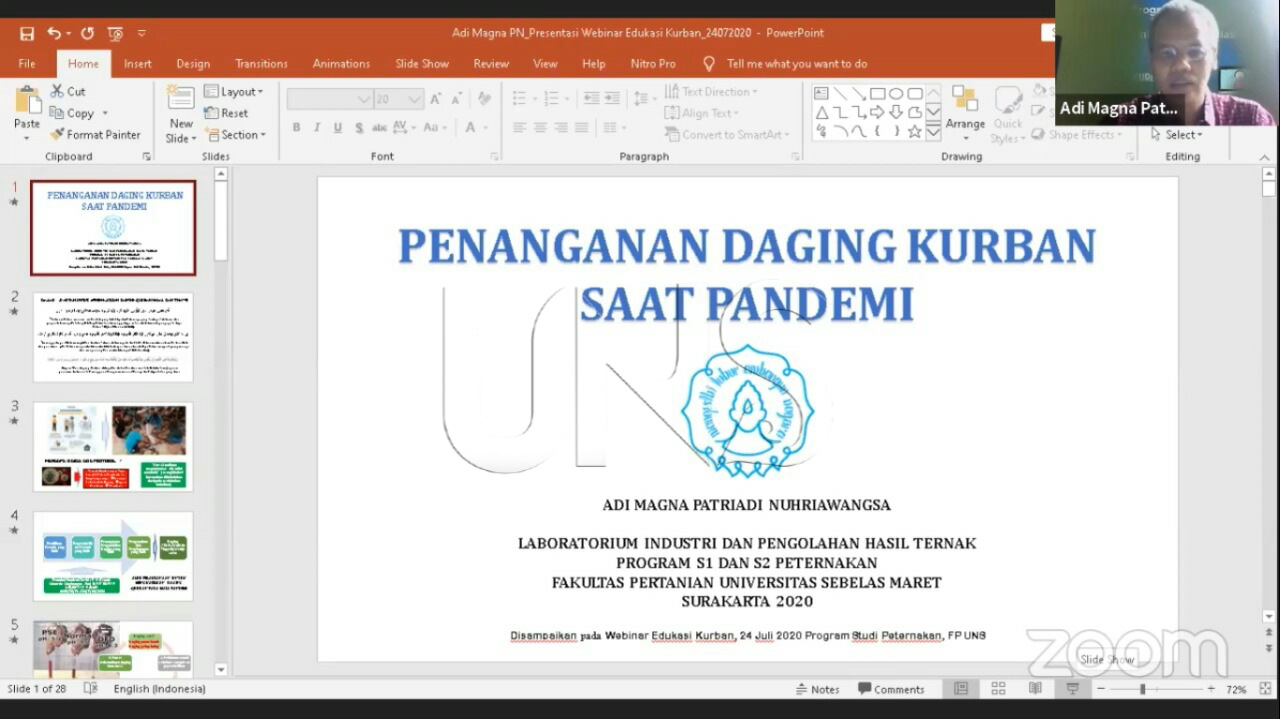
UNS — The Animal Husbandry Study Program, Faculty of Agriculture (FP), Universitas Sebelas Maret (UNS) Surakarta hosted a webinar on Sacrificial Cattle. The event was held through Zoom Cloud Meeting on Friday (24/7/2020) followed by many participants. The study program invites three speakers from different backgrounds, they are Head of Animal Health, Animal Husbandry, and Agriculture Service Boyolali, drh. Afiany Rifdania, the owner of CV Izzah farm, Sulistyo, M.Si., and Lecturer of Animal Husbandry FP UNS, Dr. Adi Magna Patriadi.
Eid al-Adha that will soon be celebrated requires the society to understand the procedure for slaughtering to the examination of sacrificial animals, especially amid the Covid-19 pandemic. As the first speaker, drh. Alfiany delivers material on examination of sacrificial cattle during the ongoing Covid-19. He explains the general examination that normally carried out in terms of cattle health is antemortem and post-mortem examination.
“The antemortem examination following health protocol including the examination on the cattle physical condition, the examination of early signs of infectious animal disease, and examination of livestock origin. Healthy livestock can be seen from its physical appearance such as cattle appear healthy, can stand upright, the body is not thin, the face does not look lethargic, good appetite, and so on,” he explains.
Several diseases that often found in sacrificial cattle are worms especially liver worms, paramphistomum worms, tapeworms, and roundworms. The committee for Eid al-Adha needs to pay attention to these diseases, to avoid unwanted situation. “The four (t/n worms) have different characteristics, the liver worm is leaf-shaped and flat, found in the ducts in the liver and zoonoses. In contrast to liver worms, paramphistomum worms look like cucumber seeds, are flat but small in shape, and are found in the Ruminaceae rumen. Tapeworms are usually found in the digestive tract, has a hairy flat shape and having a suction mouth,” he added.
Other than worm disease, there are other diseases that also common in sacrificial cattle such as anthrax, brucellosis, and leptospirosis. It is advised to choose healthy cattle because, according to fiqh, unhealthy cattle are classified as disabled animals and have a risk of disease that endangers human health.
The second speaker, Sulistyo explains that in cattle sacrifices, there are several factors to be considered such as the procedures, tools used as well as the slaughterer themselves.
“In slaughtering the sacrificial cattle, there are three critical points that determine whether the meat is halal or not, first is slaughterer needs to read tasmiyah or basmalah, then cutting the three channels namely the esophagus, trachea, and two carotid arteries. All these need to be done once,” Sulistyo explained.
For the last session, Dr. Adi Magna Patriadi delivers the steps of slaughtering sacrificial animals in order to produce good meat. “We need to pay attention to several aspects such as choosing good cattle, slaughtering method, meat handling, as well as meatpacking and storing that must be done well. In addition, the public should not be swarmed during the slaughter and adhere to the Covid-19 health protocol,” he said. Humas UNS
Reporter: Bayu Aji Prasetya
Editor: Dwi Hastuti