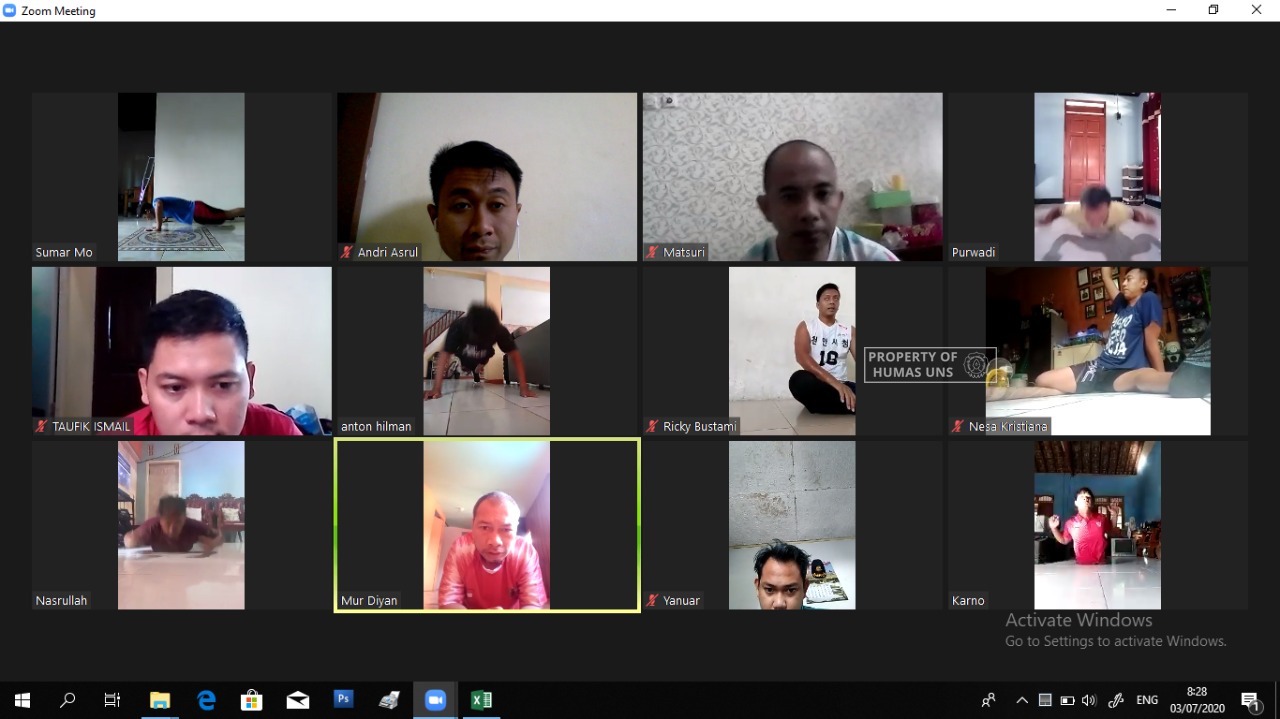
UNS – A Community Service Team from the Faculty of Sport (FKOR), Universitas Sebelas Maret (UNS) Surakarta organizes assistance and training in Biomotor Ability for sitting volleyball athletes. The event has been conducted intensively since March until the end of August. The training and assistance were held at FKOR UNS Campus in Manahan. This program is conducted as a form of FKOR UNS attention to the problems arise from the research regarding athlete training process, which shows various obstacles. Moreover, the community service team also found that many practitioners are hard to accept and implement the research result because it is often considered to interfere with the athletes’ training process.
The team is led by Dr. Deddy Whinata Kardiyanto with 8 (eight) members namely Dra. Ismaryati, Tri Winarti Rahayu, M.Or., Waluyo, M.Or., Hendrig Joko Prasetyo, M.Or., Fajar Ekawati, Ph.D., Slamet Widodo, M.Or., Drs. Bambang Wijanarko, dan Pomo Warih Adi, M.Or. The team focused on the assistance for the implementation of research results to solve the problems by implementing sports coaching science. “Action research is used to understand the implementation of various physical performance aspects. This reflects the episodes of the training program prepared by the coaches,” Dr. Deddy Whinata, Monday (7/9/2020).
He added that the sports coaching science implemented in the training covers physical, psychology, and biomechanics. He believes that the implementation of coaching science will increase athlete achievement in National Paralympic Committee (NPC) Indonesia. During the program, FKOR UNS Community Service Team collaborates with NPC Indonesia. Dr. Deddy states that this program provides an opportunity for the academician and coaches to adopt a collaborative action approach.
The target of this program the formation of optimal biomotor conditions and abilities for Indonesian NPC athletes when facing multi-events or single international events. Dr. Deddy adds training and assistance sessions for the athlete into 5 times a week, on Monday, Tuesday, Thursday, Friday, and Saturday. “We monitored the training and held weekly assistance. The assistance is held before the training start, during the training, and after the training, this lasts for 5 (five) months. The monitoring is conducted by collaborators, coaches, and Paralympics athletes. The subject of training for Pelatnas in Solo is 11 people,” he added.
Dr. Deddy also explains the training and assistance stages, which covers planning, action, observation, and feedback. Although the program was constrained by the Covid-19 pandemic, the team quickly changes the training pattern and portion, by providing online material. During the training from home, the athletes are requested to do individual programs and training online. Besides, they are also asked to carry out routine controlled exercises supervised by a monitoring team. Humas UNS
Reporter: Yefta Christopherus AS
Editor: Dwi Hastuti