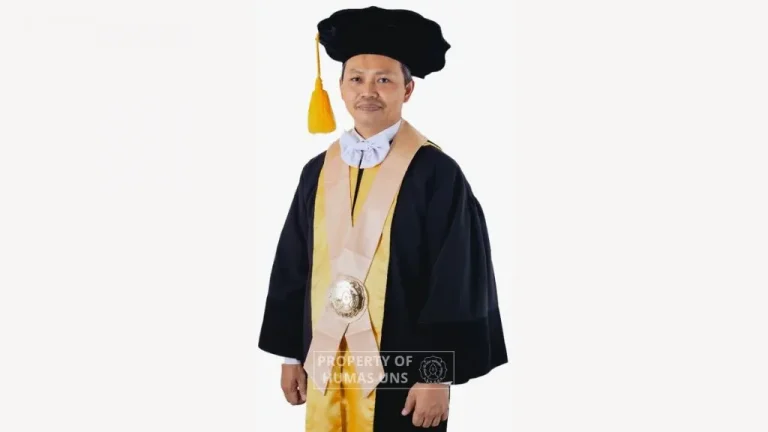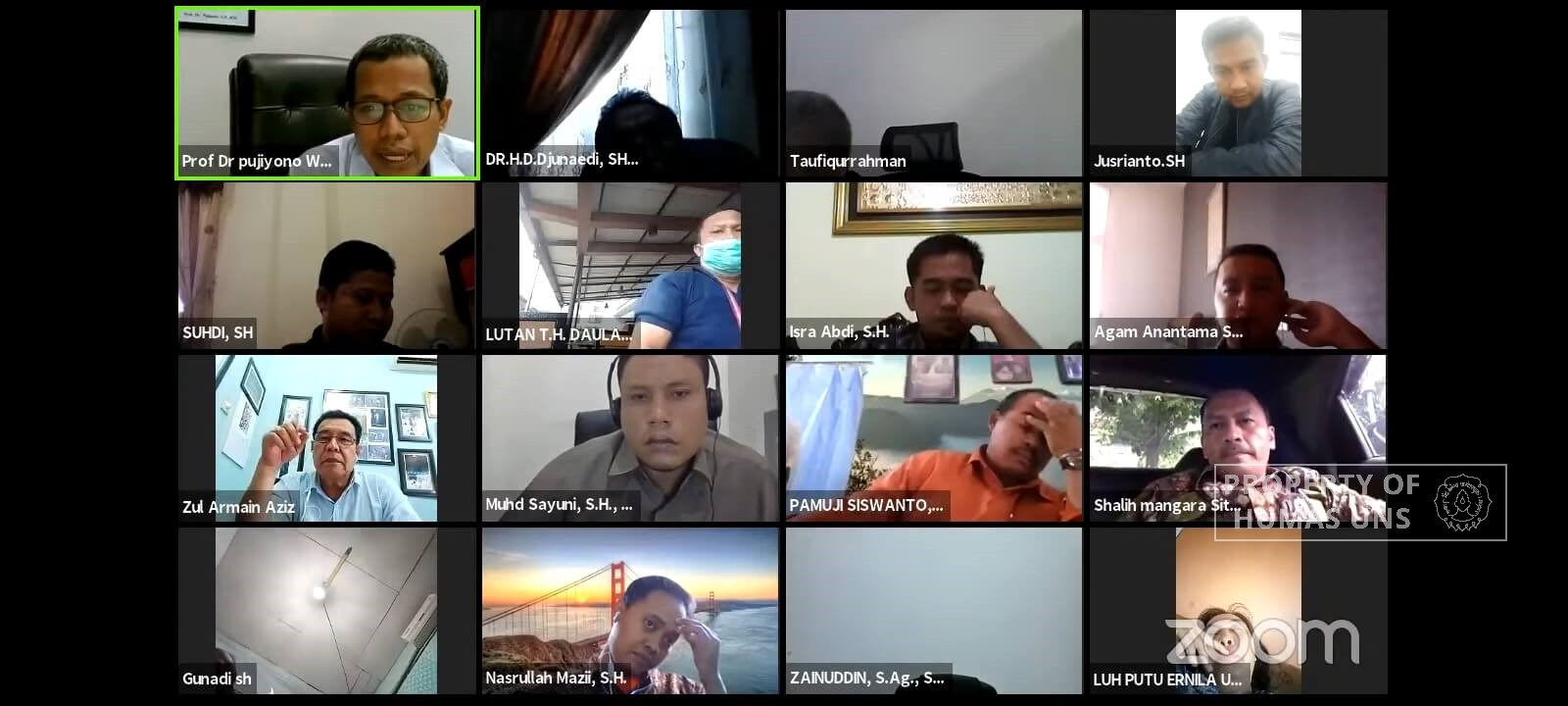
UNS — The Professor in Civil Law Faculty of Law (FH) Universitas Sebelas Maret (UNS) Surakarta, Prof. Pujiyono, highlighted the non-uniformity of advocate professional standard in Indonesia in the discussion and launching of “Kepastian Hukum Single Bar System Organisasi Advokat Indonesia” (red: Single Bar System Legal Certainty in Indonesian Advocate Organization) book, Tuesday (6/10/2020).
In the discussion held by the Institute for Legal Consultant and Assistance (Lembaga Konsultasi dan Bantuan Hukum – LKBH) FH UNS through Zoom Cloud Meeting, Prof. Pujiyono stated that after the issuance of Republic of Indonesia Chairman of Supreme Court No. 73/KMA/HK.01/IX/2015 which grants authority for the Chairman of the High Court (Ketua Pengadilan Tinggi – KPT) to take oath from advocates who meet the requirements from any organization which leads to the growth in the number of advocates in Indonesia.
“There is significant growth. It is believed that there are 30 advocate organizations and the number can increase. The problem that arises later is that the organization need to exist and compete to get new members. This leads to the diverse quality standard from each professional member,” Prof. Pujiyono stated. Prof. Pujiyono is concerned that this will lead to a decline in the professional standard and advocate professionalism. He stated that the government has attempted an intervention to control advocate professional standard through the Minister of Research, Technology, and Higher Education Decree (Permenristekdikti) No.5 of 2019 concerning Advocate Professional Program (Program Profesi Advokat – PPA).
However, Prof. Pujiyono was disappointed with advocates’ rejection of this Permenristekdikti. He considers that Permenristekdikti No.5 of 2019 concerning Advocate Professional Program (PPA) can improve the quality and ability of the advocates. Based on this Permenristekdikti, a university that has Law Science Program with a minimum accreditation of B-Level can conduct PPA. Besides, PPA, the effort to maintain advocate professional standard can also be implemented through upholding the advocate code of ethics. For him, code of ethic is the law/norm to practice a profession, this includes the effort to require their members to be honest and responsible in implementing their profession to their clients, court, community, and associates. Prof. Pujiyono stated that supervision is needed to ensure that advocates uphold the moral values and to ensure that the code of ethics does not become a death clause.
Prof. Pujiyono who is also the Vice Dean for Academic Affairs FH UNS stated that supervision on advocates profession must involve the role of the community and the government. In the community, cultural supervision can provide social sanction for an advocate if they commit an offense. While the supervision from the government can be implemented through intervention. In the discussion and book launching, LKBH invited several legal experts, such as Dr. Sapto Hermawan (Faculty Member of State Administrative Law FH UNS), Achmad, S. H., M. H (Faculty Member of State Administrative Law FH UNS), Dr. Bayu Dwi Anggono (Director of Puskapsi FH Universitas Jember), Dr. Andina Elok Puri Maharani (Faculty Member of State Administrative Law FH UNS), and Riska Andi Fitirono, S. H., M. H (Faculty Member of Criminal Law FH UNS). Humas UNS
Reporter: Yefta Christopherus AS
Editor: Dwi Hastuti