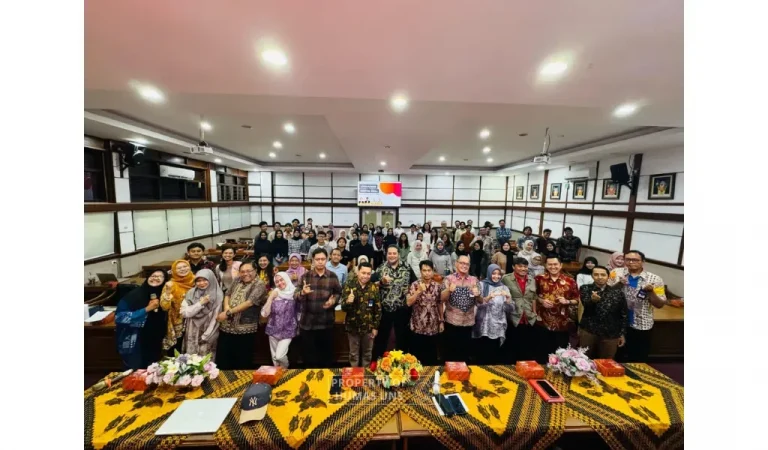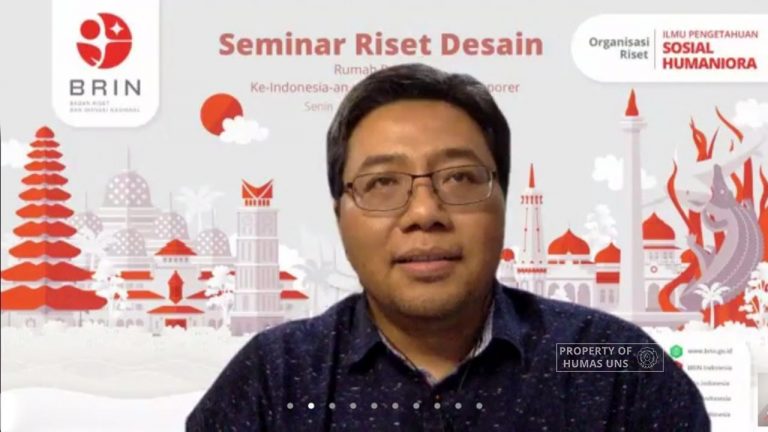
UNS — The Student Executive Board (BEM) of Faculty of Social and Political Sciences (FISIP) Universitas Sebelas Maret (UNS) Surakarta in collaboration with Student Bureau of UNS held a National Webinar on “The Campaign to Prevent Sexual Violence: Understand Sexual Violence, Avoid Negative Behavior”. The webinar was held through Zoom Clouds Meeting and YouTube live streaming in UNS channel on Sunday (1/11/2020).
With Lisa Elfena, the Founder of Komunitas Salirang, as a moderator, this event was attended by three speakers, Siti Aminah Tardi, the Commissioner of National Commission for Women Protection (Komnas Perempuan), Kalis Mardi Asih, writer and Gender Equality Campaigner, and the Dean of FISIP UNS, Prof. Dr. Ismi Dwi Astuti Nurgaheni, M.Si.
In his opening remark, the Vice-Rector for Students and Alumni Affairs UNS, Prof. Dr. Kuncoro Diharjo, S.T., M.T., conveyed that the objective of this event is to support nationalism education. Bullying has the potential to disturb Indonesian children’s mental health so that efforts need to be taken to avoid this behavior. “By understanding what is bullying or sexual violence, the behavior, thus, we can avoid this behavior so that we do not become a victim or the person who got affected by this behavior,” Prof. Kuncoro added.
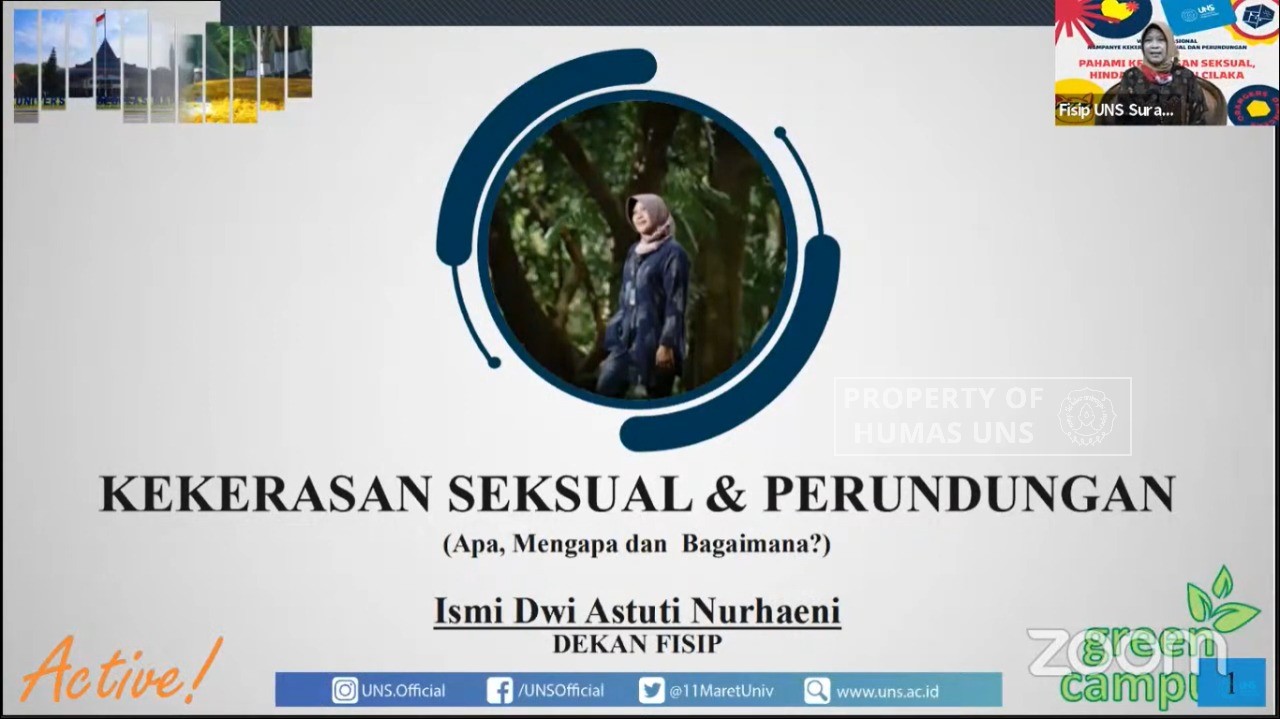
As the first speaker, the Dean of FISIP UNS, Prof. Ismi discussed sexual violence to open the event. She explained that there three components of sexual violence, unwanted sexual action or activities, there are perpetrator and victim, and threat and coercion to somebody. There are also myths in the community surrounding sexual violence such as sexual violence only slightly affects women, and that how women dress and behave are what invite sexual violence, also that they can just ignore the perpetrator to stop the violence. However, the facts show that these myths are not true, because first, violence occurs widely in the community. The technology development also becomes a medium for sexual violence to grow in the community.
Stepping into the next issue, how to avoid sexual violence and bullying especially in higher education. Prof. Ismi suggested that university should have a regulation concerning sexual violence and bullying which includes stern punishment for perpetrators and a system of counselling for victims by professionals. Secondly, universities should have a clear Standard Operational Procedure (SOP) to facilitate reporting. Third, universities should develop counselling by professional or experts who are concerned with Human Rights issues. Also, lastly, develop networking with the community to solve sexual violence and bullying issues, and integrating the issues surrounding Human Right and gender-based violence into the curriculum.
The second material was delivered by Siti Aminah Tardi, a Commissioner in Komnas Perempuan, who stated that Komnas perempuan collects the data on the cases of violence against women in the form of Annual Notes (Catahu), which is usually released on March before commemorating International Women’s Day. Based on a chart shared by Siti Aminah concerning the violence against women from 2008 to 2019, the violence against women tends to increase and the number of sexual violence case is 5,000 on average.
“The impact of sexual violence (on physical health, psychological, economy, social relation, and women human right) is women cannot play an optimum role as a citizen in the family life, community life, and in the state life,” Siti Aminah stated.
As the last speaker, Kalis Mardi Asih particularly discussed Gender-Based Violence (Kekerasan Berbasis Gender – KBG) performed through online media. Online KBG is performed with an aim to harass the victim based on their gender or sexually through short message services (SMS), instant messaging apps, social media, games forum, dating apps, and other media. Several types of online KBG are, among others, cyber harassment which is usually performed in the form of comments in the social media or by making sticker from photos of women with certain poses or clothing with an aim of harassing the women. HUMAS UNS
Reporter: Ratri Hapsari
Editor: Dwi Hastuti