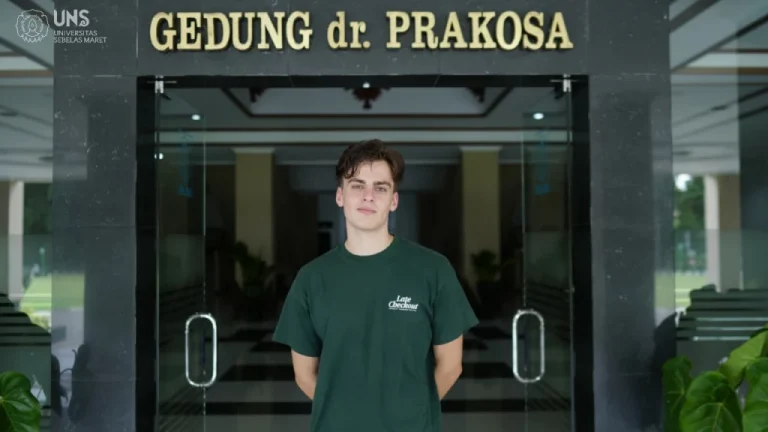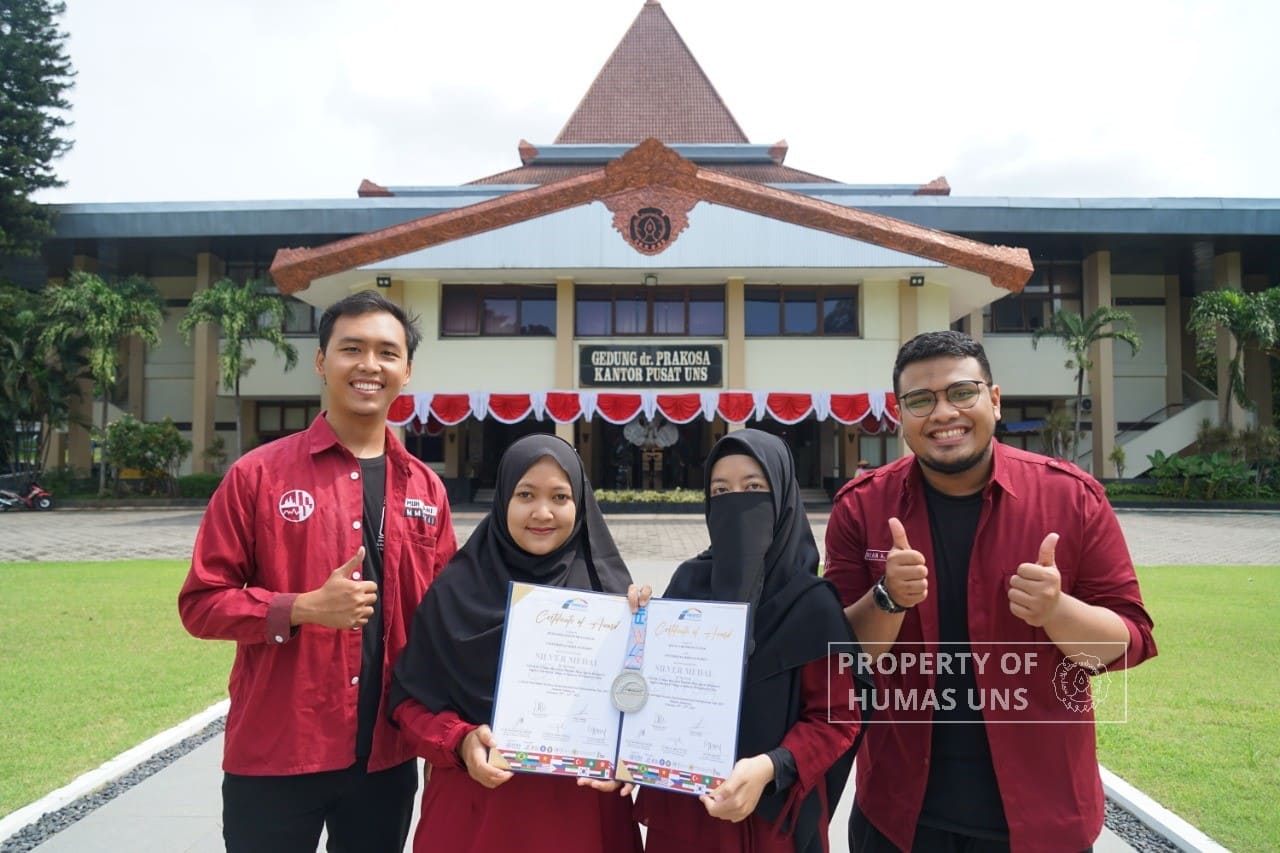
UNS — Four students from Universitas Sebelas Maret (UNS) Surakarta class of 2017, succeeded in winning a silver medal in ASEAN Innovative Science Environmental and Entrepreneur Fair (AISEEF) last February 2021. This astounding achievement was presented by Abyan Ajrurrafi Syauqi (Communication Science Study Program), Muhammad Dani Mulyawan (Statistics Study Program), Roisatul Khoiriyati (Agricultural Extension & Communication Study Program), and Tasya Ayu Oktayana (Javanese Language Education), after competing with 450 teams from 20 countries.
The participating countries are Indonesia, Malaysia, Singapore, Nepal, Cambodia, South Korea, the US, Iran, Brazil, Turkey, Mexico, Thailand, Mesir, Hongkong, Philippines, Russia, Egypt, Azerbaijan, Sudan, and Yaman.
The AISEEF is organized by IYSA in collaboration with the Food Technology Department of IPB University, the Nutrition Department of Undip, Udinus, Indonesia International Institute for Life Sciences (i3L), and Yayasan Prestasi Pendidik Indonesia.
“AISEEF is an international championship attended by inventors from various parts of the world. The competition this year taking on a general theme under several specifications for innovators such as entrepreneur, environmental-science, innovative-science, and social-science,” Abyan Syauqi explains on Thursday (11/3/2021).
Their creation, ‘NATAYA: A Smart Historical Tourism All-in App as Solution to Support Internet of Things in Industry Revolution 4.0 Era’ become the idea that made their team winning the competition. Abyan explains that NATAYA is an application that covers all pieces of information related to Solo tourism and culture. The application also accommodates museum ticket reservations, thus, helping museum management and visitors. The idea is motivated by the potential and branding of Solo as the Spirit of Java and Cultural City. However, there is still limited promotion and access to pieces of information on tourism objects.
The limitation, Abyan added, reduces public interest in visiting places related to culture and history. For instance lack of visitation to the museum and a low understanding of museum entrance ticket fees and system. “Based on our observation, Solo remains as study tour location. Because there are also many cultural and historical sites, as well as cultural performance, therefore it becomes the perfect place to be the object of ‘Smart Historical Tourism App’. Moreover, as students from UNS, we want to create something useful for Solo,” Abyan explains.
This wish is symbolized in the name ‘NATAYA’ meaning ‘protector’ in Javanese. This name symbolized Abyan and his team members’ role in protecting Javanese culture because the culture is a legacy to be passed to the next generation. On the other hand, Smart Historical Tourism All-in App is a support to the Internet of Things (IoT) implementation. He considers that IoT is the appropriate method to introduce Surakarta (Solo) easily.
“Moreover, there is no platform that specifically facilitates cultural and historical tourism development,” Abyan states.
When asked regarding special strategy, Abyan reveals that his team was more focused on urgency, visibility, relevance, and idea differentiation. To achieve this, the team went through several stages. The initial stage is idea generation to find the appropriate idea responding to the current condition. Following this stage, the team observes different types of tourism applications to determine what type of application available. Afterward, they combine their idea with the observation result and determine the different options that have not available in other applications.
“In the future, we hope there will be collaboration to realize the concept we propose. It can be in the form of application that useful for the general public, Solo resident, and visiting tourists,” Abyan concludes the interview. Humas UNS
Reporter: Kaffa Hidayati
Editor: Dwi Hastuti