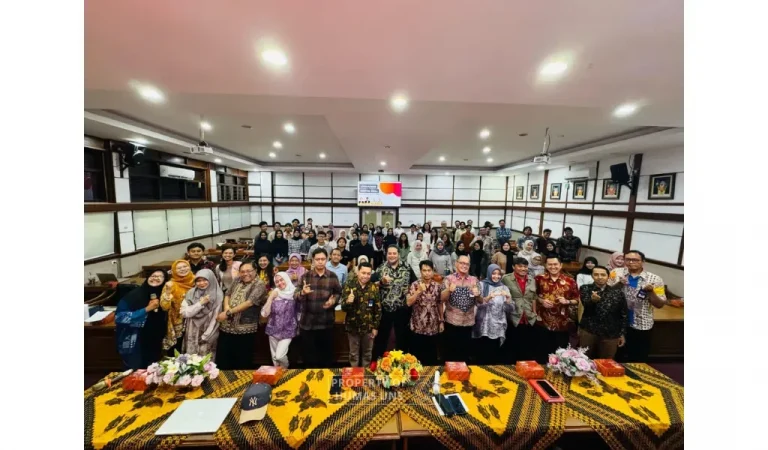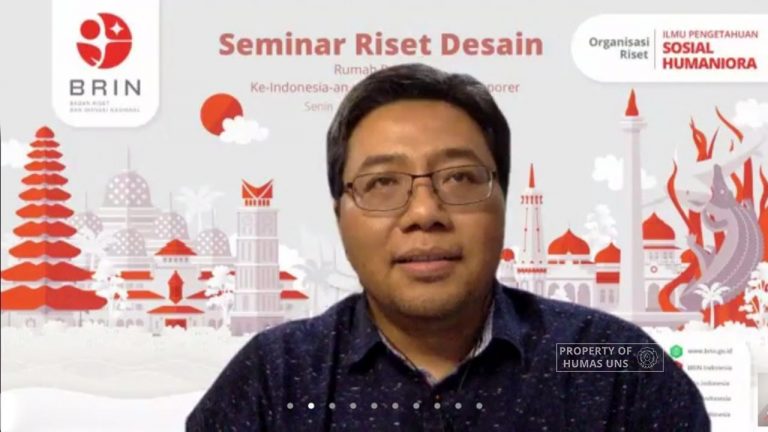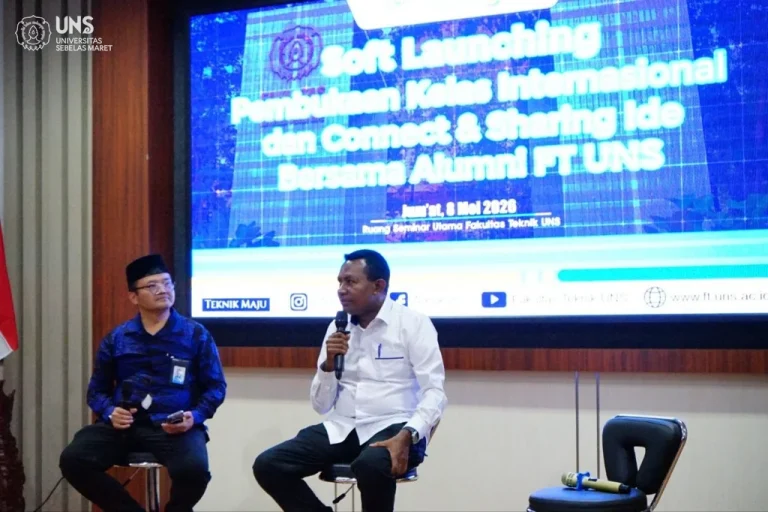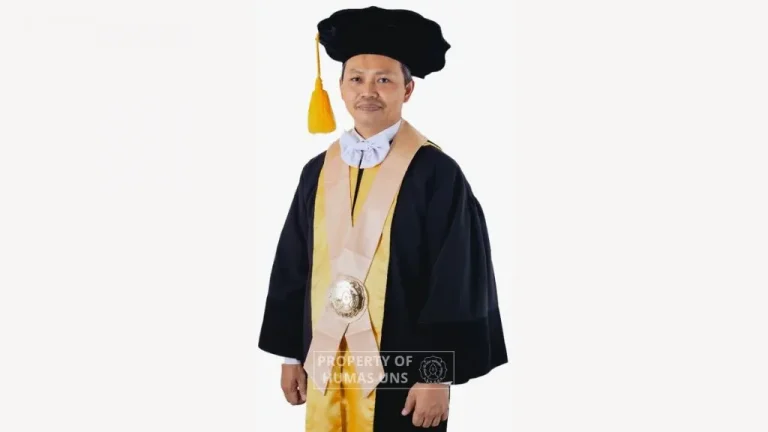
UNS — The Public Transparency and Anti-Corruption Study Center (Pustapako) Universitas Sebelas Maret (UNS) Surakarta and the Institute of Educational Quality Assurance and Development (LPPMP) UNS in collaboration with the Indonesia Corruption Eradication Commission (KPK), held a General Lecture in Anti-Corruption Education for Students. The general lecture invites Dr. Wawan Wardiana, who serves as the Deputy of Education and Community Engagement KPK. Also attending the event is Prof. Sarwiji Suwandi as the Head of LPPMP UNS and Prof. Ahmad Yunus as the Vice-Rector for Academic and Student Affairs UNS.
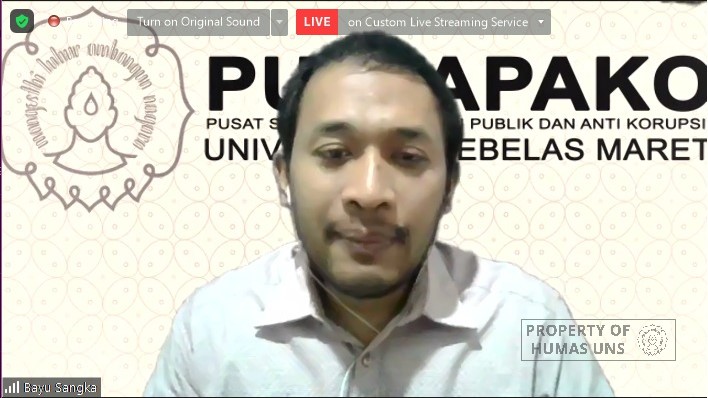
The virtual general lecture on Thursday (15/4/2021) captivates students’ interest with more than 562 participants in Zoom Cloud Meeting. The discussion was led by Khresna Bayu Sangka, S.E., M.M., Ph.D., (Head of Pustapako UNS), who acts as the session’s moderator. Opening the discussion, Prof. Sarwiji Suwandi reveals the effect of corruption in the economy, social, and political sectors. “Corruption brings negative impacts to a country such as increasing social inequality. Moreover, this crime will reduce country welfare and prosperity,” Prof. Sarwiji explains.
From 2004 to 2020, there are thousands of corruption cases in Indonesia. Prof. Ahmad Yunus reveals that most corruption cases are dominated by bribery and asset misuse. Ironically, 86% of the corruption perpetrators are from well-educated backgrounds. Furthermore, the Indonesia corruption perception index reaches 37 points, making Indonesia ranked 102nd among the 180 listed countries. The high corruption cases lead KPK to establish three corruption eradication strategies, which consist of action, prevention, education, and the campaign. The actions taken on corruption crime include investigation, prosecution, and execution. Meanwhile, prevention involves monitoring measures.
However, Dr. Wawan Wardiana mentioned that corruption crime has a different modus operandi each passing year. Therefore, KPK decides individuals to instill the anti-corruption values through education and campaign for the community. Corruption eradication is not only the states’ responsibility but all of Indonesia’s citizens. “If we do not take any measures, then we are participating in this corrupt system,” Dr. Wawan stresses.
Students as the Hope of KPK
Dr. Wawan Wardiana further stresses that KPK hopes that students will contribute to eradicating corruption cases in Indonesia. “Students have great potential to be the future leaders,” Dr. Wawan Wardiana states. This consideration is based on the minimum age requirement to apply for the election in the state government. For the DPD and DPR, the minimum age requirement is 21 years old, City Mayor/Regency Head is 25 years old, Governor is minimum 30 years old, and the President minimum 40 years old. Therefore, KPK hopes students will be the agent of change for Indonesia’s welfare.
Corruption eradication starts from individual efforts such as limiting corruption actions within the education process. This action includes, but not limited to, cheating, leaving fraudulent attendance, being late, plagiarism, fake proposals, gratification to lecturers, and misuse of scholarship funds. Preventing these fraudulent actions can be done through student community service program, creative learning, research on the anti-corruption act, and Focus Group Discussion (FGD).
Concluding the session, Dr. Wawan Wardiana mentions the Nine Anti-Corruption Values, namely honest, caring, independent, disciplined, responsible, fair, brave, simple, and hard working.
“Hold on to one of the values, InsyaAllah, others values will follow. For instance, honesty with leads to independence and many others,” Dr. Wawan Wardiana concludes. Humas UNS
Reporter: Alinda Hardiantoro
Editor: Dwi Hastuti