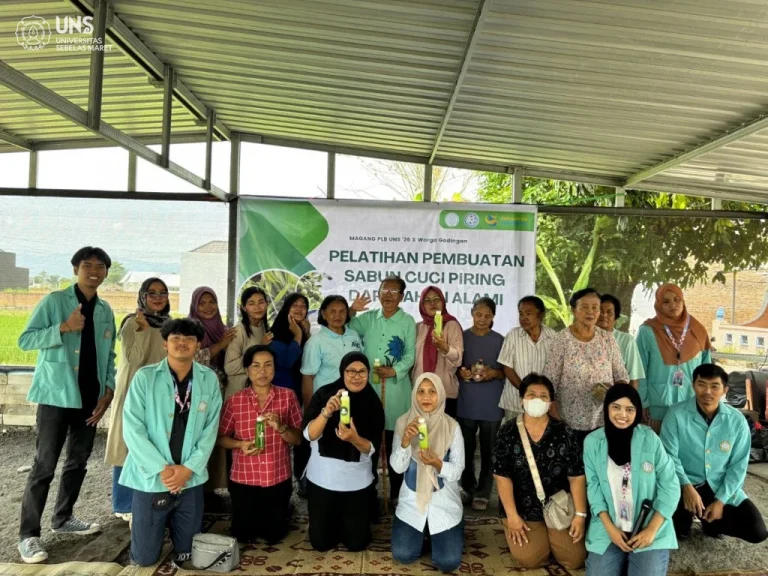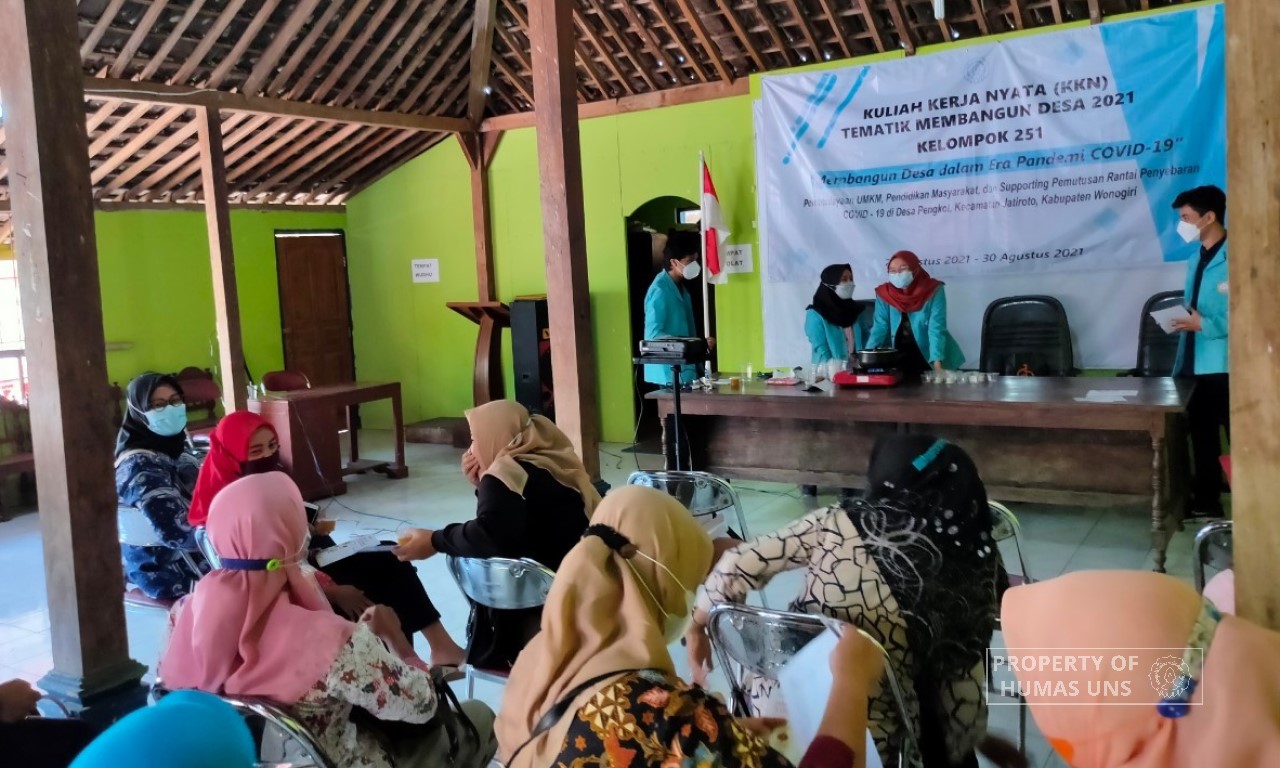
UNS — Jamu can be an alternative of beverages to maintain and improve the immune system, which is highly needed amid the Covid-19 pandemic. However, not everyone likes consuming jamu, especially children. To solve this issue, the Student Community Service Program (KKN) Thematic Universitas Sebelas Maret (UNS) Surakarta Group 251 held a “Training to Produce Jamu Jelly” for PKK members in Pengkol Village, Jatiroto Subdistrict, Wonogiri District.
KKN UNS Group 251 is supervised by Dadan Kurniawan, S.Pd., M.A., and has eight members: Ika Yulianti (Guidance and Counseling Education), Arissa Dwi Pangestu (Industrial Engineering), Ali Mustofa (Agrotechnology), Ali Zainal Abidin (Food Technology), Adji Muhammad Nur R (Elementary School Education), Elza Mayliana A (Geography Education), Firda Noor Komala (Agrotechnology), and Ishaniar Uwais (Law Science).
In an interview with uns.ac.id through a short message, Ika Yulianti, as the team leader, explained that jamu jelly is introduced as an innovation for people who do not like to drink jamu, especially children. Therefore, these people, especially children, could consume jamu comfortably during the pandemic.
“This training is also an effort to introduce the benefit of MSMEs for the surrounding community by providing an example of MSMEs in an innovative jamu jelly product,” Ika said on Thursday (26/8/2021).
Jamu Jelly is made from turmeric, gelatine, tamarind, brown sugar, white sugar, pandan leaf, and a bit of salt. Fresh turmeric is cut and boiled in 650ml of water, add tamarind and brown sugar, left until boiling. The boiled mixture is filtered and then re-boiled, then gelatine and white sugar are added. After boiling, the mixture can be poured into a container.
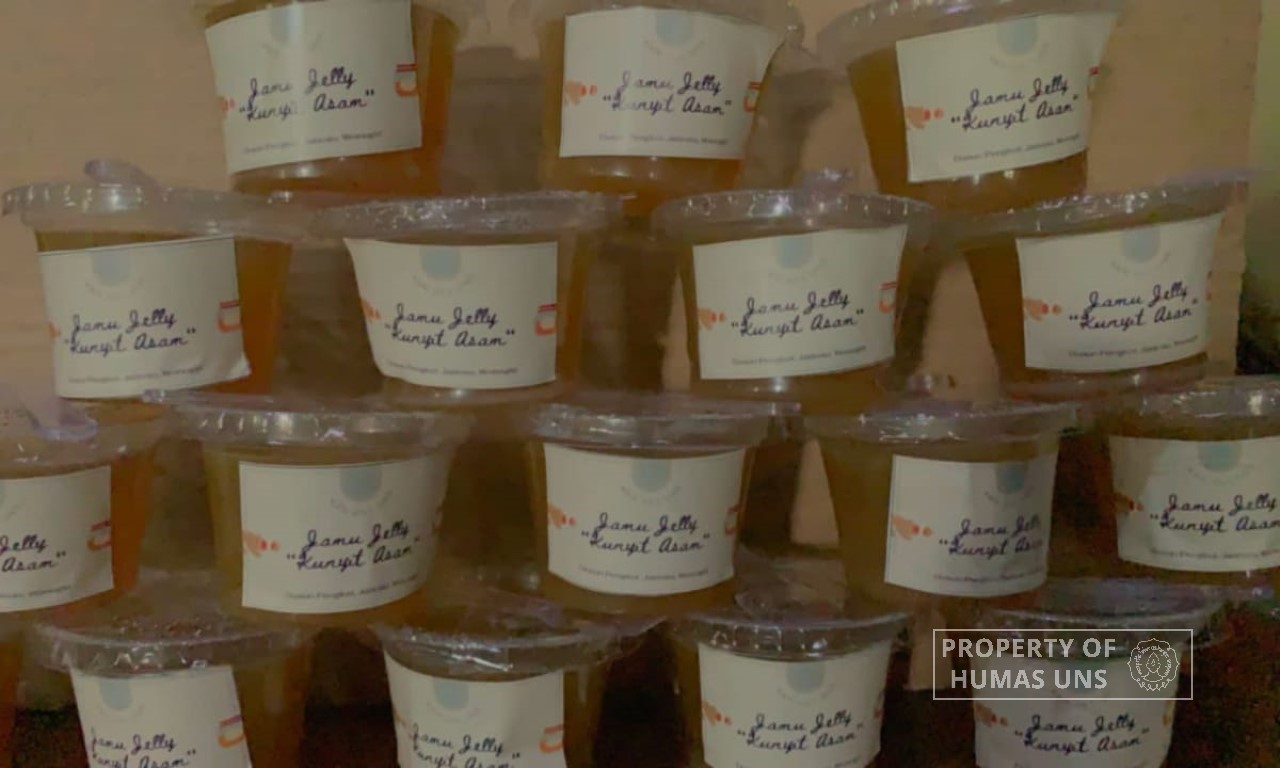
This training received a positive response from the local community. They felt that the training is very beneficial and the product is marketable. “The village apparatus also gave positive responses through a support that jamu jelly will be developed as a product that will be sold by PKK or individual brand through Bumdes,” Ika said.
Besides training on jamu jelly, Ika and her team have several other programs. Their program including socialization of digital marketing for MSMEs, socialization on Budikdamber (budidaya ikan dalam ember – fish cultivation in bucket), group guidance to improve communication ethics for adolescence, training to make fertilizer, training to use learning websites for elementary school and preschool, and training to create learning media for elementary school and preschool teachers. The team also has the main program, conducting a webinar on stress management for parents in the pandemic, vaccination socialization, and creating a reading box to improve literacy.
Most of the programs are aligned with member’s fields of study, and they received one program suggested from the community, which challenges them in its implementation, creating fertilizer and cattle forage. “Thus, we need to find references on cattle forages. Alhamdulillah, we could make pro-biotic forage as a mixture for cattle forage to make it more nutritious,” Ika explained.
Representing her team, Ika hoped that their programs would benefit Pengkol Villagers and encourage them to be creative and innovative in their daily life. Humas UNS
Reporter: Kaffa Hidayati
Editor: Dwi Hastuti