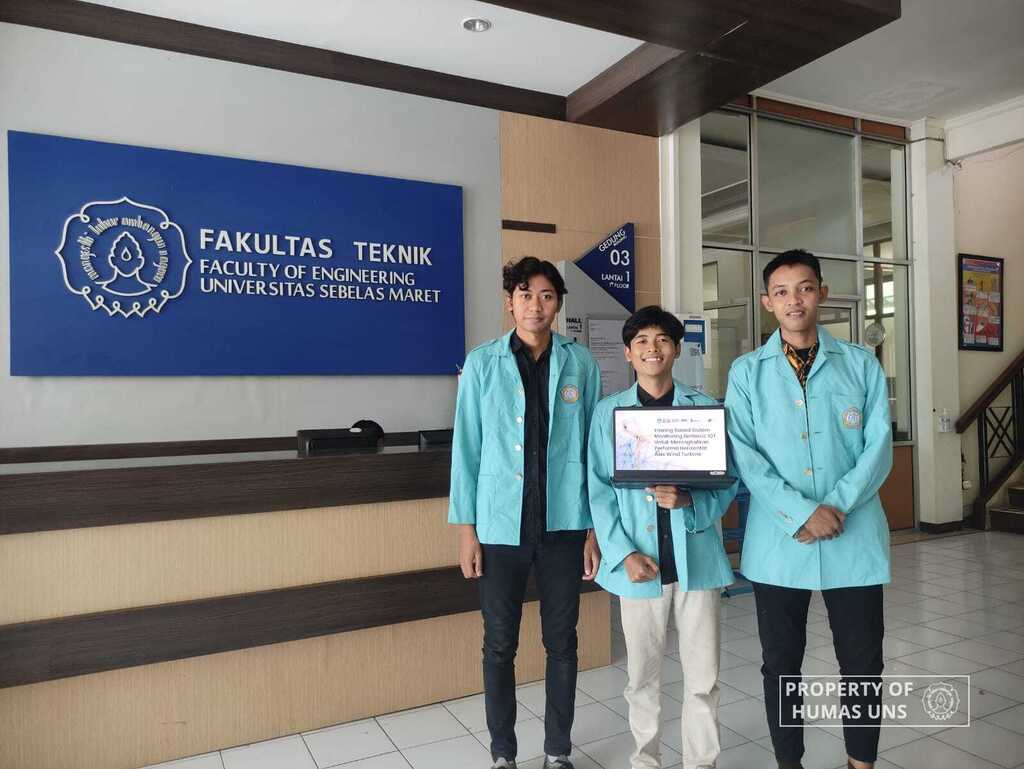
UNS – In their latest research, students at Universitas Sebelas Maret (UNS) Surakarta combined a yaw-based monitoring system with Internet of Things (IoT) technology. The yaw-based monitoring system is designed to provide real-time monitoring of Horizontal Axis Wind Turbine (HAWT) performance. This innovation was born from a team that successfully obtained funding from the Student Creativity Program (PKM) of the Directorate of Higher Education, Research, and Technology (Diktiristek).
Alif Ilham, the team leader, explained to uns.ac.id that the growing crisis of non-renewable energy resources is increasingly pressing the world to seek sustainable energy alternatives. Their data shows that 50.3% of Indonesia’s electricity needs are still met by non-renewable energy sources, such as coal.
One promising solution is wind energy, which can be converted into electricity using wind turbines. However, Horizontal Axis Wind Turbines (HAWT), one type of turbine, face challenges in capturing wind from various directions, affecting their operational efficiency.
Alif explained that to address this challenge, he and his team conducted research that combined a yaw-based monitoring system with Internet of Things (IoT) technology. The yaw-based monitoring system has been designed to monitor HAWT performance in real-time. The features they designed include monitoring various parameters, such as wind speed, rotations per minute (rpm), electric current, and voltage.
This efficient turbine prototype uses several sensors. The ACS712 sensor is used to monitor current and voltage, the wind vane sensor is used to monitor wind direction, and there is also an anemometer sensor to monitor wind speed. Other components used include the Arduino Nano microcontroller, the ESP8266 to transmit sensor data, and a stepper motor as an actuator.
“The parameters used for yawing-based motion are the wind vane sensor value to detect the optimal wind direction and the voltage sensor to prevent overvoltage, which can damage the generator,” Alif explained.
The yaw system on HAWT is an actuator that moves the blades to face the wind’s direction. Through this technology, energy conversion efficiency can be improved. Moreover, the yaw system can prevent generator damage due to overvoltage by manipulating wind speed.

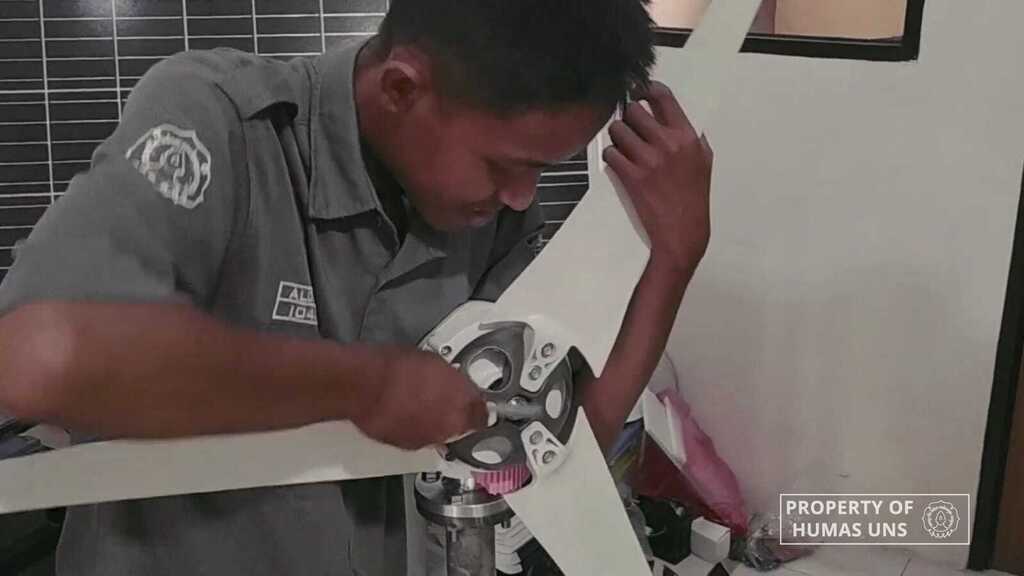

“The mechanism involves a stepper motor as an actuator placed on the mounting. The spur gear connected to the stepper motor will rotate, moving the generator in a yaw direction,” he added.
According to Alif, the data obtained from this monitoring system is not only useful for monitoring performance but also for identifying potential HAWT damage, allowing for timely preventive measures. Thus, this system not only enhances the operational efficiency of HAWT but also reduces maintenance costs and extends the lifespan of these turbines.
The research results found a significant difference between conventional systems and systems with active yaw. Turbines equipped with active yaw systems were capable of producing significantly more power than conventional turbines.
“On average, conventional turbines produce 213 watts of power, while turbines equipped with an active yaw system achieve an output of 296 watts. This means an efficiancy increase of about 39%, significantly enhancing wind energy capture capability,” Alif said.
The findings confirm that the integration of an active yaw system can optimally adjust the turbine alignment to the direction of the oncoming wind. Thus, this system significantly improves overall system performance. The findings of this UNS PKM team represent a significant step forward in harnessing the potential of wind energy as a sustainable and efficient alternative.
Humas UNS
Reporter: R. P. Adji
Editor: Dwi Hastuti