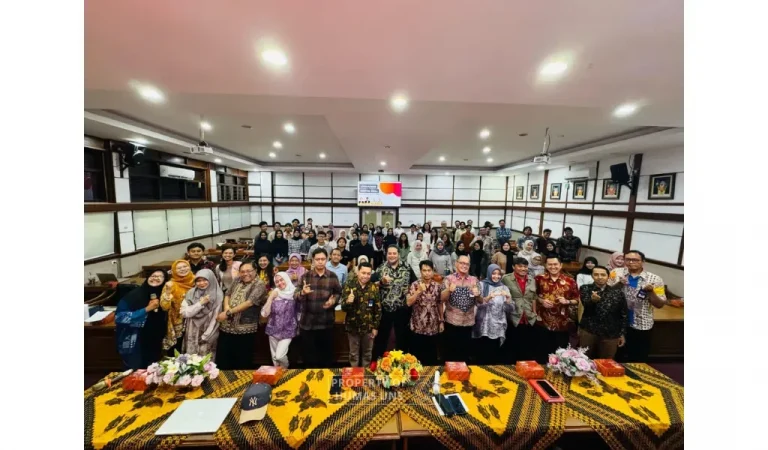
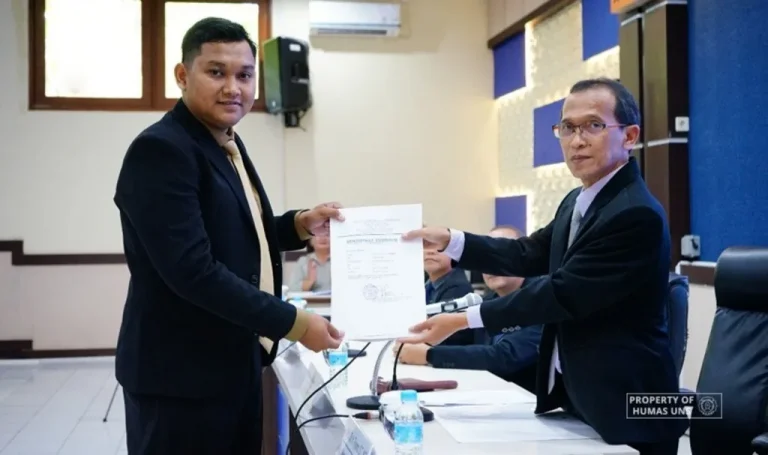
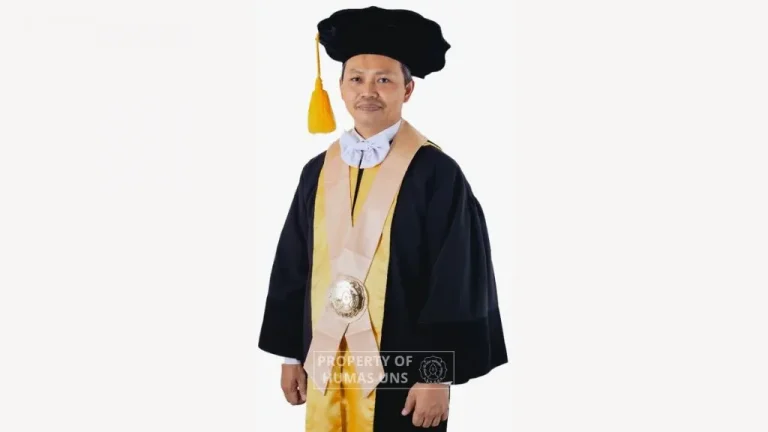
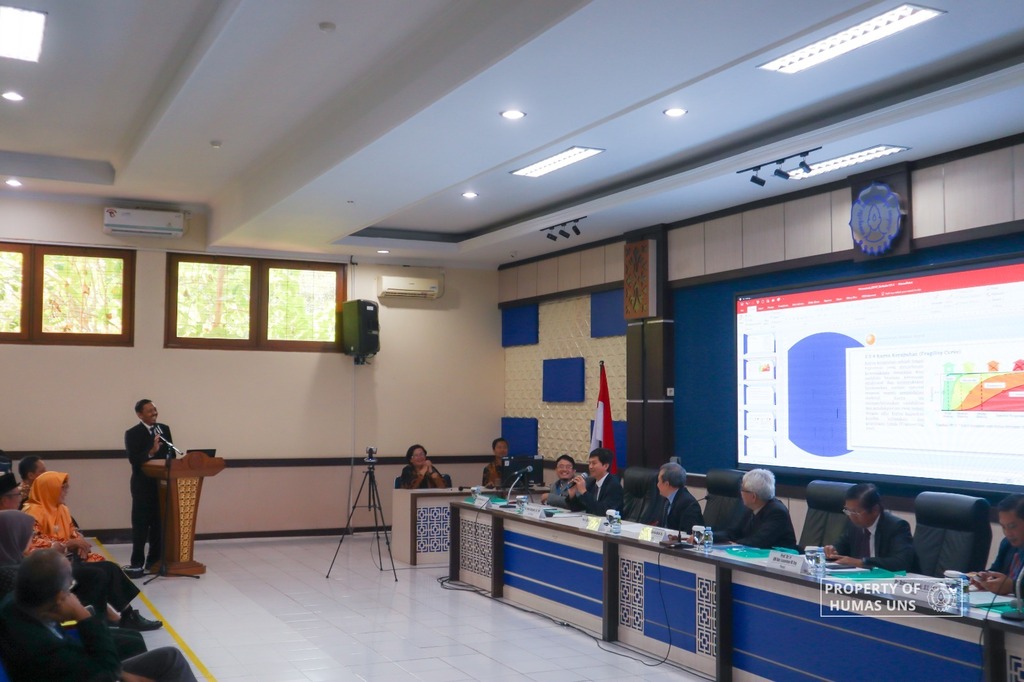
UNS – The Doctoral Program in Civil Engineering at the Faculty of Engineering (FT) Universitas Sebelas Maret (UNS) Surakarta has graduated a new doctor. The new doctoral graduate, Edy Purwanto, successfully defended his dissertation before his promoters and examiners in an open doctoral promotion exam held in the Multimedia Room of FT UNS Building 4 on Tuesday (30/7/2024). Edy Purwanto was awarded his doctorate with a perfect GPA of 4.0, achieving the highest distinction.
Edy’s dissertation, titled “Strengthening Beam-Column Connections in Non-Engineered Buildings with Steel Plates to Improve Seismic Performance,” addresses the significant earthquake risk in Indonesia. This research is motivated by the fact that most of Indonesia is located in earthquake-prone areas. Earthquakes in Indonesia have caused significant damage, particularly to residential buildings. These damaged houses fail to meet technical requirements for earthquake-resistant structures. Damage to non-engineered buildings (NEBs) often occurs due to the separation of building elements, especially beams and columns. The damage at the beam-column joints is primarily caused by insufficient anchorage length or a lack of strong connections between the beam and column elements.
In engineered buildings, reinforcement materials such as Carbon-Fibre-Reinforced Polymer (CFRP), Glass-Fibre-Reinforced Polymer (GFRP), Textile Reinforced Concrete (TRC), and steel have been widely used. Reinforcement in non-engineered buildings (NEBs) has not been widely implemented, prompting this research to explore the use of steel plates for reinforcement. Steel plates were chosen due to their effectiveness and efficiency, which are comparable to reinforcement materials used in engineered buildings, such as CFRP.
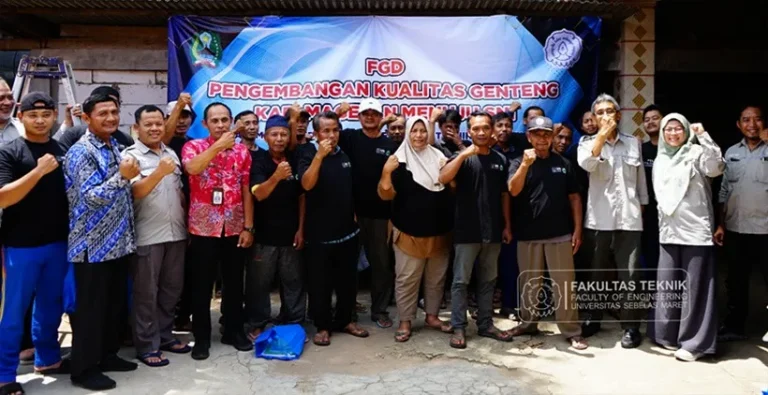
“Surveys of material quality and implementation in NEBs were conducted in the Surakarta (Solo Raya) area and Pacitan Regency,” Edy explained.
The first set of data collected for this research pertains to the quality of concrete. Survey results show that the quality of concrete in most cases is below standard, with strengths less than 10 MPa, whereas the minimum required strength for earthquake-resistant buildings is 21 MPa. Secondly, the reinforcement details do not meet technical standards, including the type of reinforcement (plain and deformed bars), the quantity of reinforcement (insufficient reinforcement ratio), and the development length and anchorage connections between the beam and column reinforcements. Thirdly, the quality of construction in the field is poor because the workers generally lack training in building earthquake-resistant structures.
The conclusions of the study indicate that, first, non-engineered buildings (NEB) in residential areas generally have very poor quality reinforced concrete, both in terms of material quality and workmanship, making them highly vulnerable to earthquake hazards. Secondly, the reinforcement of beam-column joints in non-engineered buildings has proven to be both effective and efficient. This significantly improves seismic performance by increasing load capacity by up to 71,23%, reducing the risk of failure from joint collapse to column sections, and enhancing the undamaged condition under Design Basis Earthquake (DBE) scenarios from 56,08% to 82,41%, and under Maximum Considered Earthquake (MCE) scenarios from 29,21% to 66,80%.
Edy recommended several measures to mitigate risks in NEBs: implementing structural reinforcements to prevent catastrophic failure and loss of life and property, and providing training and raising public awareness about earthquake-resistant construction techniques. “Thirdly, enhancing collaboration between government, academia, practitioners, and the private sector to improve earthquake mitigation efforts,” he added.
The head examiner, Dr. Techn. Ir. Sholihin As’ad, M.T., congratulated Edy Purwanto on his achievement. “May your knowledge be beneficial and inspire other faculty members who have not yet obtained their doctorates. Dr. Edy is also a lecturer at FT UNS,” Dr. Techn. Sholihin, who also serves as the Dean of FT UNS, said.
Dr. Techn. Sholihin added that the faculty is actively encouraging more lecturers to pursue doctoral degrees. “We are optimistic that in the next three to four years, 80 percent of our faculty members at FT UNS will hold doctoral degrees,” he concluded.
HUMAS UNS